Handle Remodeling Sales Curveballs Like a Pro

Set clear expectations so busy homeowners never feel ignored
The best way to keep overwhelmed homeowners calm during a remodel is to set clear expectations about your sales and project process before they sign. In practice, that means explaining timelines, handoffs, communication rhythms, and what “busy season” really looks like for your team in plain language.
Use an upfront “post‑sell” conversation once a client says yes. In that meeting, walk them through a simple week‑by‑week roadmap: intake, design, estimating, pre‑construction, and build. One Meadowlark designer described emailing a color‑coded “next steps” timeline where client action items are highlighted in blue. That single email reduced anxious “Where are you?” calls from older clients who assume they’re your only project.
You can reinforce this with a short, written service promise. Spell out who owns what: who pulls permits, who chases vendors, who schedules inspections, and how quickly you respond to email or voicemails. When a prospect compares you to a one‑man general contractor who “doesn’t really have staff,” you can point to that structure as the reason your price includes dedicated project management instead of leaving them to herd trades themselves.
Finally, be honest about capacity. One salesperson in the conversation above had 18–21 active files yet still tried to be lightning‑fast on the front end. She realized the real risk was not workload, but the perception that attention dropped after the prospect said yes. A direct script solves this: “My biggest fear is you’ll think I’ve forgotten you. I haven’t—I’m building your job in our system. If you’re ever wondering where things stand, call or email anytime.” That simple sentence protects trust when your calendar is full.
Protect your time while still giving high‑touch client service
Design‑build sellers walk a tightrope: they are rainmaker, estimator, and internal facilitator all at once. If you say yes to every meeting and rush every proposal, your evenings disappear and errors creep into six‑figure contracts. The fix is not working harder; it’s qualifying harder and using downtime strategically.
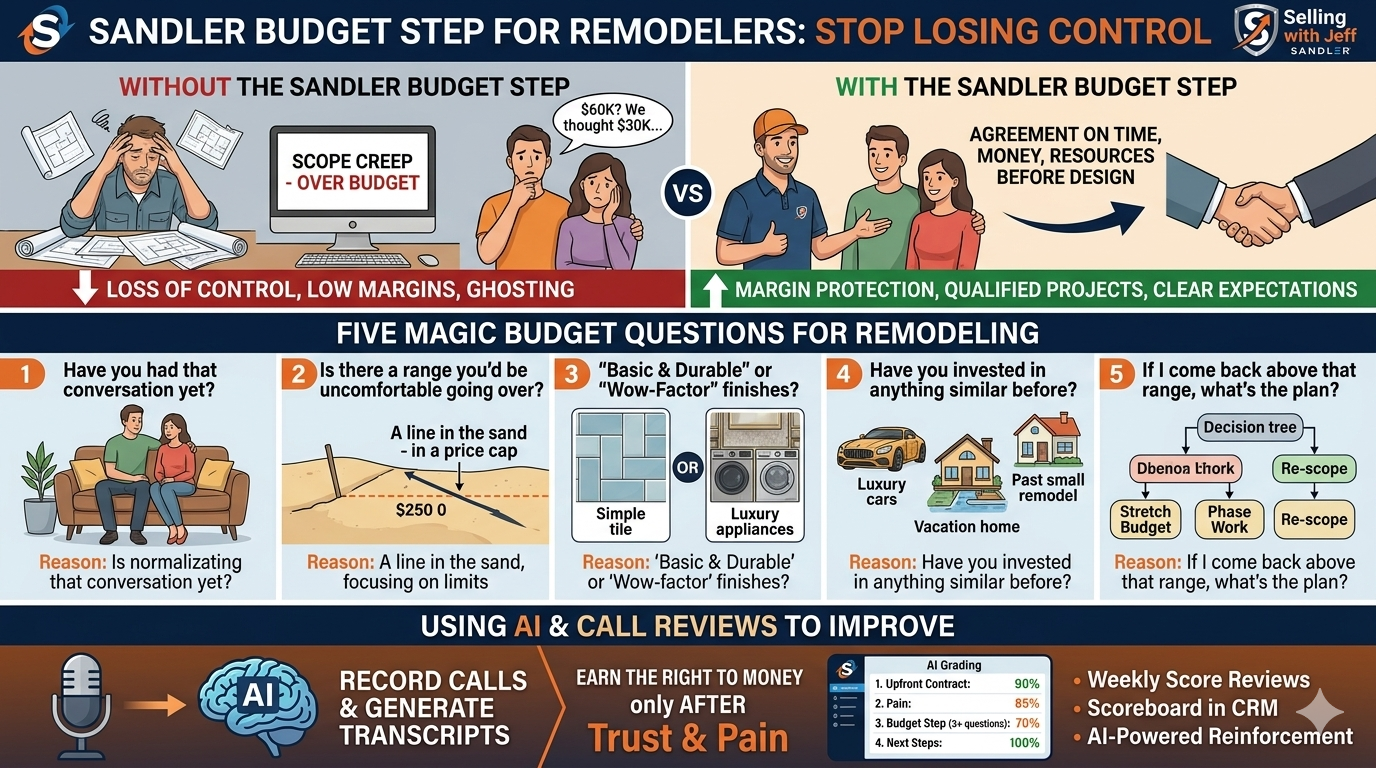
Start on the very first call. When a homeowner asks, “What would it cost to remodel my entire first floor?” resist the urge to throw out a number. Instead, use a short question sequence: square footage, last time the space was touched, whether they’ve considered moving, and what they’ve budgeted or can access through cash, investments, or home equity. One salesperson in the transcript above only moved to a site visit after confirming the client’s rough comfort level around $100,000 and acknowledging that amount might still require prioritizing scope.
Next, turn software “lag time” into relationship time. A rep noted losing 30 minutes a day to a slow system while building contracts. For her neediest clients, that is the perfect window to make a quick, proactive touch call: “I’m in your file right now getting your numbers finalized. You don’t need to do anything yet—I just didn’t want you wondering where things stand.” That transforms dead time into perceived white‑glove service without adding hours.
Finally, protect your calendar at key decision moments. If a client walks into a final proposal review with a surprise third‑party designer, or admits they’re suddenly unsure, you do not have to plow ahead. One effective move is to pause the formal proposal, answer high‑level questions about process and scope, and reset the signing meeting to a later date. It feels counterintuitive in a busy quarter, but it prevents having to re‑present the job twice and keeps you in control of the sales process instead of defending your work in front of an unexpected “expert.”
Turn repeat, referral, and nervous buyers into confident advocates
In the conversation above, the team shared a powerful number: roughly 73% of their work came from repeat and referral clients, with about 19% of that being “rebirth” projects from past homeowners returning. That does not happen by accident. It is the result of treating every job like a long‑term relationship, not a one‑time transaction.
Leverage that strength early and often. When a prospect says, “We’re down to two companies—why should we choose you?” don’t recite generic quality claims. Ask why they called you first. Many homeowners will say some version of, “I’ve seen your signs for 15 years,” or “Friends told us you actually show up and finish the punch list.” Then you can connect the dots: “That’s exactly why 73% of our business is from people coming back or sending friends. People who have lived through our process still choose us again.” It’s concrete, not salesy.
For nervous buyers, co‑create decision criteria instead of piling on more reassurance. Step back and say, “Let’s list the top three things that will make this project a win for you—price, schedule, low disruption, one point of contact, design quality. Then we’ll evaluate both options against that list together.” Shifting to joint problem‑solving pulls you onto their side of the table and reduces the emotional “wind chill” they’re feeling from news headlines about interest rates or global conflicts.
Finally, have a clear plan for handling “help me choose you” moments. When a prospect says another contractor is cheaper but calls you their favorite, ask, “What kind of help are you hoping for today?” Sometimes they want a discount. Often they just need language to justify paying more to a spouse or parent funding the project. Give them that language in writing: a short email summarizing why your dedicated project management, documented process, and proven repeat‑client base reduce risk and hidden costs. That email becomes the script they use at the kitchen table—and the reason they sign with you now and call you again for phase two.