Disqualify Remodeling Prospects Without Burning Bridges

Shift your mindset: disqualification is a service, not a rejection
Disqualifying a remodeling prospect is healthy when the project, budget, or timeline can’t realistically support your process; done honestly and early, it protects the homeowner’s money, your team’s capacity, and future referral potential while keeping the relationship warm instead of burned.
For many remodelers, the biggest pain point isn’t finding leads—it’s knowing when, and how, to say no. In the transcript above, a designer walks a couple through why their Ypsilanti home and seven-year time horizon don’t justify a $300,000–$750,000 renovation. The tension is obvious: the clients love the firm, but the numbers and context simply don’t make sense.
This is the classic collision between vision and reality. Homeowners collect ideas from HGTV, Pinterest, and friends’ forever homes, then try to apply them to a house that was a flipped property on a busy intersection. Your job isn’t to fulfill every wish list. Your job is to protect everyone from a bad decision.
Sales frameworks like the Sandler Success Triangle—Behavior, Attitude, Technique—are particularly useful here. They remind you that your behavior (asking budget questions, disqualifying bad fits) and your attitude (believing that no is okay) matter as much as your design or sales technique. As one Sandler coach puts it, open budget conversations and honest disqualification “protect both sides” instead of feeling like rejection, especially when you’re dealing with projects where the remodel could cost more than the house itself.
Treat disqualification as a service. When you decline a project that would over‑leverage a family, trap them in a neighborhood they plan to leave, or chew up your production schedule for thin margins, you’re acting as a trusted advisor. That reputation outlasts any single lost job—and often leads to referrals from people you never took on as clients in the first place.
Exactly what to say when a remodeling project isn’t a good fit
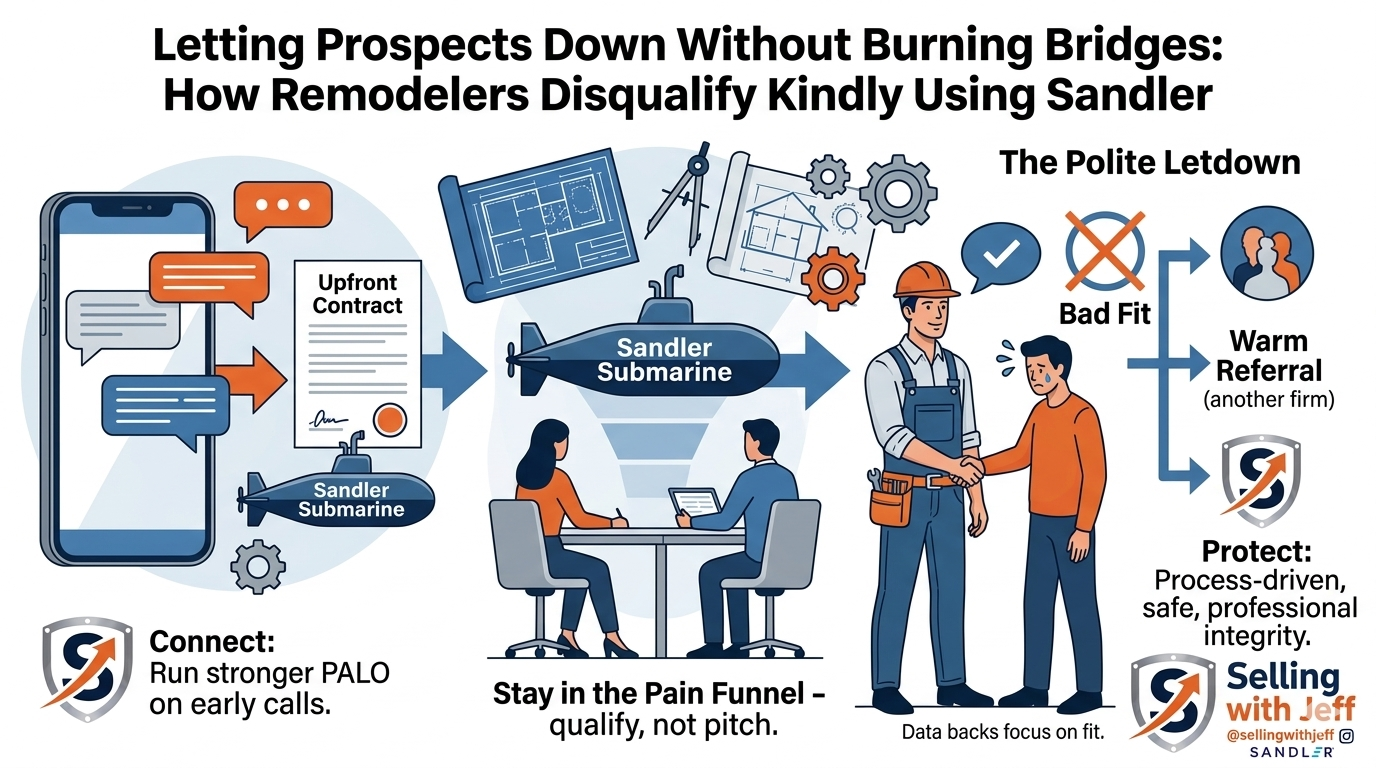
The cleanest way to disqualify is to summarize what you heard, connect it to clear decision criteria (budget, timeline, fit with your model), then state calmly that it’s a “no for now” and why, while still inviting future contact and referrals.
Most remodelers stumble not on the decision to walk away, but on the language. They either over‑explain and sound defensive, or they ghost prospects because the conversation feels awkward. The Sandler‑style dialogue in the source material offers several concrete talk tracks you can adapt.
Start with a brief recap: “Here’s what I heard you want, here’s your budget, here’s your timeline.” In the Ypsilanti example, the designer realized that the homeowners planned to move in seven years, disliked almost everything about the flipped house, and wanted a remodel that would exceed their purchase price. A simple summary like, “You bought at $250,000, the neighborhood won’t likely support a $300,000–$750,000 renovation, and you plan to leave in seven years,” frames the issue without blame.
Then, use disarmingly honest language: “I’d be doing you a disservice if we kept going down this path.” This line landed well in the conversation because it aligned with the designer’s caretaker personality and reframed “no” as advocacy. Research on buyer trust shows that buyers place high value on advisors who protect them from over‑spending, even when it means walking away from a sale; it signals integrity that’s rare in high‑ticket home improvement.
Finally, script your exit. A simple structure:
- Name the decision: “Based on everything we’ve discussed, it sounds like this is a no for now.”
- Keep the door open: “I’d love to work with you when you’re in your forever home.”
- Ask for a referral: “Even though we’re not the right fit today, who else do you know planning a long‑term remodel who might value this kind of process?”
Follow up with a short email that thanks them, reiterates why pausing makes sense, and explicitly welcomes them back if circumstances change. That one message turns an awkward breakup into a long‑term relationship asset.
Protect your identity: separating role failure from personal worth
When a prospect says no—or when you decide to say no—it’s a role outcome, not a verdict on your value; protecting your identity lets you stay calm, curious, and confident enough to have candid budget and fit conversations.
The Sandler IR theory (Identity–Role) is crucial in remodeling sales, where deals are big, emotions are high, and “no” can feel personal. Your identity is your worth as a human being. Your roles are the hats you wear—designer, salesperson, project manager, parent, volunteer, neighbor. You can perform brilliantly or poorly in any role without changing your fundamental value.
In the group dialogue, the coach invites the team to rate themselves as cooks on a 1–10 scale, then compares them to celebrity chefs. The point is not culinary skill; it’s how quickly we let outside comparisons drag our number down. The same happens in sales: you lose a deal, a homeowner chooses a cheaper contractor, or a colleague closes a project you wanted, and suddenly your inner voice says, “I’m terrible at this.”
That’s identity erosion, and it directly sabotages behavior and technique. When your self‑worth is tied to every yes or no, you avoid budget talks, cling to bad‑fit leads, and over‑give free design work to “prove” your value. A study from a major sales training provider found that teams who explicitly coach mindset and self‑concept alongside skills see significantly higher adoption of process changes than those who only teach technique. In other words, when people feel okay about themselves, they’re willing to risk a no.
To protect your identity, draw a hard line: “I can fail in the role of salesperson or designer; that does not make me a failure.” Before tough meetings—like presenting an over‑budget concept—remind yourself: “My job is to be honest, not to get a yes at any cost.” That mindset frees you to use disarmingly honest language, present multiple options (“you can see both designs, one, or none”), and sit quietly while clients decide.
Over time, practicing this separation lets you disqualify faster, say no more gracefully, and walk into every discovery call with less desperation and more calm authority. Homeowners feel that difference immediately—and so do you.