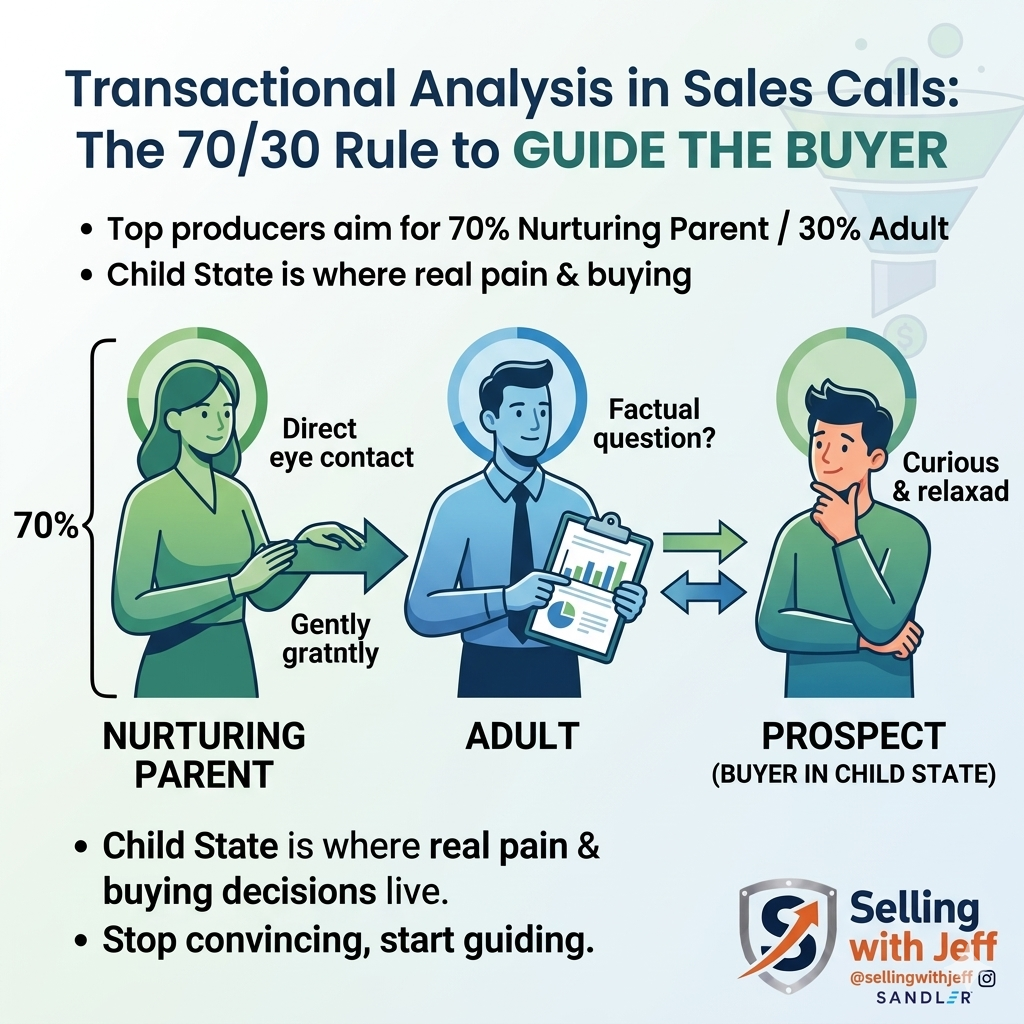
Transactional Analysis in Sales: Predict, Don’t Persuade

Why great sellers predict, not persuade
Transactional analysis in sales is a practical way to qualify faster by understanding which ego state a buyer is in and guiding the conversation, instead of trying to talk them into a decision. When you focus on predicting what they will buy, you protect your time and avoid chasing bad‑fit deals.
Most teams lose hours every week rewriting proposals, reworking designs, or re‑quoting jobs for prospects who were never going to buy. The problem isn’t your deck; it’s your mindset. When your goal is persuasion, you stay in deals long after the data says walk away. When your goal is prediction, every question tests, “Is there real business here?” That’s the mindset behind Sandler’s emphasis on qualification as advanced time management, not arm‑twisting.
A practical example: one remodeling firm we worked with cut their average cycle time by simply adding, early in discovery, “What will you definitely decide and not decide at the end of this process?” That Adult‑state question exposed non‑buyers early and kept the team out of four‑year “maybe” projects.
The Parent, Adult, Child model made practical for sales
Transactional Analysis says every conversation happens from three ego states: Parent, Adult, and Child. Buyers say yes in their emotional Child state, justify in Adult, and sense whether it’s responsible in Parent. Your job is to work with all three, without slipping into your own unhelpful Child.
Research on buying behavior, including Sandler’s work summarized in Parent, Adult, Child: Why Buyers Really Decide to Buy, shows decisions start emotionally, then get justified logically. In practice, that means you:
- Use curiosity and pain questions to light up the Child (“I want this fixed”).
- Use clear math and business cases for the Adult.
- Use risk, responsibility, and fit for the Parent.
For example, an enterprise SaaS seller might ask, “If nothing changes, what does that cost your team this quarter?” (Child), then, “How many hours and deals is that in real numbers?” (Adult), and finally, “What happens to your customers and your reputation if this continues?” (Parent).
Staying in Nurturing Parent and Adult on real sales calls
On live calls, your own ego state often shifts without you noticing. When you’re desperate to be liked, you slide into Adapted Child. When you lecture, you show up as Critical Parent. Neither helps the buyer decide.
A more effective pattern is 70% Nurturing Parent, 30% Adult. That looks like calmly guiding the process, protecting the buyer’s time and money, and asking direct questions without emotional charge. As described in Understanding Transactional Analysis (TA), simply observing your own state pulls you back into Adult.
A simple self‑check in a tough budget discussion is: “What am I feeling right now?” The moment you notice, “I’m anxious they’ll think our price is too high,” you’ve already moved into Adult. From there you can choose a Parent‑style question such as, “Can we talk frankly about what happens if you choose a cheaper option that can’t deliver?”
Turning TA into a time-management advantage for your pipeline
Used well, TA becomes a powerful filter for your pipeline, not just a communication model. You stop measuring success by how many proposals go out and start measuring by how accurately you can predict what a prospect will do next.
On your next deal review, label the dominant ego state for both sides at each major meeting: discovery, budget, decision. If you never saw genuine Child‑level motivation from the buyer—no real pain, urgency, or personal win—treat that opportunity as a low‑probability “nice to have,” not a core forecast.
Then, upgrade your pre‑call planning. Before every meeting, script: one Adult question to clarify facts, one Nurturing Parent question to protect the buyer from a bad decision, and one Child‑oriented question to surface emotion. Reps who adopt this simple discipline typically report cleaner pipelines and less “mystery” around stalled deals within a quarter.