
Sandler Sales: Psychology, Not Manipulation
Why Sandler Selling Is Psychology, Not Manipulation
Sandler selling is an ethical, buyer‑focused sales methodology that uses psychology and structured questioning to uncover real problems, not to trick people into buying. It replaces pressure, scripts, and pitch‑first habits with curiosity, empathy, and clear rules that make decisions safer for both salesperson and prospect.
One of the biggest misunderstandings about Sandler sales training is that it’s about clever word tracks that “overcome” people. In reality, Sandler’s roots are in behavioral psychology. The goal is to skillfully handle conversations, not control people. David Sandler warned that if you step between someone and their beliefs, they will push back—often hard. That insight is backed by modern research showing that when you attack someone’s beliefs with facts, they tend to double down instead of changing.
So instead of challenging beliefs, Sandler teaches you to work with them. You avoid arguments and “gotcha” moments. You stay genuinely curious, ask more questions than you answer, and let the buyer connect the dots. This is closer to a doctor’s mindset than a stereotypical salesperson’s: diagnose first, prescribe later.
Ethical selling also means no pressure. In Sandler, “no pressure” is literal: no pressure on you, and no pressure on the prospect. You move people gradually from suspect (anyone who shows up) to prospect (someone you’re actively qualifying) by asking permission, setting expectations, and being transparent about “no” being a perfectly acceptable outcome.
That approach works. Studies in behavioral economics, such as Daniel Kahneman’s work on decision‑making, show that people decide emotionally and then justify logically. Sandler aligns to that reality. Instead of fighting it with more data, you guide people to explore the emotional side of their problem in a safe, respectful way, so they can make a decision that actually fits their life or business.
How the Pain Puzzle Works Without Pressure or Pushiness
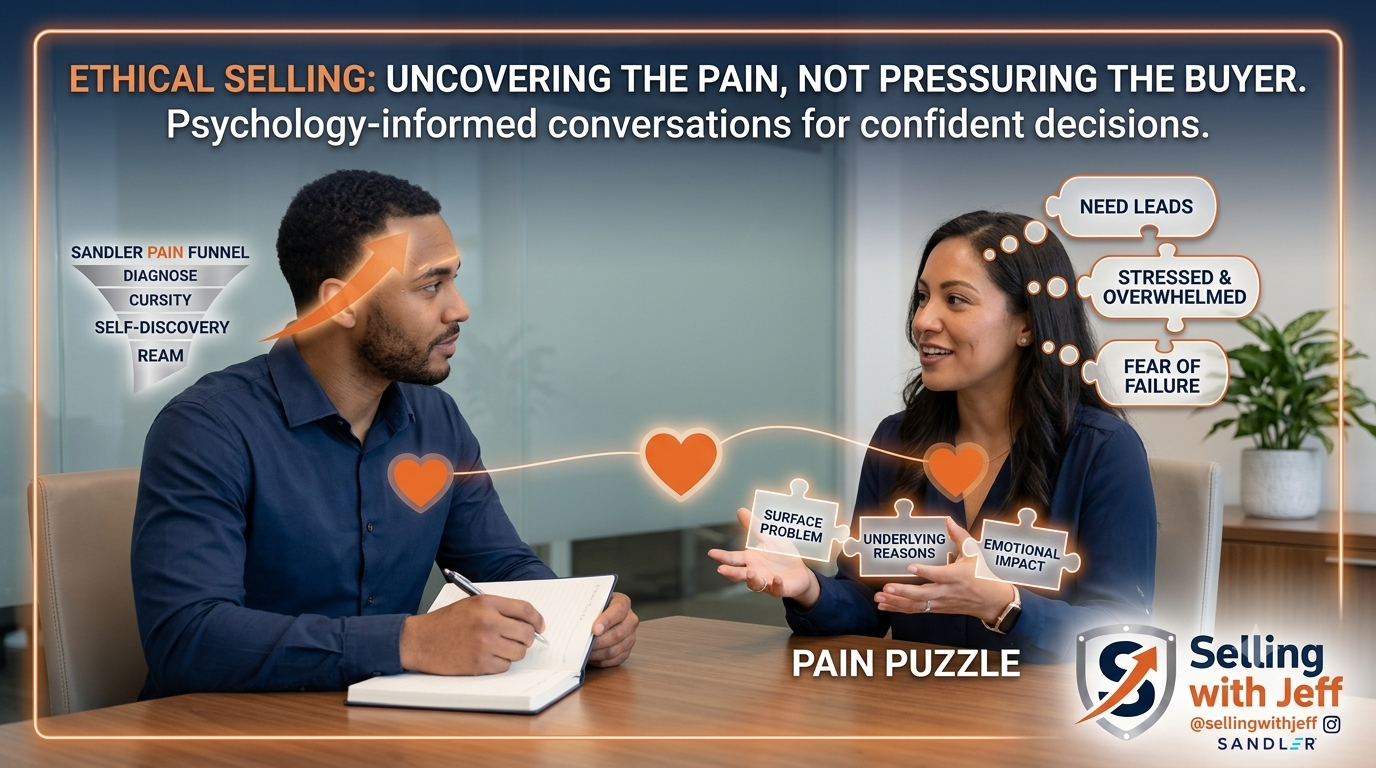
The Sandler pain puzzle is a three‑layer questioning framework that moves from surface problems to deeper reasons and personal impact, so buyers feel their own motivation to change instead of being pushed. Done properly, it feels like helpful coaching, not interrogation.
Most salespeople stop at the surface level: “What do you want?” A homeowner says, “We want a bigger shower,” or a CEO says, “We need more leads.” At that point, the average rep races to present—features, benefits, slides, and a proposal. The problem is that surface problems rarely carry enough weight to drive a decision, especially when competing options look similar.
The pain puzzle asks you to stay in the problem a little longer:
- Surface problem – What they openly say they want: a new kitchen, a faster CRM, a three‑hour sales seminar.
- Underlying reasons – Why they want it now: what’s frustrating them, what’s broken, what they’ve already tried.
- Personal emotional impact – How the situation affects them personally: stress, embarrassment, lost time, fear of a repeat “nightmare project.”
For example, a client might start with, “We just want marble countertops.” With simple questions—“How long have you been thinking about this?” “Why now?” “What happens if you don’t?”—you may discover they entertain often, worry about stains, and hate the idea of constant maintenance. That emotional context might lead them to choose a more durable material once they see the trade‑offs for themselves.
This is where Sandler’s famous pain funnel comes in. It’s a sequence of open‑ended questions that gradually deepens the conversation. Sandler experts describe it as guiding someone from symptoms to root causes and business impact, much like a physician narrowing a diagnosis. Used with empathy and authenticity, the funnel creates a controlled sense of uncertainty—“Maybe what I planned won’t work”—that holds attention without ever using fear tactics.
Because the buyer is doing most of the talking, they experience what Sandler calls self‑discovery. They connect their own dots: “We’ve tolerated this for nine years,” “We can’t keep re‑doing this work,” or “Paying a bit more for experienced design help is actually less risky.” That moment of internal “ouch” is far more powerful than any scripted close.
Practical Questioning Tactics That Create ‘Ouch’ Moments Ethically
Ethical Sandler questioning uses choice, contrast, and third‑person stories to help prospects see consequences clearly, while still feeling fully in control of the decision. You’re not twisting arms; you’re sharpening their thinking.
One simple tactic is the choice frame when a buyer is asking for something that won’t work. If an executive wants a three‑hour seminar to “fix” a struggling sales team, you might say, “We can talk about a one‑time seminar that gets people excited for a day, or a longer program that creates lasting change. Which should we focus on?” You haven’t lectured them. You’ve laid out honest options and let them pick.
In a remodeling context, the same structure works for material or layout decisions. “We can talk about marble, which looks beautiful but demands careful maintenance, or granite, which is more forgiving if wine or coffee sits for a while. Which direction makes more sense for how you live?” The discomfort of extra maintenance is the small “ouch”—but it’s their conclusion, not your push.
A second tactic is the “If you knew…” contrast question. Instead of defending your price or criticizing cheaper competitors, you invite the prospect to compare outcomes: “If you knew this approach meant a dedicated designer guiding you through hundreds of choices, and the cheaper option meant more DIY stress and change orders, would that affect how you see the price difference?” You’re not saying the other option is bad; you’re asking them to weigh the real trade‑offs.
Third, Sandler uses presumptive questions to highlight your unique advantages without bragging. Suppose you know a competitor rarely involves designers past the initial plan. You might ask, “When their team walked you through how your designer stays involved during construction, how did that sound?” If the prospect says, “We didn’t talk about that,” you gently repeat, “You didn’t?” and then explore how important that ongoing support is to them. They often sell themselves on why your approach matters.
All of this rests on empathy and curiosity. You ask, “What’s behind that?” rather than “Why would you do that?” because “why” can sound accusatory, as former FBI negotiator Chris Voss has pointed out. You slow your own instinct to pitch, and you give the prospect space to talk through their fears, past bad experiences, and hopes for a better outcome.
Used this way, Sandler questions don’t manipulate; they clarify. They help people see the emotional and practical cost of doing nothing—or of choosing a risky shortcut—so they can make a confident decision they’ll still feel good about a year later.
Using Sandler to Help Prospects Decide With Confidence
The real payoff of Sandler is a calmer sales process where both sides know the rules, talk openly about money, and can walk away without resentment if there isn’t a fit. That confidence is what turns suspects into long‑term clients who trust your advice.
It starts with mindset. In Sandler, you’re not trying to “win” a battle with your prospect. You’re trying to avoid a fight altogether. Drawing on ideas similar to Sun Tzu’s—“be extremely subtle, even to the point of soundlessness”—you quietly target the strategy, not the person. Prospects often keep conversations strictly intellectual with questions about price, timing, and features because emotions feel risky. Your job is to gently shift from facts to feelings: “How would it affect you if this project went badly again?” “What’s at stake for you personally if this doesn’t change?”
Next is structure. Sandler is rules‑based, not script‑based. Rules like “No man should cede the strategy out of which victory is evolved” translate to sales as: don’t let the buyer’s process turn you into a free consultant or commodity. You agree upfront on the agenda, decisions, and next steps. You’re clear that “no” is okay. That frame alone removes much of the hidden tension in traditional sales calls.
Research on complex B2B buying shows that indecision and internal conflict stall far more deals than price alone. By helping buyers talk through pain, trade‑offs, and criteria out loud, you reduce that internal friction. Even if they choose a competitor, they’re more likely to feel the process was fair and respectful—and to remember you as the advisor who told them the truth.
Finally, Sandler gives you a way to continually improve. After calls, you can debrief using the pain puzzle: Did I only hear surface problems? Did I explore underlying reasons? Did I reach personal impact, or did I let them stay comfortable and intellectual? You can also coach your team with the same lens, turning every “no decision” into a learning moment.
When you treat Sandler as an ethical, psychology‑informed framework—not as a bag of tricks—you get a very human outcome: better conversations, fewer sideways deals, and clients who feel they discovered the answer with you, not because of you.