Sandler Pain Funnel: Record Your Calls to Master It
Why most remodelers stop too early in the pain funnel
The Sandler pain funnel is a question sequence that moves a prospect from surface complaints to the real personal and financial impact of their problem. Remodelers who go all three levels deep uncover stronger motivation, hold price better, and win more projects without pressuring homeowners.
On paper, most remodelers understand the three levels: surface symptoms, reasons, and deeper impact. In live conversations, though, many stop after a few “vanilla” questions like, “Tell me more,” or “How long has that been going on?” They never quite reach the emotional and personal impact that actually drives decisions.
External research backs up why it’s worth pushing deeper. Teams that consistently move from symptoms to business and emotional consequences using a structured pain funnel see roughly 30% higher discovery-to-opportunity conversion rates and about 25% higher win rates on pain-qualified deals, according to It’s Just Revenue.
For remodelers, that impact layer often sounds like, “I’m embarrassed to have people over,” or “I’m exhausted from fighting with my spouse about the kitchen.” When you don’t slow down long enough for those words, you end up in budget fights, price shopping, and “We’ll think about it.” When you do, the investment conversation becomes easier and more honest.
Use “game film” to hear your real pain questions
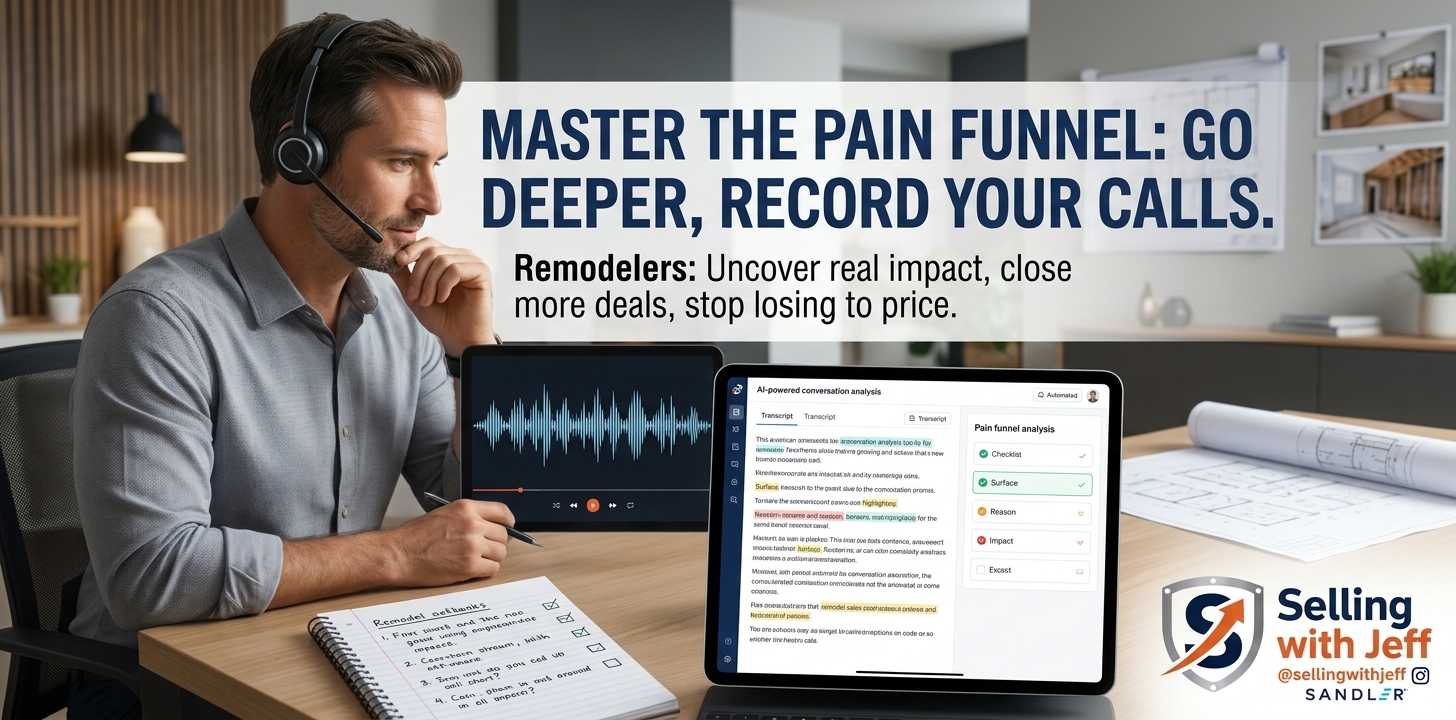
The fastest way to see how well you’re really using the pain funnel is to record your sales calls and design consultations, then listen back like a coach watching game film. Conversation-intelligence tools, call-recording apps, or even integrated meeting recorders make this simple.
Pick one recent call and listen only for pain questions. Count how many times you asked follow-ups like “Can you be more specific?” “What have you tried to solve this?” and “What’s the effect of that on your day-to-day life?” Most remodelers are surprised at how quickly they jump from a single surface complaint straight into design ideas or pricing.
As you review, mark the exact moment when a homeowner gave you a chance to go deeper and you moved on. That one missed “Tell me more” often equals a lost project or a brutal price comparison later.
AI role-play: safely rehearse deeper pain funnel questions
Role-play still makes many salespeople uncomfortable, but AI tools can make practice private, repeatable, and specific. Drop a call transcript into an AI coach or run a mock discovery conversation where the AI plays a skeptical homeowner with a tight budget and a vague project idea.
Ask it to score you on three levels: surface, reasons, and impact. Did you ask how long the issue has been going on? What they’ve tried? Whether it worked? How it affects their family and daily life? Use the feedback to highlight where you routinely stop short of impact.
Then rehearse out loud. Running the pain funnel silently in your head doesn’t build “muscle memory.” Practicing spoken questions with an AI partner or recording yourself on video trains you to stay calm in silence, handle emotional answers, and keep the focus on the homeowner’s words instead of your pitch.
Turn notes and checklists into natural pain conversations
Scripts feel stiff; zero structure feels chaotic. A simple compromise is to walk into meetings with a printed pain-funnel checklist and a few discreet notes. Write the key questions in normal ink, and keep your private prompts—like a child’s name or a reminder to ask, “Is doing nothing an option?”—in small pencil that clients can’t read across the table.
As homeowners share pains, jot each one in their words with a small checkbox beside it. Once you have three or more, say, “To see whether we can really help, I’ll need to ask a few deeper questions about each of these. Is that okay?” Now you’ve visibly committed yourself to exploring every pain instead of stopping at the first.
When you finish a full funnel on one issue—surface, reasons, and impact—summarize it back in their exact words and check the box. That simple act of visible, structured listening turns notes and checklists into a natural, trust-building conversation instead of a rigid script.