
When a loyal remodeling client starts “bidding you out”
A remodeling sales meeting debrief is a short, honest review of a client conversation where you identify what happened, what you controlled, and what you’ll do differently next time. For remodelers, it turns emotional moments—like loyal clients bidding you out—into repeatable plays you can run with confidence.
In the source call, Shannon walked into a meeting with past clients she loved working with. They’d done three projects together. This time, the couple was considering a much larger, possibly $800,000 remodel—and had decided to “bid it out” with multiple builders. That’s the nightmare scenario for many relationship-driven remodelers.
The emotional hit was real. Shannon admitted it felt “shitty,” like, “I thought you loved us.” That reaction is normal. The risk is what happens next: you either cave (rush a bid, drop your standards, chase price) or you freeze and avoid the tough conversation.
Debriefing the meeting afterward with a coach and peers let Shannon see something important: she could honor the relationship, stay in control of her process, and still walk into a multi-bid situation like a pro. That’s what this article shows you how to do.
Turn chaos into structure with PALO and pre-call planning
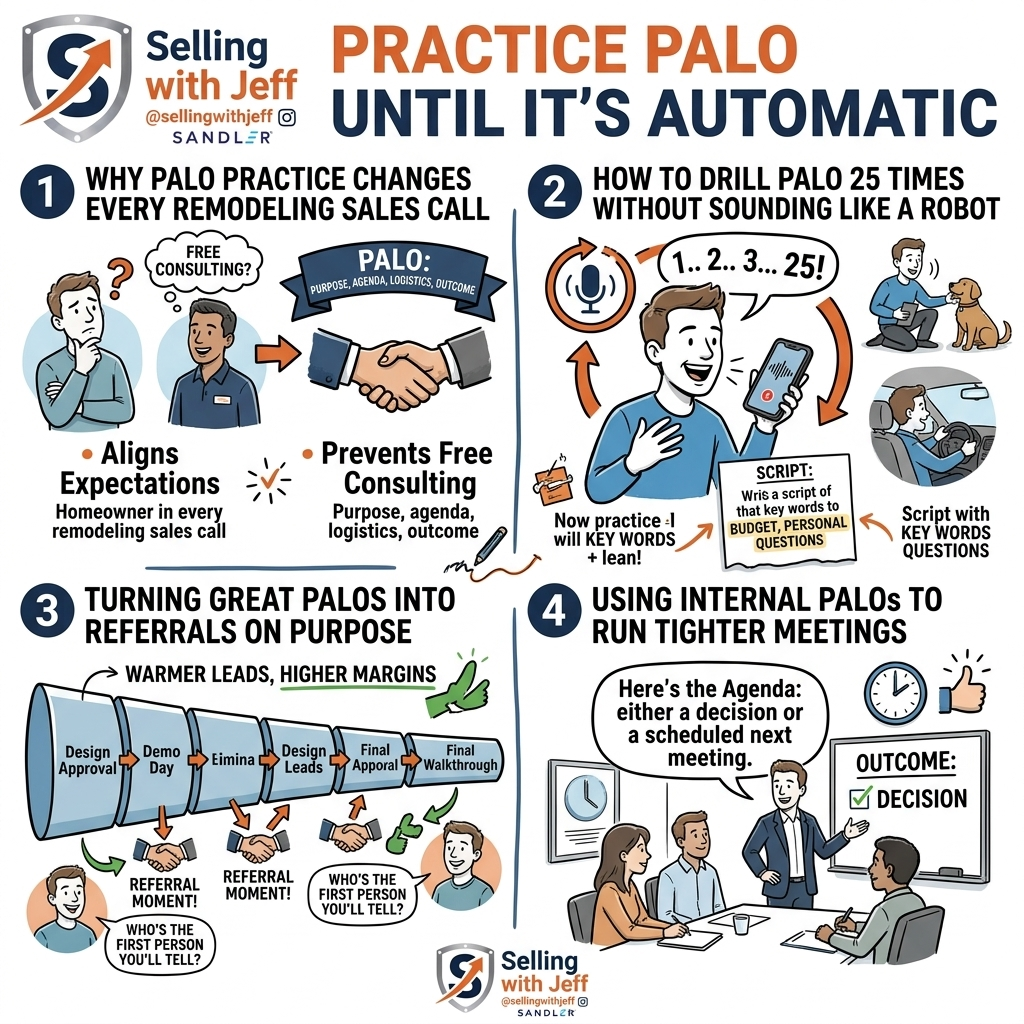
Before a high-stakes homeowner meeting, pre-call planning and a simple PALO upfront contract give you structure. In 40–60 words, PALO clarifies the purpose, agenda, logistics, and outcome so you don’t drift into free consulting or vague futures like “We’ll get back to you.”
Shannon didn’t just wing it. She booked time with her sales coach, worked through the scenario, then rewrote her notes several times. She decided what she’d say first, what questions she had to ask, and what outcome would count as a “base hit” (a clear follow-up meeting after all bids were in).
That mirrors a six-step pre-call checklist many remodelers use: rehearse your opening PALO, list critical questions, think pessimistically about what could go wrong, define best and minimum outcomes, script your closing PALO, then execute. One Sandler study found 96% of salespeople fail to define a clear call objective, which is why their meetings drift.
Shannon’s opening sounded like: thank them for their time, acknowledge they were busy, state that a bid was one goal, then ask what they wanted to achieve so they’d leave feeling their questions were answered. In under a minute, she reset the meeting from “price review” to a mutual agenda.
Ask the questions that prove you’re not a commodity
When multiple contractors are bidding from the same plans, homeowners tend to treat you as interchangeable. Smart questions break that illusion and highlight your unique value without chest-thumping about how great you are.
Shannon focused on curiosity. First, she asked whether the clients had already received other bids—and discovered they were talking to more companies than she realized. Instead of panicking, she dug deeper: How did those bids make you feel? What were they like? The couple admitted all the numbers were “shockingly expensive,” including hers.
Then she asked the turning-point question: “How in the world are you going to decide between all these bids?” That forced them to confront the confusion they were creating. She reinforced it with a concrete analogy: choosing between bids would be like laying red, green, blue, purple, and orange paint chips on a table and trying to compare them.
From there, she used specific examples no competitor could match. Her team knew the house’s “bones” from past projects, including a steel beam hidden in a wall the designer had moved. Other bidders had no way to price that accurately. She also asked whether anyone else had offered a fixed-price agreement; none had even used the term. Those questions quietly differentiated Lane’s process without tearing others down.
Handle price pressure and leave with a clear next step
In big remodeling decisions, price pressure and discount requests are almost guaranteed. Knowing in advance what you will and won’t do lets you stay calm when the client pushes on budget, timeline, or “just a little break on the price.”
Shannon tackled budget directly: “Is price the determining factor?” When both clients said, “Absolutely not,” she followed with, “Then why are you torturing yourselves with this process?” That respectful challenge helped them admit the real drivers—fear of a huge investment and outside voices telling them to get multiple bids.
She also positioned their next step before leaving. Once she learned two more bids were coming, she asked when they expected them and scheduled a follow-up meeting after all bids would be in. That way, her minimally viable outcome wasn’t “win the job on the spot”; it was a defined future discussion where they’d compare everything together.
When discount requests do come, her coach suggested a simple script: if a client says, “Can you do any better on the price?” respond with a genuine sigh and, “I wish I could,” then stay silent. Homeowners who emotionally decided to work with you usually move ahead anyway, without you negotiating against yourself.
The result of Shannon’s meeting wasn’t a perfect textbook call—it never is. But she left with a stronger position, sharper insight into her competitors, a scheduled next conversation, and a repeatable playbook she and her team can use the next time a “dream client” starts bidding them out.