Practice PALO Until It’s Automatic
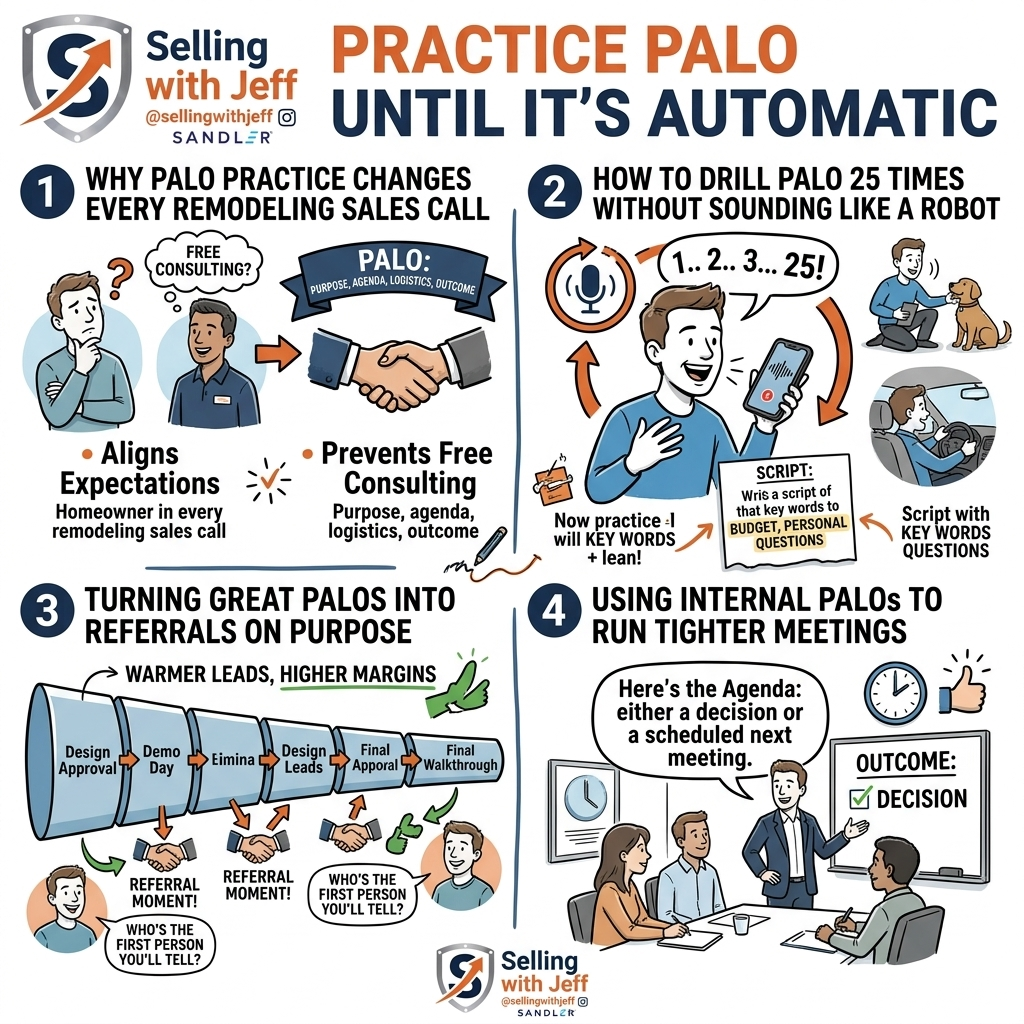
Why PALO Practice Changes Every Remodeling Sales Call
A PALO upfront contract is a short, clear agreement at the start of a meeting that sets the Purpose, Agenda, Logistics, and Outcome. In 40–60 seconds, it aligns expectations, reduces surprises, and prevents free consulting so both you and the homeowner know exactly why you’re there and how the call will end.
When you sell remodeling, most frustration comes from fuzzy expectations. You think you’re at a qualified design meeting; the homeowner thinks you’re there to give ideas and a free ballpark. A tight PALO fixes that. In the kitchen example above, the rep calmly sets ground rules: confirm the project (kitchen), widen the scope (“anything else besides the kitchen?”), surface all pain with “anything else?” loops, then negotiate time, questions, budget, and possible outcomes.
Notice how the language stays human: “Is it okay if I ask some questions that are a little personal?” and “No is a perfectly acceptable answer.” That tone keeps control without pressure. Sandler data with remodelers shows that when they consistently open with a strong upfront contract, they close more projects at higher margins and send far fewer unpaid proposals, because every meeting has a clear next step already agreed.
Just as important, PALO gives you permission to disqualify. You can say, “Our process isn’t a good fit for what you’re trying to accomplish,” instead of, “Your project isn’t a fit.” That one change dramatically reduces bad reviews and lets you refer mismatched prospects to other contractors without burning the relationship.
How to Drill PALO 25 Times Without Sounding Like a Robot
To make PALO automatic, you can’t just read a script once; you need drill. The assignment from the transcript is simple and brutal: record a one‑way PALO 25 times in 24 hours. Record the first and the last, say it out loud every time, and don’t listen to the first until you’ve finished all 25. It feels silly—and it works.
Here’s why. When you repeat the same talk track out loud, your brain, mouth, and body wire it together. You stop “remembering lines” and start speaking naturally. Sales trainers see that after about 20–25 reps in a single day, the words are locked in for life. Years later, reps catch themselves running a clean PALO with their kids or at the doctor’s office because the pattern lives in their muscle memory.
Use a simple setup: your phone’s voice recorder, no video needed. Talk to a pretend prospect: “Hey Chris, thanks for inviting me into your home…” then walk through Purpose (why you’re here), Agenda (what you’ll cover), Logistics (time, people, personal questions, budget), and Outcome (three possible endings and what ‘no’ looks like). Say it to your dog, your steering wheel, your bathroom mirror—it doesn’t matter, as long as your lips are moving.
A printed script is fine as a safety net, but don’t read it into the microphone. If you read word‑for‑word, you sound stiff and fake. Instead, highlight key beats—“anything else?” loops, permission for personal questions, budget permission, three outcomes—and then paraphrase in your own style. That way, when you face a real homeowner, you’re not reciting; you’re having a conversation with a structure you’ve already mastered.
Turning Great PALOs into Referrals on Purpose, Not by Accident
A strong PALO does more than keep a single call on track; it sets up trust spikes where referrals become natural. Homeowners trust people they know far more than any ad—industry surveys regularly show 90%+ of consumers trust word‑of‑mouth over paid marketing—and referred remodeling leads often close three to five times better than cold leads, at higher margins. Yet fewer than 15% of remodelers have a written, repeatable referral process inside the sales role.
The transcript walks through seven specific moments to ask for referrals on purpose: design agreement, final design approval, construction contract, demo day, mid‑project excitement, final walkthrough, and a 30–90 day follow‑up call. Each moment is a built‑in “memory jogger.” Instead of the weak, “If you know anyone…,” you ask, “Who’s the first person that pops into your head you’re going to tell about this?” That question triggers an immediate, concrete name instead of a polite nod.
You don’t have to use all seven moments, but hitting at least five creates a steady stream of introductions. Combine that with creative touches—demo night pizza parties where kids and neighbors draw on demo walls, or post‑project open houses with catered food and professional cleaning—and you turn happy clients into proud hosts who want to show off your work. Each event gives you face time with neighbors and friends who already trust you by association and are far less likely to shop you against three cheap bids.
Over time, this “referrals on purpose” system can make 70–80% of your signed contracts come from introductions, with near‑zero lead cost. Your PALO upfront contracts protect your time on each call; your referral moments compound that time into a pipeline full of warmer, better‑fit projects.
Using Internal PALOs to Run Tighter Meetings and Decisions
PALO isn’t just for homeowners. Internal PALOs turn scattered internal meetings into short, decisive sessions. The structure is the same: state the Purpose (“we’re here to talk about AI optimization”), agree on the Agenda (“what do you want to make sure we cover?”), confirm Logistics (who’s here, how long we have), and lock in the Outcome (“either I decide today, or before we leave we schedule a next meeting with a short homework list”).
In the internal example from the transcript, the sales leader and marketing lead use an upfront contract to prevent a common problem: wandering 60‑minute meetings that end with, “I’ll get back to you.” Instead, everyone knows up front that the meeting ends one of two ways: a decision, or a scheduled follow‑up with clear tasks. That makes it obvious when the conversation is drifting and gives the leader permission to steer back.
This same pattern applies to production huddles, design reviews, hiring interviews, and even cross‑department negotiations about access, terms, or change orders. Many remodeling companies already run EOS or similar systems; PALO fits neatly on top as the conversational layer that keeps each agenda grounded in real decisions. When every internal meeting starts with a 40–60 word upfront contract, people show up prepared, stay on track, and leave knowing exactly what will happen next.
Drill it the same way you drill homeowner PALOs. Have team members practice one‑way internal PALOs into their phones before big meetings. Within a few weeks, you’ll hear supervisors opening with, “Here’s what I thought we’d cover—what did you want to make sure we hit?” That simple question, asked consistently, will do more to reduce misalignment and rework than any new software you buy.