
Remodel Timelines Clients Can Actually Trust
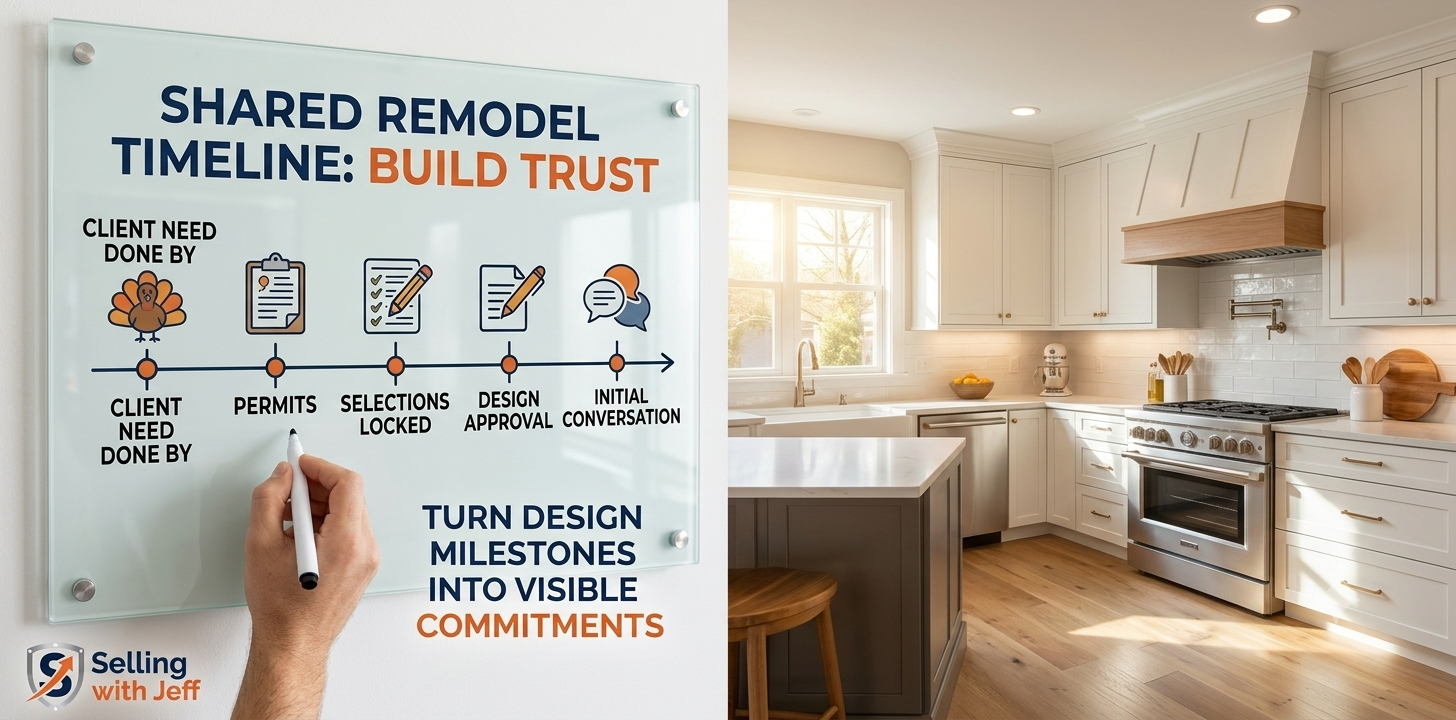
Set a shared project timeline before design really begins
A realistic remodel timeline starts by asking when the client truly needs the project finished, then working backward through design, selections, permits, and construction to agree on dates everyone can live with, document, and revisit together throughout the job. That shared plan becomes the reference point for every later decision.
Most timeline problems begin because no one ever puts a full project path on paper with the homeowner. Sales talks about start dates in vague “ish” language. Design dives into drawings. Production only creates a detailed schedule after the build contract is signed. By the time a concrete start date appears, the client has already built their own expectations in their head.
Instead, treat timeline like budget: a qualification tool, not a formality. In your very first substantive conversation, ask, “If everything went perfectly, when would you want this done by?” Then, instead of promising anything, pull out a blank sheet and sketch a backward timeline together.
Start from their desired “done by” date—maybe it’s a September fundraiser, Thanksgiving, or a new baby arriving. From there, work in reverse: how many weeks for construction, inspections, and punch list? When do you realistically need permits in hand? When must design decisions and selections be locked so you can order long-lead items?
This quick exercise does three things. First, it shows clients what has to happen between today and their dream date. Second, it surfaces immediate risks—like an unrealistic completion goal or a vacation right in the middle of framing. Third, it positions you as a guide, not just a bidder.
Once you’ve sketched a reasonable path, formalize it. Create a simple one-page timeline that shows major milestones: concept approval, selections complete, construction contract signed, target start, target completion. Have both you and the homeowners initial it. Give them a hard copy for the fridge and follow up with calendar invites for each milestone.
Industry articles on design-build trust show that firms hitting 85–90% conversion from design to construction nearly always have a predictable, transparent process around timing. They don’t guarantee exact dates early, but they do guarantee clarity—clients know what needs to happen, by when, and who owns each step.
When clients can literally see how slipping on decisions threatens their own deadline, you no longer own the timeline alone. You share it.
Use Sandler-style questions to uncover real deadlines and risks
Most remodelers ask whether there’s a “deadline” once, early, and then never come back to it. Sandler-style questioning treats timing as something you explore from multiple angles over time, using presumptive questions that reveal the stakes beneath the calendar.
A presumptive question assumes a smart client would already have considered a risk, then gently tests that assumption. Instead of asking, “Do you have any events we should know about?” you might say, “Most of our clients forget to mention things like fundraisers, graduations, or houseguests until later. What’s on your calendar over the next six to nine months that this project could bump into?”
Notice the difference. You’re not interrogating; you’re normalizing the idea that hidden events exist. Clients feel safe surfacing them. In the transcript that inspired this article, a major conflict only emerged after contract, when a homeowner suddenly revealed they were hosting a big fundraiser mid-project. That surprise could have been avoided with one presumptive question.
Sandler trainers use similar questions around budget, such as, “When you talked with other builders about what percentage of their projects finish on time and on budget, what did they say?” They know most prospects haven’t asked that—and the silence that follows makes the missing due diligence obvious. You can do the same around timing.
Try questions like:
- “When you picture construction happening, what months do you absolutely not want us in your home—and why?”
- “If this slipped by four weeks, whose life gets hardest? What happens?”
- “What’s the latest this could realistically finish and still be a win for you?”
Each answer gives you more than a date. It gives you context: a fundraising event, an elderly parent moving in, a baby’s due date, a seasonal rental. That context becomes part of your ongoing timeline conversations.
Research on design-build sales shows that trust, not price, is the main driver of whether homeowners move from design into construction. When you ask thoughtful, forward-looking questions about their lives—not just their floor plan—you communicate that you’re planning their project, not just their drawings. That’s what turns you into a long-term advisor instead of an easily replaced estimator.
Turn design milestones into visible commitments clients own
Once you’ve agreed on a shared, high-level timeline, the next step is turning it into specific design and decision milestones the client can see and own. Many teams have rough internal targets (“we’d like selections done in four weeks”), but they live in project management software, not in the homeowner’s world.
Bring those milestones into the homeowner’s line of sight. Using your backward-planned map, identify the key check points between now and construction start: schematic approval, detailed design sign-off, selections complete, and build contract signing. Tie each to a simple calendar date range and explain what must be decided by then.
For example, you might say, “If you want to be done before your September fundraiser, we’ll need to start construction by mid-June. That means we’ll need your final design approved by April 20th and all selections wrapped up by May 1st. If either of those slips, your September completion becomes at risk.”
Print this on a one-page timeline, have both parties initial it in the meeting, and physically hand them a copy. Encourage them to put it on the fridge or family bulletin board. Then, follow up with calendar invites for each milestone, just like you would for your own team.
This simple mechanic has outsized impact. In Sandler terms, you’re creating an “up-front contract” not just for the next meeting, but for the entire design phase. You’re making clear who does what by when, and what happens if they don’t.
It also reframes responsibility. Instead of, “The builder is dragging their feet,” it becomes, “We’re behind on selections, which is putting our own date at risk.” That shift reduces the blame your project consultants and designers carry and increases the client’s sense of partnership.
One design-build firm profiled in a recent article on trust reported that after they began using signed client timelines and calendar invites for every design milestone, their design-to-build conversion rate climbed from the low 60s to above 85% within a year. Nothing changed in their estimating software or finishes; what changed was how clearly clients could see and own the path forward.
When people can track progress visually and know exactly what’s expected of them, “we just lost momentum” stops being an excuse.
Keep trust high when dates slip or priorities and scope change
Even with the best planning, dates will slip. Permits get delayed. Clients take longer than expected to decide on appliances. A surprise structural issue adds weeks. The difference between a meltdown and a simple recalibration is whether you treat the original timeline as a rigid promise or a living agreement you revisit together.
The shared, initialed timeline you created gives you a powerful tool for those conversations. When something threatens the schedule, don’t quietly adjust your internal project plan and hope the client won’t notice. Instead, schedule a short call and literally pull out the same roadmap you built together.
You might say, “When we met back in February, we agreed that to be done by September 15th, we’d need selections complete by May 1st and permits in by June 1st. We’re now at May 15th and still have several big choices open. Let’s walk through how that affects your September goal and what options you have.”
This approach keeps you in “adult-to-adult” conversation rather than slipping into blame or defensiveness. You’re not scolding; you’re showing cause and effect using a plan they helped create.
Here, Sandler’s coaching on budget talks applies directly to time. Trainers often stress that budget should be a continuous dialogue, not a one-time question. The same is true for schedule. Revisit it at every major checkpoint. Ask, “Has anything changed in your world since we last talked that might affect when you need this done?” Life moves; your plan should, too.
If scope grows, link it explicitly to time as well as money. For instance, “Adding the laundry room and extra bath will add roughly $40,000 and six weeks. If we keep the same deadline, we’ll need to compress decision windows and may have crews on site more intensely. Are you comfortable with that trade-off, or would you rather push the date?”
Clients rarely resent reality when they see it coming and feel invited into decisions. They resent surprises. By anchoring every change back to the shared timeline, you convert potential surprises into informed choices.
In the long run, this is what builds the trust that keeps clients moving from design into construction, even when projects are larger or longer than they first imagined. They’re not just buying a remodel. They’re buying a process they can believe in.