No-Pressure Prospecting Calls That Actually Book Meetings
Start with mindset: beating call reluctance and “head trash”
A no-pressure prospecting call is a short, structured outreach where you ask permission, lower resistance, and focus only on earning a next conversation, not closing a deal. Done consistently, it turns “head trash” into measurable activity and more first meetings.
Most salespeople don’t struggle because they can’t sell. They struggle because they never talk to enough prospects. Research shows that call reluctance is common—nearly 40% of experienced reps report episodes strong enough to threaten their career, according to an interview with Revenue.io’s Maria Bross shared by Mailshake. That’s not a rookie problem; that’s a human one.
The inner story usually sounds like:
- “I’m interrupting them.”
- “What if I sound stupid?”
- “They’re just going to say no.”
Left alone, that head trash turns into avoidance. You check email, tweak a proposal, or scroll LinkedIn—and your pipeline quietly shrinks.
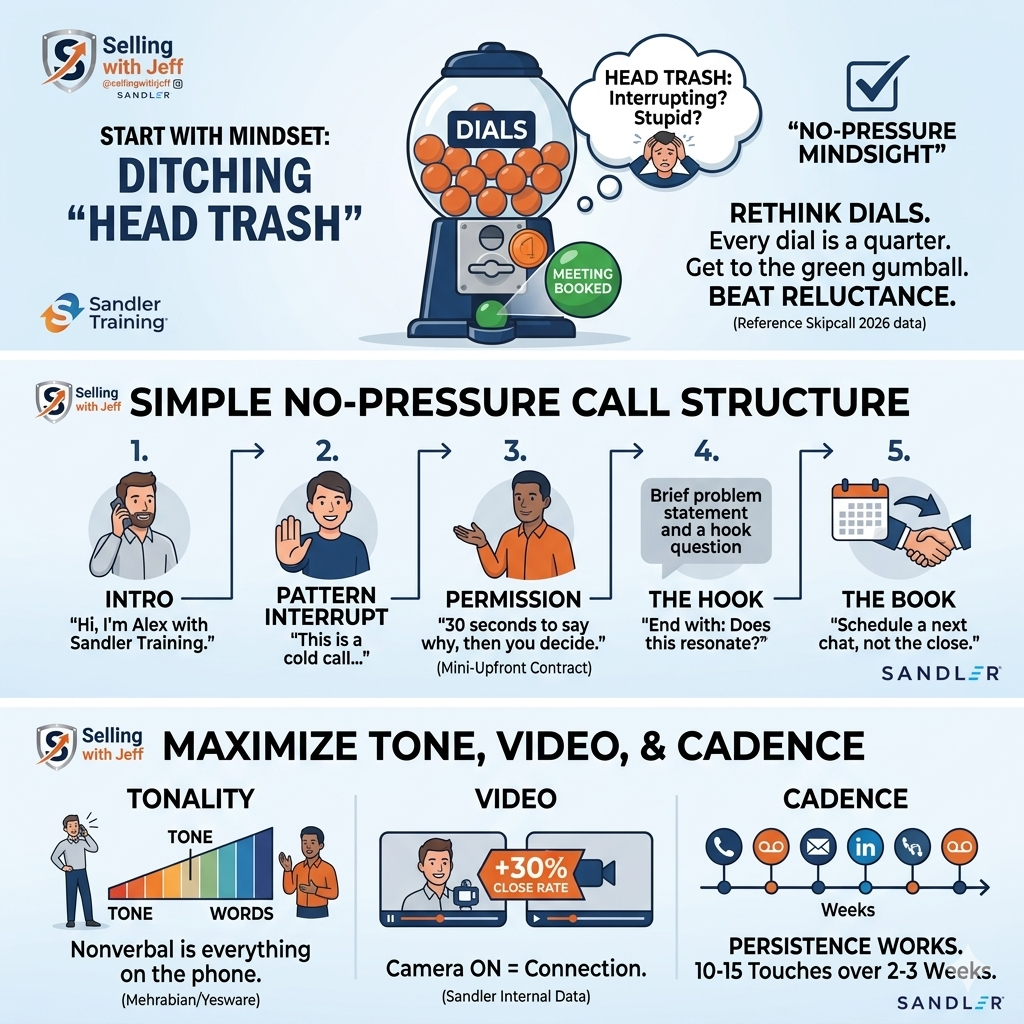
A better approach is to treat prospecting like the gumball machine metaphor from training. Every dial is a quarter. Most gumballs aren’t green (buyers ready to spend), but you can’t get to the green ones without turning the handle over and over. Top B2B benchmarks suggest it often takes 25–35 dials to book a meeting, with elite reps getting there in 12–18, according to 2026 SDR data from Skipcall.
That math is liberating. When you know it may take 30 calls to book one meeting, a “no” or a voicemail stops feeling like failure and starts feeling like progress. Combine that with a simple, repeatable call structure and your reluctance drops. You’re not going into battle; you’re just putting another quarter in the machine.
Use a simple no-pressure call structure that feels natural
A no-pressure prospecting call works because it respects the prospect’s time and psychology. Instead of sounding like a pushy pitch, you sound like a calm professional offering a quick decision: keep talking or hang up.
Here’s a practical structure you can adopt and tailor to your industry:
-
Introduce yourself and your company.
- “Hi Jamie, this is Alex with Sandler Training.”
-
Use a pattern interrupt to disarm them.
- “This is a cold call—I hate making these about as much as you probably hate getting them.”
- Or: “Did I catch you at a bad time?”
-
Ask for permission with a mini upfront contract.
- “Do you mind if I take 30 seconds to tell you why I’m calling, and then you can decide if it makes sense to keep talking?”
-
Deliver a tight 30-second commercial plus a hook question.
- Focus on problems you solve and results you create, not features.
- End with: “Does any of that resonate with you or your team?”
-
If there’s interest, book a meeting—nothing more.
- “The only reason I called was to see if it’s worth a short discovery conversation. Do you have your calendar handy?”
Notice what’s missing: pressure. You’re not trying to qualify budget, timeline, and decision process on the spot. You’re not “handling objections” aggressively. Your entire goal is a scheduled conversation where both sides can slow down and think.
This structure is effective because it lines up with how most people like to buy: low risk, clear control, and honest expectations. In training, reps often report that once they use the opener “this is a cold call,” they hear an actual laugh on the other end. That tiny release of tension buys you 30 more seconds—and 30 seconds is all you need to earn the right to a next step.
Practice this script out loud until you can say it without reading. Then, role-play with your team. In group breakouts, have one person play the decision maker and one the salesperson, and always finish the call by setting an actual time and date. Reps who rehearse like this are far more confident when a real CFO or owner finally picks up.
Maximize tone, video, and cadence so the math works in your favor
Even the best script fails if your voice and behavior work against you. On the phone, tonality in sales does most of the heavy lifting. Communication research based on the Mehrabian model suggests that in face-to-face settings about 55% of impact comes from body language, 38% from tone, and just 7% from the words themselves. On the phone, that nonverbal 55% disappears—leaving tone to carry nearly everything, as highlighted in Yesware’s guide to sales tonality (Yesware).
That’s why simple tactics—standing up, smiling into a mirror, using a relaxed pace—change results. Prospects can’t see you, but they can absolutely hear whether you’re confident, rushed, or checked out. In virtual meetings, cameras matter too. Internal Sandler data shared in workshops shows roughly a 30% higher close rate when the salesperson has their camera on, even if the buyer’s camera stays off. You may feel awkward seeing only yourself on screen, but the extra visual connection still helps.
Cadence is the final lever. Most reps give up after three or four touches, yet it often takes 12+ touches across calls, emails, and social to connect with a decision maker. High-performing teams design a clear 10–15 touch sequence spread over two to three weeks: call + voicemail, follow-up email, LinkedIn message, repeat. Because they follow the plan instead of their mood, they stay in front of prospects long enough for timing to line up.
To pull all this together, schedule dedicated prospecting blocks on your calendar, just like client meetings. During those blocks, run your cadence, follow your call structure, and focus on controllable behaviors: dials made, conversations started, meetings set. When you combine a no-pressure approach with disciplined volume and strong tonality, you stop dreading the phone and start seeing it for what it really is: the fastest, most direct way to new revenue.