Never Negotiate: Six Principles for High‑End Sales

Redefine sales: beliefs, trust, and price objections
Sales negotiation in high-end projects means helping buyers make the best decision for them while confidently protecting your value, not haggling over discounts. When you treat sales as guiding decisions, conversations shift from price resistance and delays to clear choices, mutual fit, and long-term trust.
Most designers, builders, and furniture specialists never chose a “sales career.” They see themselves as professionals, not closers. That’s exactly why this mindset shift matters. If you define sales as convincing people or pushing them, you will either avoid the hard conversations or overcompensate with price cuts. Both erode trust.
A better definition is simple: sales is helping people make the best decision for themselves, even if that decision is “no.” That means understanding their beliefs, not just their budget. When a prospect says, “You’re too expensive,” the surface issue is price, but the deeper issue is what they believe about your value, risk, and alternatives.
Think of the consulting firm that spent 4–5 weeks and $30,000–$40,000 per proposal and won only 1 in 10. On paper, the “problem” was close rate. In reality, the belief problem was bigger: they didn’t trust that a higher investment in a better sales process would be paid back. Until that belief changed, every fee looked too high.
Trust changes both time and price. Stephen M. R. Covey, in his work on trust, shows that when trust is high, decisions happen faster and negotiation pressure drops; when trust is low, cycles drag out and buyers push harder on price. You already see this in referrals: a neighbor raves about your work, and suddenly your quote feels fair before you’ve opened your laptop.
Your job is to earn that trust on purpose. That starts with how you prepare for every meeting: clarify the purpose, define the desired outcome, guess their pains, and consider their style. Then in the conversation, you uncover not just the problem (“We hate our kitchen”) but the reasons and impacts (“We entertain a lot and feel embarrassed,” “We’re worried about over-investing before a move”). That emotional clarity is what later gives you leverage when price pressure shows up.
Six practical negotiation principles every seller can use
The most effective negotiators don’t wait until the end of a deal to negotiate; they bake six core principles into every step of their sales process. These principles reduce price pressure, shorten sales cycles, and help you protect margin without feeling adversarial or “salesy.”
1. Price is never the real issue
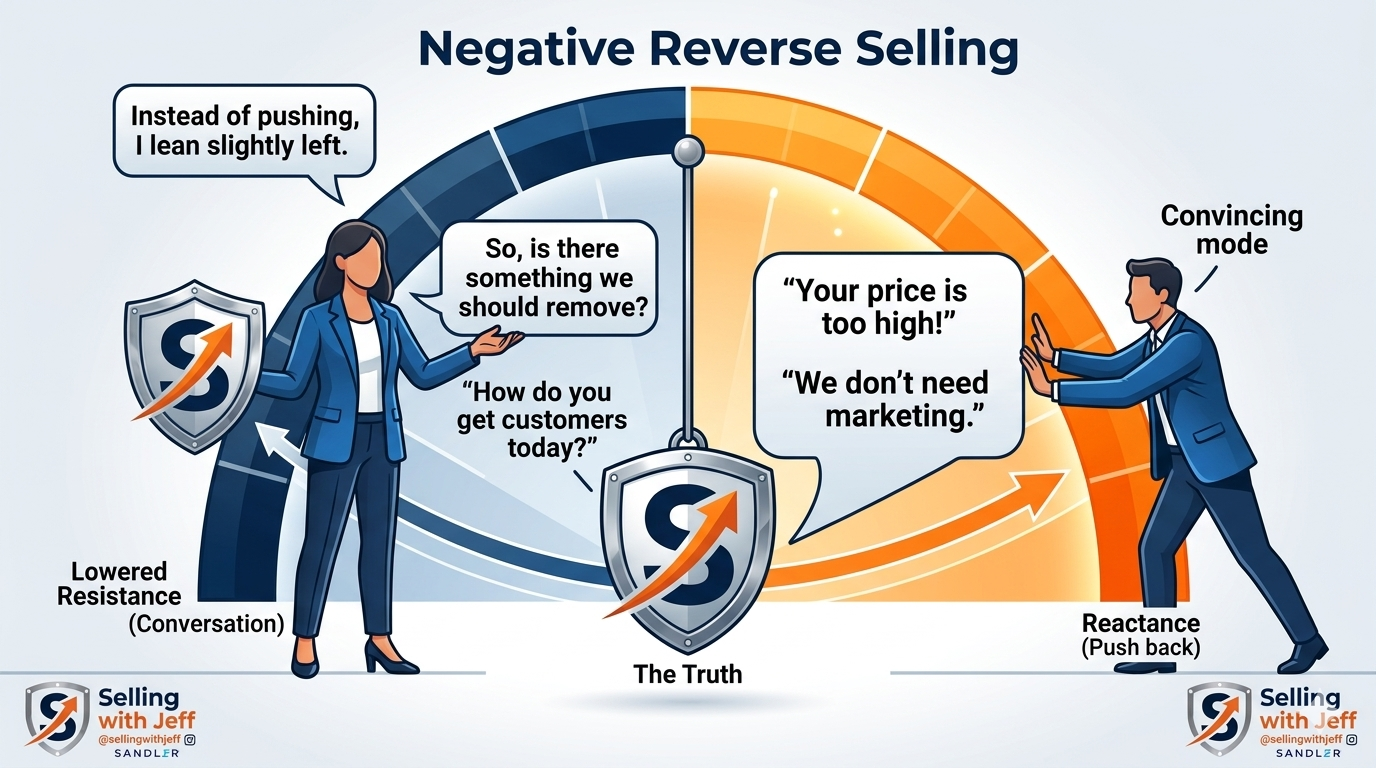
When buyers say, “You’re too expensive,” it usually means, “I don’t yet believe the value, or I fear making the wrong decision.” In a Sandler-style approach, selling is a battle of beliefs: either they buy your belief in your value, or you silently buy their belief that cheaper is safer.
Two quick examples:
- At a trade show, sellers insisted buyers always chose on price. A corporate buyer eventually admitted, “The reason we let them think that is because it gives us leverage.” She had shifted to prioritizing reliability after cheap options kept burning her.
- In your world, a prospect might tell you another builder is “aggressive on price.” That doesn’t automatically mean they trust that builder more. It might just mean no one has yet connected cost to risk, rework, delays, or daily experience living in the finished space.
Instead of arguing price, explore beliefs. Use questions like, “Help me understand—when you say it feels high, what are you comparing it to?” or, “What would have to be true for this to clearly feel worth it?” You’re not defending a number; you’re uncovering what value and safety look like for them.
2. Show your willingness to walk away
Confidence is a negotiation tool. When you gently signal that you’re open to “no,” you remove pressure and gain credibility. In the Sandler system, this shows up in the upfront contract: agreeing together on the purpose of the meeting, possible outcomes, and next steps.
For example: “By the end of our time, one of a couple things can happen. You might decide this isn’t the right fit—totally fine if you tell me that. It’s also possible I’ll realize we’re not the best partner for what you need. Or we may both feel there’s a fit and talk about next steps. Are you comfortable with that?”
You’re not bluffing. Sometimes the right move is to walk away from a purely price-driven buyer. But you say it with warmth and respect, not ego. That posture alone often reduces posturing on their side.
3. Build leverage through pain, not pressure
Leverage doesn’t mean tricking people; it means understanding what truly matters to them so they’re motivated to act. Sandler breaks “pain” into three parts: problem, reasons, and impact. Surface problems live at the top of the funnel (“We don’t like our layout”). Real leverage lives in the middle and bottom (“We avoid hosting holidays,” “This house doesn’t reflect who we are anymore”).
Research on decision-making consistently shows people move faster to avoid loss than to gain a generic improvement. When a homeowner connects a tired kitchen to feeling embarrassed with friends, or a poor layout to safety issues for aging parents, they’re no longer shopping only for cabinets—they’re investing in a different life. That emotional connection gives you leverage when they later say, “We need to think about it,” or, “Can you just email a quote?”
4. No unilateral concessions
A unilateral concession is any “give” where you get nothing in return—price, scope, timeline, or even how proposals are handled. If a CEO says, “Email me the proposal and I’ll get back to you,” and you agree with no conditions, you’ve just made a concession: more work, less control.
Instead, pair every give with a get that serves them and protects you: “I’m happy to put that together. Since you’ll likely have questions, can we schedule 30 minutes to review it live so we can tailor it and make sure it’s a fit?” You’re not being difficult; you’re guiding an efficient decision process.
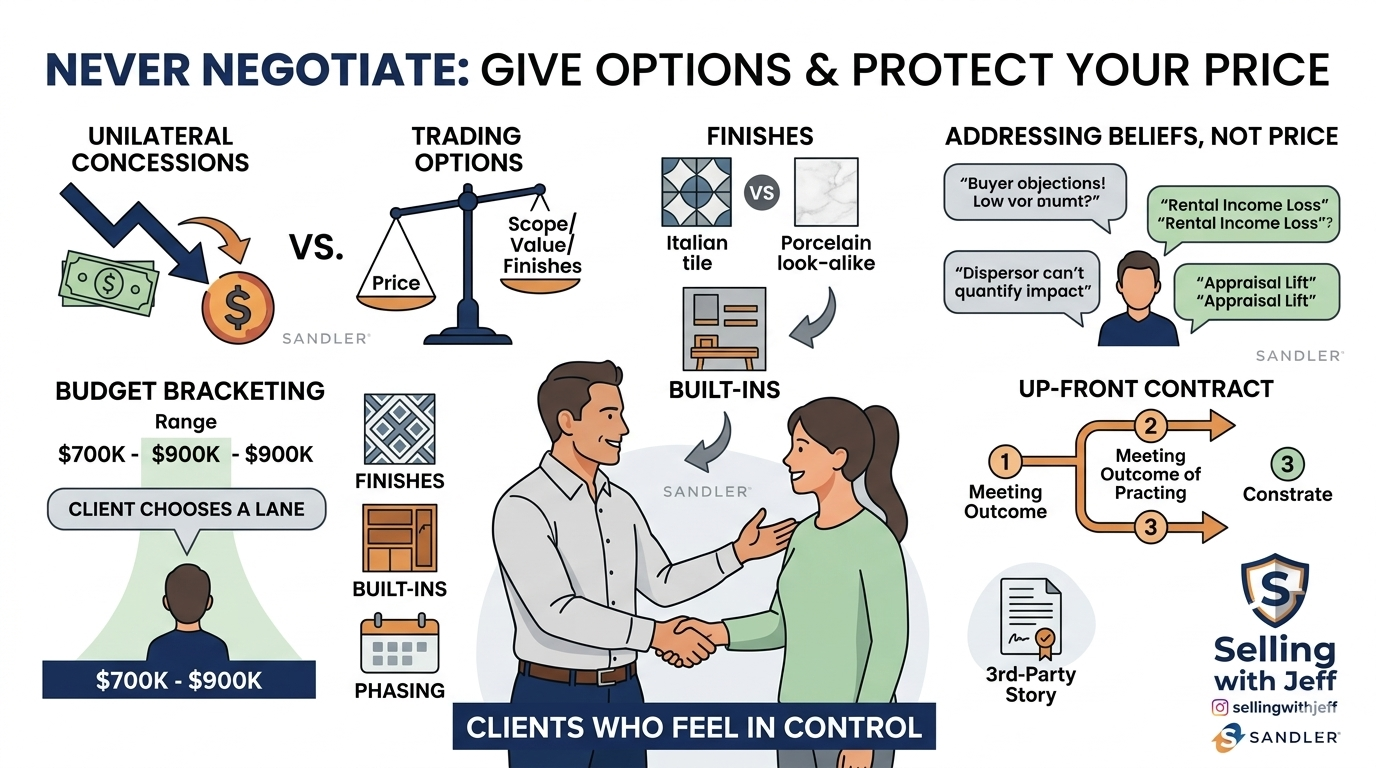
Same with scope and price. If a client asks for a discount, you can say, “We can definitely look at reducing cost. That will mean adjusting the scope or specification. Would you rather look at alternative materials, smaller square footage, or phasing the work?” Price only moves when something else moves with it.
5. Never negotiate—only give options
Negotiating feels like arm-wrestling; options feel like collaboration. Instead of serving a single “take-it-or-leave-it” number, you frame structured choices, each with clear trade-offs.
Think of three tiers:
- Value-conscious: meets the core needs with thoughtful compromises
- Preferred: reflects what most clients in their situation choose
- All-in: maximizes design, performance, or longevity
One experienced Sandler trainer was once asked to bring in a superstar colleague for a keynote. The star’s fee was high, and he knew the client would push back. So he presented three options: the superstar at the top tier, mid-tier seasoned trainers, and newer consultants at a lower rate. The client chose the mid-tier—him—without any haggling.
You can do the same on a remodel: “We can approach this at three levels. Option A keeps the footprint and uses good-quality finishes. Option B upgrades appliances and cabinetry with more customization. Option C gives you full custom millwork and structural changes. Based on what you’ve shared so far, which range feels like the right starting point?” You haven’t discounted. You’ve helped them choose.
6. Don’t get emotionally attached to the outcome
Care deeply about the process and the person; stay neutral about “yes” or “no.” When you emotionally need the deal, you over-explain, over-discount, and accept fuzzy next steps like, “We’ll get back to you.” When you’re grounded—“I want the business, but I don’t need this specific project”—you can ask the real questions.
For instance, the biggest competitor in most sales is not another firm; it’s indecision. People hesitate not because they hate making decisions, but because they fear making the wrong one. Hearing “We need to think about it,” you might say, “Totally fair. Most people in your position are worried about one of three things: cost overruns, delays, or the project not turning out as promised. Which of those is most on your mind right now?” Now you can address the real barrier instead of chasing them for weeks.
Applying these tools in design-build, interiors, and retail
High-end builders, designers, and furniture retailers can apply these six principles by building a simple, repeatable meeting rhythm that turns every conversation into guided decision-making. The goal is consistency: everyone on the team uses the same structure, even if their personal style is different.
Start with a quick “two-minute drill” before each client interaction:
- Clarify the purpose: discovery, concept review, scope alignment, or decision.
- Define the desired outcome: a clear yes/no, agreement on next step, or a narrowed set of options.
- Guess their pains: budget anxiety, timeline pressure, fear of disruption, or previous bad experiences.
- Consider their style: detail-oriented, big-picture, fast-deciding, or relationship-driven.
Walk into the meeting ready to ask, not tell. Use the pain puzzle: problem, reasons, impact. If a furniture client says, “We just need a new sofa,” you might explore: “What’s not working with the current one?” “How long has that been an issue?” “How does that affect how you use the room?” You may discover the real problem is entertaining a group of eight comfortably. That insight shapes your recommendations and strengthens your leverage when a cheaper, smaller piece elsewhere tempts them.
In design-build, apply “no unilateral concessions” at key points:
- When asked for “just a ballpark,” tie it to a live conversation and a range, not a single hard quote.
- When someone wants detailed plans without a commitment, trade that for a design retainer or a scheduled review.
- When price pressure appears, shift to options: adjust finishes, phasing, or scope instead of cutting margin.
In interiors and retail, “never negotiate, only give options” might look like two curated schemes, not five mood boards. Research on choice overload shows that too many options stall decisions; two to three thoughtful options create momentum. One top shoe salesperson summarized this with “two, not three”: every time a customer wanted to see a third pair, he removed one from the table so they were always deciding between two. You can do the same with sofas, fabrics, or tile: “Between these two, which feels more like ‘you’?”
Finally, reinforce a shared belief across your team: you are not there to push product—you are there to guide high-stakes decisions. When everyone, from project managers to showroom staff, sees sales as “helping people make the best decision for them,” they naturally ask better questions, tell more relevant third-party stories, and feel more confident walking away from bad-fit deals.
Over time, that discipline compounds. You’ll see fewer ghosted proposals, less frantic discounting, and more of the kind of clients who walk into their finished home, smile, and say, “This is exactly what we pictured”—because you helped them paint that picture from the very first conversation.