
Handle Wandering Prospects Without Losing the Sale
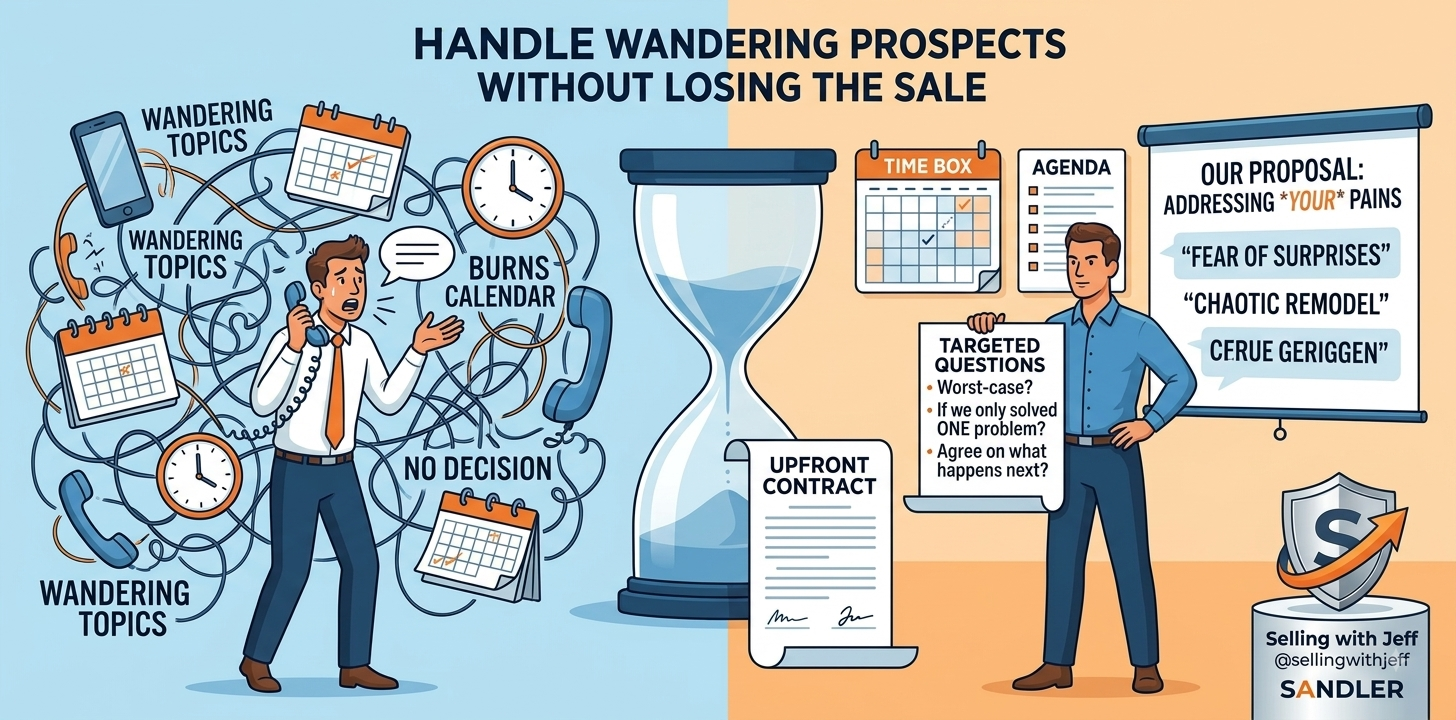
Set a Clear Time Box So Prospects Stay Focused
A wandering prospect is a buyer who talks freely, jumps between topics, and burns your calendar without moving the deal forward. The simplest way to keep them focused is to set a short, clear time limit up front, then agree on what you’ll cover and what decision you’ll reach by the end.
When someone calls you out of the blue, it’s tempting to “be nice” and let them talk as long as they want. That’s how an innocent question turns into a 60‑minute monologue with no clear next step. Instead, borrow the move from the transcript: “I’m glad you called. I’ve got about 10–15 minutes right now—can we use that to see if this is a fit and agree on what should happen next?”
Research on medical consultations shows that brief, structured openings lead to higher trust and better outcomes than long, unstructured chats. Sales is no different. As Sandler often teaches in their material on upfront contracts, a quick agreement about time, agenda, and outcome at the start of the call stops meandering before it starts. You can adapt that by:
- Stating your time limit (“I’ve got 15 minutes for this first conversation.”)
- Asking what they most want to cover.
- Sharing what you need to cover (fit, budget range, timing).
- Agreeing on a possible outcome (schedule a deeper meeting, or decide it’s not a fit).
Counterintuitively, short calls usually feel more respectful to busy, type‑A buyers. You’re showing you value their time and your own.
Use Questions to Gently Interrupt and Redirect
Once a talkative prospect gets rolling, you can’t just sit and listen forever. At some point, your job is to guide—not just absorb. The key is to interrupt with questions that feel helpful and on‑topic, rather than critical or controlling.
Notice the coaching in the transcript: don’t wait 7 minutes while they wander down a rabbit hole. The moment they pause to breathe, step in with a calm, confident line like, “Let me ask you a question,” and then go back to the track you need: pain, budget, decision process, or timing. You’re not asking permission (“Can I interrupt?”); you’re taking gentle control.
This works best when you’ve done real pre‑call planning. As one Sandler article on questioning points out, most reps over‑prepare slides and under‑prepare questions. That’s why, in the moment, their mind goes blank. Before every call, write down a short list of must‑ask questions you can grab when the conversation drifts.
Examples:
- “You mentioned you’re worried about surprises—what’s the worst‑case scenario in your mind?”
- “You’ve shared a lot about the project; can we zoom in on what has to be true for this to feel like a win?”
- “If we only solved one problem this quarter, which one should it be?”
These questions respect the prospect’s need to talk while steering them back to the information you actually need to qualify and help.
Build Presentations Around Their Pain, Not Your Slides
The presentation example in the transcript shows a powerful shift: instead of leading with company history or process slides, the builder opened with the client’s own words about their fears and goals, then explained how the proposal answered each one.
That’s a simple formula you can reuse. First, record or carefully note your discovery conversations. Then, before you present, pull 2–3 exact quotes that capture what matters most to them—cost certainty, timeline, communication, quality, whatever. Put each quote on its own slide or section, and right underneath it, spell out what you’re doing to address it.
For example:
- Client quote: “My biggest fear is a big financial surprise.”
- Your response: how you build conservative numbers, what contingencies you include, and when you’ll flag overages.
- Client quote: “We can’t live through another chaotic remodel.”
- Your response: your communication rhythm, site rules, and how you handle change orders.
Sandler’s content on presentations emphasizes this “pain‑first” approach for a reason: people don’t argue with their own data. When they see their language reflected back, they feel heard—and they connect the dots between your price and the problems you’re solving. It also makes value‑engineering conversations healthier; instead of reflexively cutting your margin, you can ask, “Which of these pains are you comfortable leaving unsolved if we reduce scope?”
Finish With Firm Next Steps Instead of ‘Think It Over’
Most wandering prospects stay in your world as wandering opportunities: lots of talk, no decision. The cure is to finish every call—especially presentations—with a clear fork in the road and a concrete next appointment, not a vague “We’ll get back to you.”
In the transcript, the coach pushes for three real outcomes: yes, no, or a scheduled follow‑up after the couple has talked. A “think it over” without a date and time is usually a slow no. That’s why Sandler’s work on upfront contracts and post‑sell is so insistent about agreeing on the next step while you’re still together.
Here’s a simple pattern:
- Before you present price: “At the end of this, there are a few fair outcomes: you’re a yes, you’re a no, or you need to talk privately and we set a time to reconnect. Which feels right?”
- If they need to think: “Great. When should we put 15 minutes on the calendar to compare notes?”
- Then add a safety valve: “If something comes up and you can’t make that time, what would you like me to do—call, email, or text?”
Analysis from platforms like Gong, as cited in Sandler’s own writing, shows that deals with clearly defined next steps are far more likely to close. You stop chasing, the prospect knows what happens when, and your pipeline is built on real movement instead of wishful thinking.