Fix Sales Meetings with Upfront Contracts

Why your sales meetings go sideways without an upfront contract
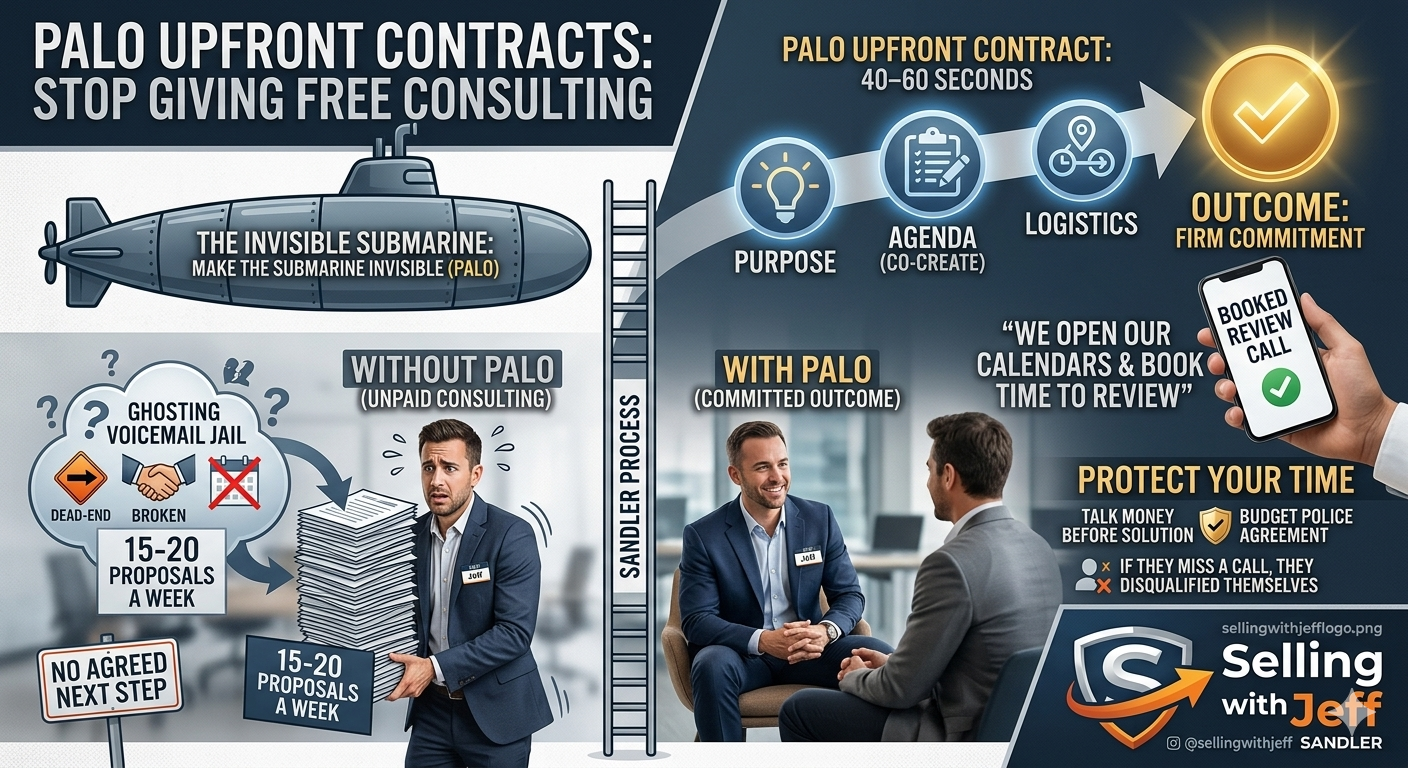
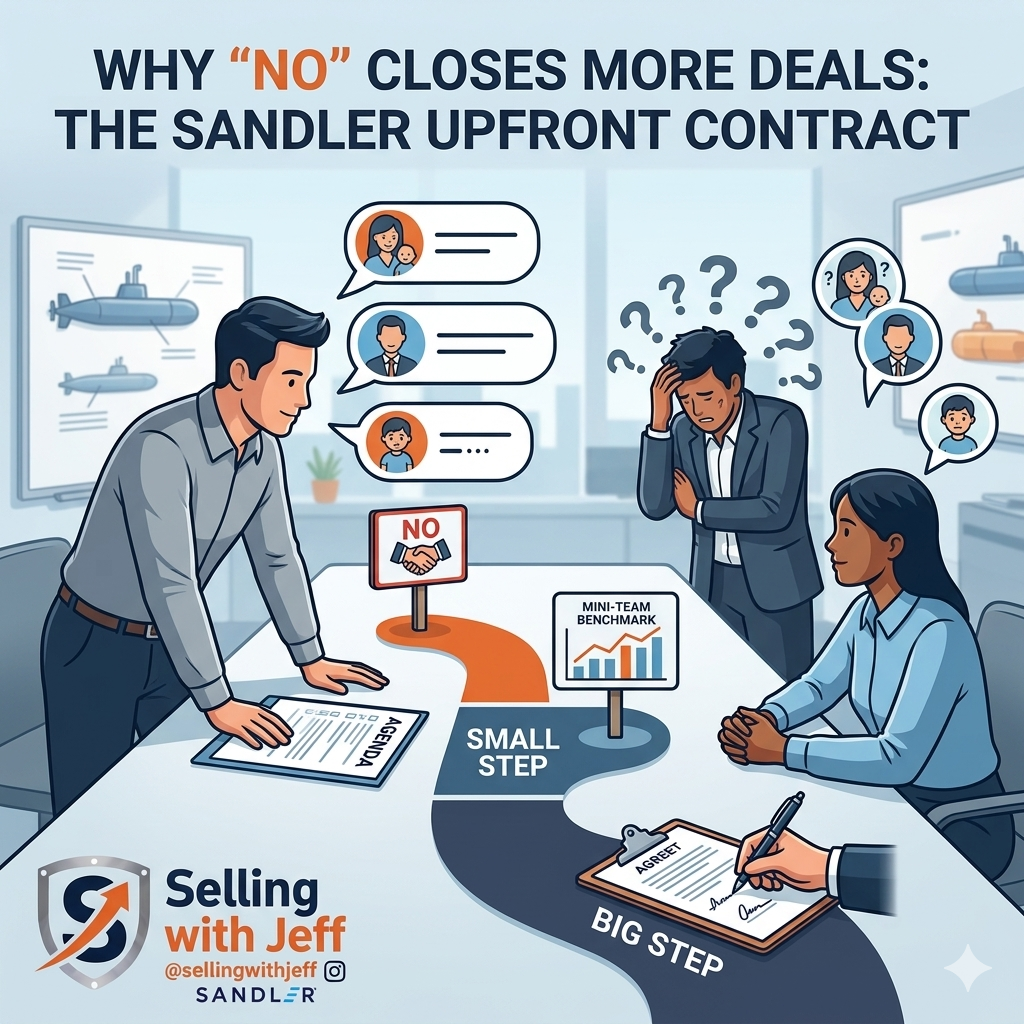
A Sandler upfront contract is a short, explicit agreement at the start of a meeting about time, agenda, outcomes, and next steps. Done well in 40–60 words, it prevents surprises, keeps both sides aligned, and makes it much easier to uncover real business pain instead of jumping straight to pricing.
Think about the situation in the source material: the rep “instigated” the meeting, mentioned a bunch of products, and assumed the prospect understood the plan. The prospect showed up expecting a price conversation. Halfway through, they said, “I didn’t know we were gonna go over this and this and that. I thought you were gonna share prices.” That is the classic symptom of no upfront contract.
When there’s no shared agreement, three problems show up:
- Mismatched expectations. The prospect wants pricing; you want discovery. Neither is wrong, but without alignment, both feel frustrated and blindsided.
- Clammed‑up prospects. When people don’t know where a conversation is going, they default to short, safe answers. You see this in the transcript: the buyer gives almost nothing, and the rep doesn’t feel permission to probe.
- Meandering meetings. Without a clear path, reps bounce between features, demos, and random questions. The coach in the transcript put it bluntly: “Meetings that begin well tend to run well and end well. When we don’t know where we’re going, we meander all over the place.”
Research on top‑performing sales teams backs this up. Conversation‑intelligence tools regularly find that high performers structure calls more consistently and get prospects speaking 60–70% of the time, while average reps sit closer to a 50/50 split or worse. That mirrors Sandler’s 70/30 guideline: the buyer should do most of the talking.
An upfront contract is the simple tool that creates this structure. You confirm time, align on agenda, agree you can both say “no,” and define exactly what “yes” looks like (for example, a deeper discovery call, a survey, or bringing in other stakeholders). Once that’s in place, moving into pain, budget, and decision becomes natural instead of pushy.
How to use a Sandler upfront contract and 30-second commercial
A strong upfront contract has five elements: time, agenda (theirs and yours), process, mutual “no,” and a clear “yes.” In practice, you don’t recite a script; you hit each element in plain language that fits you.
Here is a 40–60 word, direct‑answer version that keeps the upfront contract front and center:
“Thanks for making the time. We scheduled 30 minutes; does that still work? My goal is to ask some questions about what’s working and what isn’t, then share whether we can help. If it’s not a fit, can we both be honest and end it there? If it is, we’ll map next steps together.”
Notice what this does:
- Confirms time and gives the prospect a chance to adjust.
- Sets a simple agenda: your questions, then a brief view of how you might help.
- Normalizes a clean “no”, which lowers pressure and actually makes honesty more likely.
- Hints at a specific “yes” (mapping next steps) without locking you into a demo or proposal too early.
In the transcript, the coach pushes reps to avoid vague endings like “we’ll figure out what we do next.” Instead, they suggest something concrete, such as: “If we both think there might be something here, the next step is a 45‑minute meeting where we prioritize your top two or three issues and I share a draft strategy. Does that sound fair?”
Once you have that structure in place, the next challenge is when the prospect still won’t open up. The coach’s advice is explicit: when you’re “not getting enough pain, 30‑second commercial.” That 30‑second commercial is a short story about the problems you solve, framed in the buyer’s world, that invites them to self‑identify.
A simple 30‑second commercial structure:
- Who you work with: “I work with COOs at mid‑market manufacturers…”
- Three buckets of pain: “…who are frustrated with slow months, worried about hitting revenue targets, or tired of spending on ads that don’t generate qualified leads.”
- Your outcome: “We help them turn that into a steady pipeline of deals they can forecast with confidence.”
- Soft question: “Curious which of those sounds closest to your world right now?”
In the class, the coach repeats it like a mantra: “When you’re not getting enough pain, 30‑second commercial. Burn that into your brain.” The reason is straightforward: you stop pushing and instead give the buyer language to describe their own situation. As soon as they pick a “bucket,” you go right into “Tell me more,” “Can you give me an example?” and “What happens if this doesn’t change?”—the core of the pain funnel.
This pairing—upfront contract to set expectations, 30‑second commercial to surface pain when the buyer is clammed up—turns an awkward, one‑sided meeting into a focused, two‑way diagnosis.
Real-world examples: fixing clammed-up prospects and budget talks
The transcript is full of real situations your team will recognize: a prospect clamming up, reps skimming over budget, and people struggling to make the language feel like their own. Turning those into clear patterns and responses makes them coachable.
Example 1: The clammed-up prospect who just wants price.
In the story, the rep scheduled a meeting around “a bunch of products.” Mid‑way through, the buyer says, “I thought you were gonna share prices.” There was no real upfront contract, just a loose sense that “we’ll go over some products.” The fix would look like this at the start:
“Before we get into products or pricing, we’ve got 30 minutes. Does that timing still work? If so, how about we spend the first part understanding what’s driving the interest in changing anything at all, then I can walk you through only the options that are relevant. If it’s clear we can’t help, are you okay if we just say so and wrap up?”
Halfway through, when the buyer still isn’t talking, the coach suggests combining negative reverse with a 30‑second commercial: “John, I’m struggling a bit. I don’t usually run meetings where I just puke information; I aim for a dialogue. Without some context from you, there are 50 different things we could talk about, and I don’t want to waste your time. Is it possible this just isn’t a big enough issue to dig into?” Then, if they still don’t open up: “Can I share a quick example of the kinds of problems we typically solve, and you can tell me if any of it sounds close?” That’s your cue for the 30‑second commercial.
Example 2: Budget discomfort—technical vs. conceptual.
When Paige mentions struggling to talk about budget, the coach introduces a powerful distinction: technical versus conceptual problems.
- A technical problem means you don’t yet have words you’re comfortable with. The fix is specific talk tracks. For example: “We’ve identified a $300,000 annual problem. Do you have any money set aside for a project like this if you find a partner you trust? If not, could you share a comfortable range, low to high?”
- A conceptual problem means you were raised to believe “it’s impolite to talk about money,” and now your role requires it. There’s no clever workaround; you have to do it uncomfortable until it becomes comfortable.
The group also reframes budget as investment instead of cost: call the competitor’s spend “cost” or “bill,” and your own pricing an “investment.” One rep even tests ROI expectations early: “We’ve identified roughly a $5M revenue gap. When your company makes an investment like this, what kind of ROI do you typically look for?” That question quietly anchors the conversation around returns, not just price.
When you combine an upfront contract, a practiced 30‑second commercial, and clear budget language, calls stop feeling random. You know how to open, how to restart when a buyer clams up, and how to move naturally into money without awkwardness. Over time, that structure raises close rates and shortens cycles, because you qualify faster and stop spending full meetings with people who were never going to buy in the first place.