PALO Upfront Contracts: Stop Giving Free Consulting
What PALO really means in the Sandler submarine
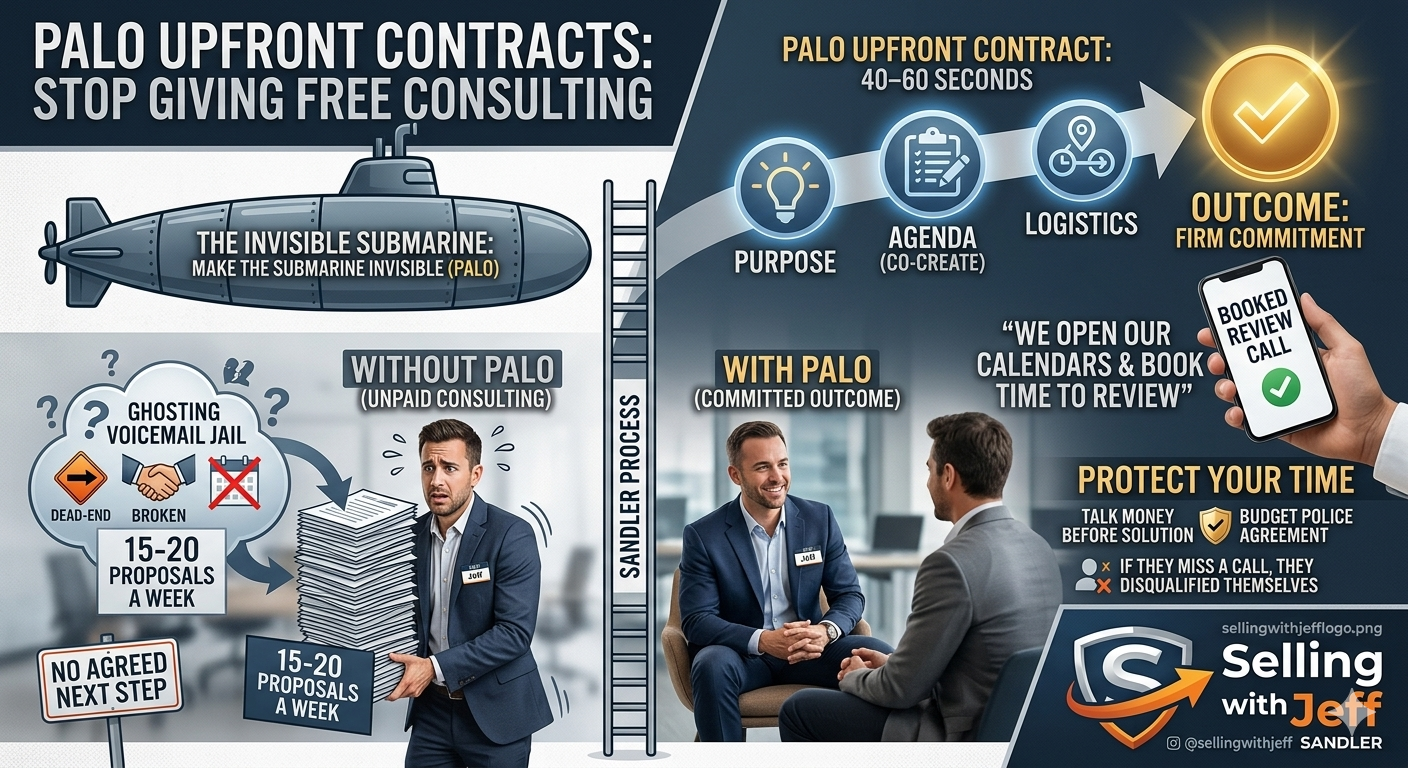
A PALO upfront contract is a short conversation at the start of a meeting where you and the prospect agree on purpose, agenda, logistics, and outcome. In 40–60 seconds, you set adult-to-adult ground rules so you stop guessing, stop chasing, and know exactly what will happen after the call.
In Sandler language, PALO is how you make the “submarine” invisible. You are not saying, “Thanks for being here, today we’ll walk through my process.” Instead, you sound casual and human: lots of questions, no speech. For example: “Here’s what I thought we’d cover—what did you want to make sure we hit?” This keeps control while feeling relaxed, not scripted.
When you add the O for Outcome, everything changes. You are no longer “seeing how it goes.” You’re agreeing up front whether there will be a decision, a scheduled next step, or a clear “no.” That one change is why reps who use PALO send fewer proposals and close at a much higher rate.
Why proposals fail without a clear outcome agreement
Most salespeople ask, “What’s the best way to follow up on all these proposals?” That question itself is a red flag. If you’re sending 15–20 proposals a week and then wondering how to get people back, the real problem is that you sent proposals without an agreed next step.
Without a strong Outcome, proposals turn into unpaid consulting. You’ve invested drive time, diagnosis, and expertise—and handed the prospect a detailed plan with no commitment. That’s why Sandler teaches: never give a proposal if you don’t know what will happen next. Once it’s in their inbox, you lose leverage and usually land in voicemail jail.
A PALO-style outcome sounds like: “If it makes sense for me to put a proposal together, could we open our calendars before I leave and book a specific time to review it together?” That simple sentence shifts you from “hoping for a callback” to a firm commitment you can test for honesty and reliability.
Running a home-services sales call using PALO
Home-services and handyman reps often think PALO doesn’t fit because they “just go measure and email the estimate.” That’s exactly how you end up driving around burning $4-a-gallon gas for people who were never qualified buyers in the first place.
A better opening in the driveway sounds like: “Here’s what I thought we’d do: I’ll ask a few questions about the project and what’s bothering you most, I’ll take measurements, and if it looks like we’re a good fit, I’ll work up a proposal back at the office. Before I leave, can we find a time on your calendar to go over it together by phone?”
Notice three moves: you set the Purpose (why you’re there), co-create the Agenda, confirm Logistics (do they have the time, will they be present), and lock in the Outcome (a specific review call). If they push back—“Just email it”—you’ve just learned a lot about their seriousness, before investing more time.
Protecting your time with budget, follow-up, and qualification
PALO only works if you connect it to the rest of the Sandler submarine: pain, budget, decision, fulfillment, post-sell. After you uncover pain, you must talk money before you start designing solutions. The goal is not to guess a price; it’s to find out what they are willing and able to invest.
One practical move is setting a “budget police” agreement: “How do you want me to handle your budget—as a strict guardrail we never cross, or is it okay if I show you options you may love that cost more?” That conversation gives you permission to recommend upgrades without betraying trust.
Finally, protect your calendar with a closing PALO. Before you write a proposal, agree on the follow-up call and the decision they’ll be ready to make: buy, say no, or choose a clear next step. If they miss that call and don’t apologize, they’ve disqualified themselves. You are evaluating them just as carefully as they are evaluating you.