
Consultative Selling for High-End Home Remodel Projects
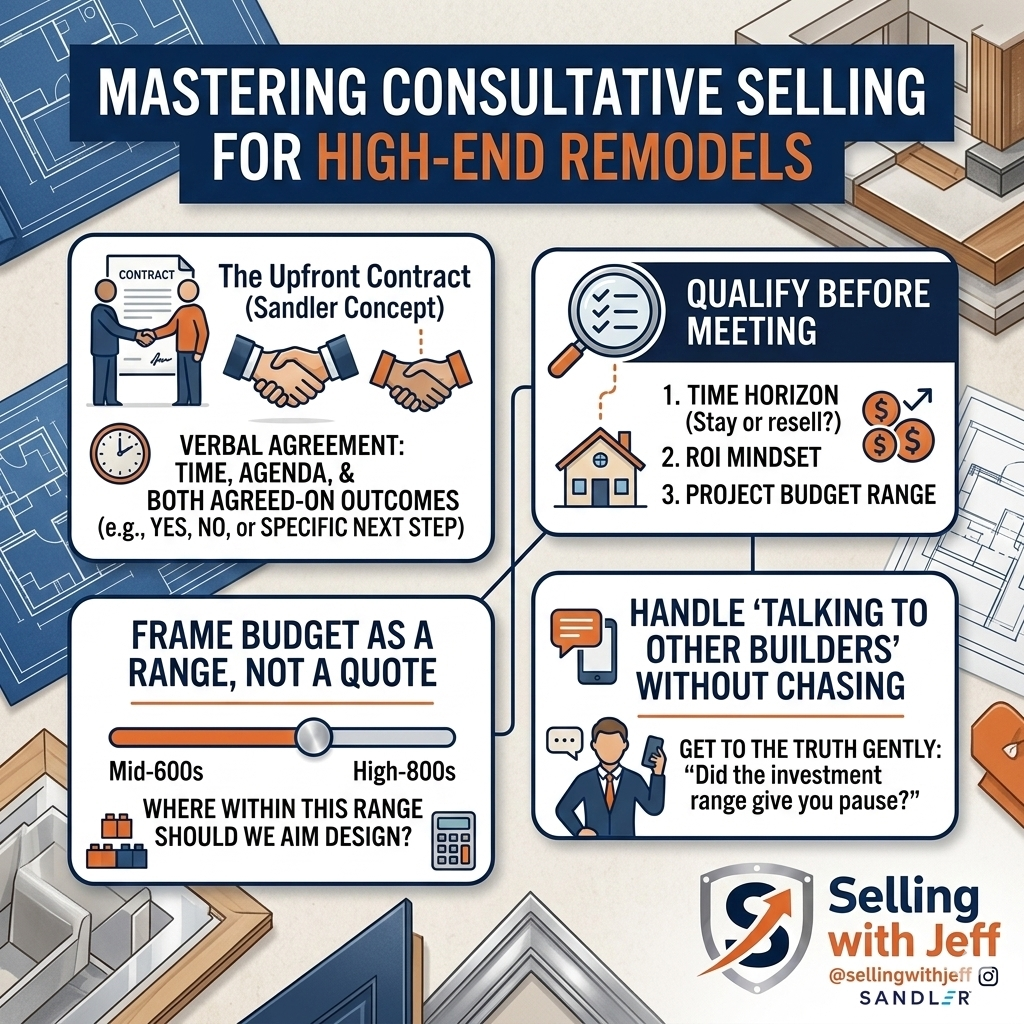
Use upfront contracts to prevent no-shows and vague "think it over" stalls
In consultative selling for home remodels, an upfront contract is a simple verbal agreement on time, agenda, and possible outcomes before you dive into design or pricing. You clearly define what you’ll cover, what the homeowner wants to achieve, and whether the meeting ends in a yes, a no, or a scheduled next step.
Borrow the Sandler idea of treating the homeowner as an equal partner in the process. At the start of a two-hour in-home consult, ask, “When we’re done, what do you want to have decided?” Then share your agenda: walk the house, discuss scope and comfort range for investment, and outline how design and pricing work.
Be explicit about outcomes: “By the end, we’ll either agree this isn’t a fit and shake hands, or we’ll set a next meeting at our office to talk through a design agreement and an opinion of investment. If we’re not ready for either, let’s call it a no for now so we don’t drag this out.” That clarity alone prevents many last‑minute texts canceling meetings.
Qualify for fit: time horizon, ROI mindset, and project budget range
Consultative sellers know not every homeowner is a good client. Before you invest four hours in drive time and a two-hour consult, qualify for three things: how long they plan to stay, how they think about ROI, and whether their comfort range matches your typical project size.
On the discovery call, ask, “How long do you see yourself in this home?” If they say two to five years and keep circling back to resale value, flag it. Your best clients usually value their time and quality of life over squeezing every dollar back out when they sell.
Next, frame budget as a range, not a quote: “For projects like you’re describing in this neighborhood, we’ve seen investments from the mid‑600s to the high‑800s. Within that range, where would you like us to aim design and selections?” Getting their number on the table matters. In the story above, a $700k opinion of investment felt like your number, not his, which made it easy for him to step back and shop.
Handle "I’m talking to other builders" without chasing or discounting
When a homeowner texts, “I’m going to chat with a few more builders,” it’s tempting to chase, discount, or push for a fast reschedule. A better consultative move is to get to the truth, without pressure, and protect your position as trusted advisor.
Call if you can. If they don’t pick up, text: “Got your note—do you have five minutes for a quick call today or tomorrow?” On the call, use a gentle negative reverse: “My guess is that the investment range we discussed gave you pause. Is that what changed your mind about our next meeting?” Then be quiet.
If they confirm budget is the issue, acknowledge it and ask permission to make a suggestion: “I don’t want to get in the way of you talking to other firms. May I make a suggestion?” Then offer a path that keeps you in the conversation—like a short follow‑up meeting to help them compare apples to apples between true design‑build partners and low‑price contractors.
Protect your time with better first-call questions and clear next steps
When consultants are carrying the workload of three people, every wasted consult hurts. Tightening the first phone call and sharpening next steps can save dozens of hours a month without hurting close rates.
Have your intake or sales coordinator ask a few strategic filters before a consultant is assigned: “Is this your forever home or a two‑to‑five‑year house?”, “What makes now the right time, after living with this issue for years?”, and “For this kind of whole‑home update, are you thinking more three‑star, four‑star, or five‑star in terms of finishes and investment?” The answers tell you whether this is likely to be a $300k kitchen or a $700k‑plus whole‑home project—or a mismatch altogether.
Then, when a consultant sets the in‑home meeting, use a stronger upfront contract that includes how you’ll both decide on next steps. Offer a big step (signing a design agreement tied to their number) and a small step (coming to your office for a deeper budget and scope session). If, at the end, they want to “think about it,” you can confidently say, “We agreed we’d either pick one of these next steps or call it a no for now. Which feels right?” That discipline shortens cycles and frees capacity for better‑fit clients.