Budget, Pain, and PALO in Remodeling Sales
Why Most Remodelers Lose Control When Budget Comes Up
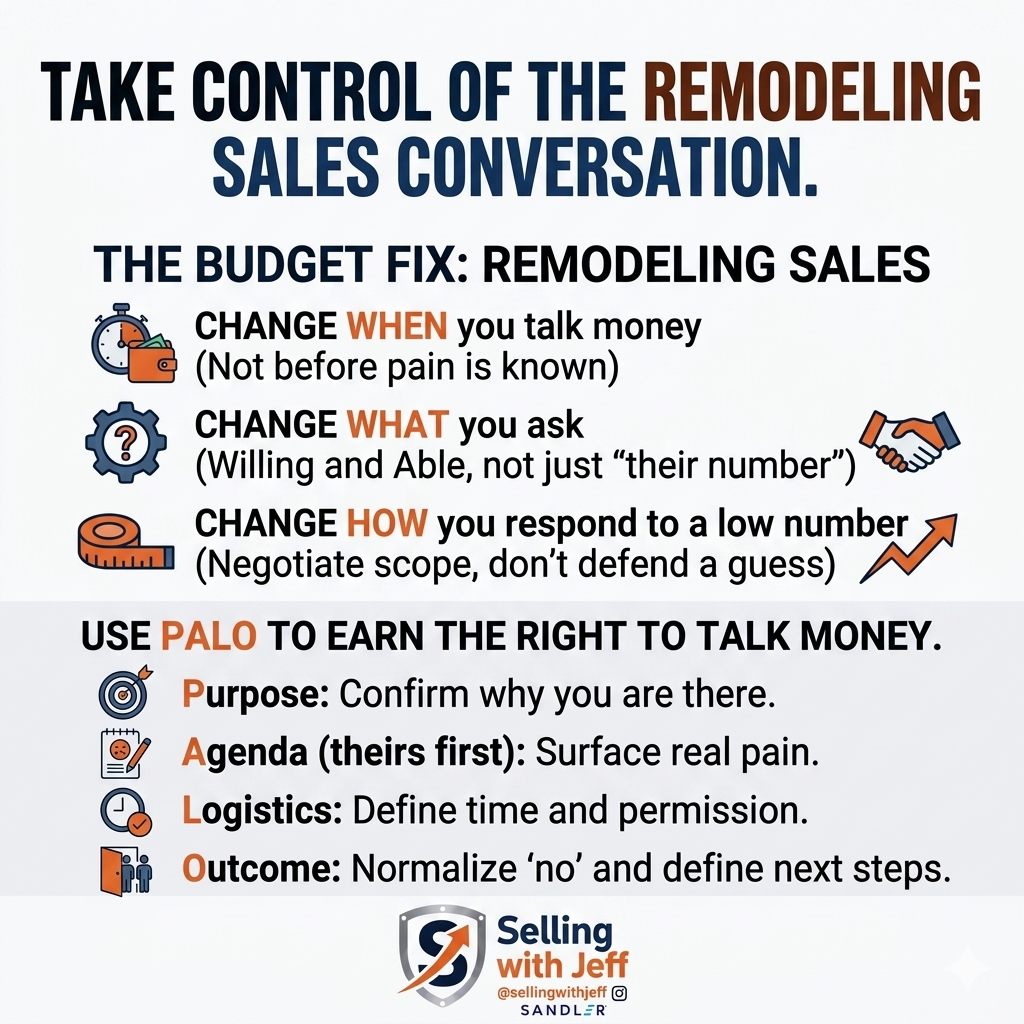
A remodeling sales budget conversation goes sideways when you treat it as “giving a price” instead of learning what the client is willing and able to spend. The fix is to change when you talk about money, what you ask, and how you respond when their number is low.
Think about the stories from the training room: homeowners who start with a “500 square foot addition for $500,000,” disappear into design, and come back with “1,000 square feet and a pool for the same $500,000.” Or the client who insists they can build a complex project for the price they saw on a TV show. None of that is really about square footage or fixtures; it’s about who controls the sales conversation.
Most remodelers were taught to respond to, “Can you do this for X?” with some version of, “It will probably cost about…” That’s where you dig the hole. You give a number before you understand pain, priorities, or decision-making. Months later, you’re back in their kitchen explaining why your actual estimate is 20–30% higher than your off-the-cuff range – and you feel like the bad guy.
Buyers don’t come into your world with realistic pricing. Their “data” comes from five places: the internet, HGTV, friends and family, what they paid years ago, and other remodelers (often the cheapest ones). None of those sources include today’s labor rates, material volatility, or your process. If you let that outside pricing anchor the conversation, you’ll chase their fantasy budget instead of qualifying whether there’s a real project.
The root pain for most salespeople in this situation is simple: they’re afraid if they don’t answer the money question right away, the prospect will leave. So they trade control for comfort and hope they can “fix it later.” In practice, that turns into years of following up with friendly, broke prospects who were never able – or never truly willing – to buy.
There’s a better way: you can decide that budget is a one-way discussion from them to you. Your job is to discover if they are both willing and able to invest in solving their problem. Once you accept that, you stop blurting out ranges, and you start asking smarter questions.
Use PALO to Surface Real Pain Before You Talk Numbers
A PALO sales call framework keeps you from jumping into pricing too soon by forcing you to earn the right to talk about money. PALO stands for Purpose, Agenda, Logistics, Outcome. When you run it well at the start of every meeting, you uncover real pain, set expectations, and avoid “random” conversations.
Here’s what that sounds like in a remodeling context.
Purpose: “I understand we’re here to talk about updating your kitchen and adding a mudroom. Did I get that right?” You’re simply confirming why you’re there. On new homes or additions, you might ask, “What makes you want to build a custom home instead of buying an existing one?” That open question starts to expose motivation, not just scope.
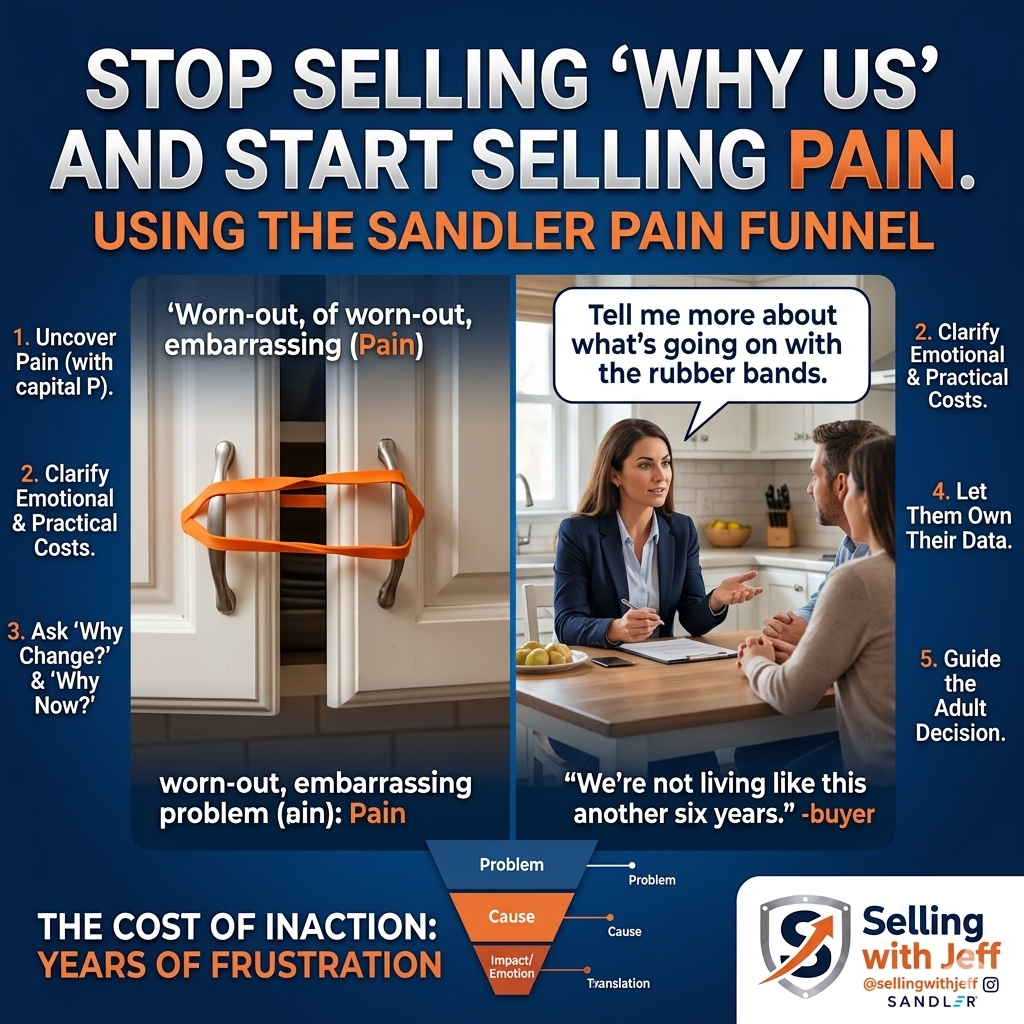
Agenda (theirs first): “What’s going on with the current kitchen and storage that made you pick up the phone and call us?” Then you stay quiet. You’re not asking what they want to “know” (which triggers price and timeline); you’re asking what’s wrong in their world.
They might say, “We feel cramped, we’re always tripping over shoes, and there’s no light.” You keep going: “What else?” Soon you have a list: walk-in pantry, more natural light, better appliances, a large island, less clutter. This is where real pain lives.
Next, you prioritize: “Out of all of these – pantry, light, less clutter, appliances, island – which is most important to tackle first? If we ran out of time today and had to skip something, what wouldn’t be the end of the world?” Suddenly you know what’s a must-have (walk-in pantry, natural light) and what’s a nice-to-have (the island). That’s gold later when they want “everything” for yesterday’s prices.
Agenda (yours): you add what you need: “I’ll need to ask a bunch of questions about how you use the space, walk you through how we work, and, if it makes sense, talk about money and next steps. Anything else you want to be sure we cover?” Now both sides have a clear plan.
Logistics: confirm time and permission. “We’ve got about an hour. Is that still good? Some of my questions may feel personal, like how you cook, entertain, or store things. Is it okay if I ask those?” According to Sandler data across thousands of recorded calls, clear logistics at the front end correlates strongly with shorter meetings and higher close rates because there are fewer surprises.
Outcome: this is where you normalize “no” and define “yes.” A strong version might be: “Sometimes people decide we’re not the right fit – and that’s perfectly fine. If you feel that way today, would you be comfortable just telling me no? By the same token, if I feel your project doesn’t fit our process, is it okay if I’m honest and refer you to someone better suited? If we both feel there’s a fit, the usual next step is a paid pre-construction agreement so we can develop your design and detailed budget together. Assuming all your questions are answered and the budget feels comfortable, would anything stop us from agreeing to that today?”
This outcome step flips the script. Instead of being a hopeful bidder, you’ve positioned yourself as an equal business partner with the right to walk away. Psychologically, when homeowners are explicitly given permission to say no, research shows they’re more likely to say yes – because the pressure drops and trust rises.
Most important, by the time you reach money, you’re not guessing. You’ve already anchored the conversation in their pain: cramped spaces, tripping over shoes, lack of light, stress as a couple. You’ve also made clear that the goal of this meeting is a decision about next steps, not just “gathering ideas.”
Turning Budget Into a One-Way Client Conversation
A remodeling budget discussion should be a structured discovery of what the client can and will invest, not a free consulting session where you hand out pricing. Think of budget as one-way information flow: from them to you.
You start by asking, “Do you have a ballpark in mind for what you’re willing and able to invest in solving these problems?” Then you stay quiet. Whatever number they give you will almost always be low and wrong. That’s fine. Your goal is not to correct it immediately; it’s to understand what it represents.
Sandler distinguishes two variables: willing and able. A prospect who is willing but not able – for example, the couple who loves your design but can’t qualify for financing – is not a prospect. No matter how much they like you, if they can’t get the money, you will never build their project. Letting those people sit in your pipeline for two or three years is a self-inflicted wound.
Able but not willing is different. That’s the Disneyland story: the parent who never imagined spending $900 extra on skip-the-line passes becomes willing after a miserable, rained-out first day and the realization that this is the last trip before their kid leaves for college. The money was always there; the pain changed the decision.
Your job in sales is to explore whether the pain of staying the same is big enough to justify the investment. That’s why you never lead with, “It will probably cost about…” If you do, you anchor the conversation in your guess instead of their reality. Industry experience shows that even seasoned remodelers underquote when they wing it, which guarantees painful budget revisions later.
Instead, you use their number as a starting point. If they say, “We’re thinking $500,000,” and you know a realistic range is closer to $750,000 based on scope and location, you might respond: “Thank you for sharing that. Based on what we’ve seen with similar projects in this area over the last year, kitchens and additions at this level often land higher than that, especially with custom finishes. Before I tell you whether your number is realistic, can we talk about which parts of the project are truly must-have versus nice-to-have?”
Now you’re negotiating scope and priorities, not defending a price. You can trim or phase work while preserving margins and honesty. If, after that conversation, there’s still a massive gap and no flexibility, you can gracefully disqualify them and avoid a one-star review by pointing them to a better fit.
Finally, remember where your competition really comes from. Homeowners’ mental budgets are shaped by online cost calculators, HGTV shows that don’t pay for materials, and well-meaning friends who remodeled seven years ago. You stand out by admitting that up front, explaining how you build transparent, current budgets, and insisting that money conversations flow from their willingness and ability to invest – after you’ve done the hard work of uncovering pain.
When you treat PALO as non‑negotiable and budget as a one-way client conversation, you stop being the free pricing service in your market. You become the professional who runs organized meetings, tells the truth about cost, and only invests time in projects where both the pain and the money are real.