AI Role Play Coaching for Higher‑Closing Sales Teams

Why most sales teams under‑practice and how AI fixes it
AI role play coaching lets salespeople rehearse real conversations in a safe environment, get objective scores, and fix gaps before they cost deals. Instead of hoping reps “learn from experience,” teams use short, focused simulations and call reviews to build skills the same way athletes and musicians do.
Most sales teams spend far more time performing than practicing. A typical rep might hit three to six live calls a day, but only role play once a week during a meeting—if that. In remodeling and construction, “practice” is often a quarterly workshop and the occasional ride‑along. Compare that to a college quarterback who spends dozens of hours on film review and drills for a few hours of game time. The outcome is predictable: call quality plateaus, close rates stall, and reps keep repeating the same mistakes.
New AI coaching platforms change this math. They let reps practice at game speed whenever they have 20 spare minutes, without needing a manager or peer. For example, one remodeling salesperson who was almost fired committed to 188 AI role plays in a quarter. Within six months, after another 123 targeted practices, he went from last place on a team of eight to second in closed revenue. The difference wasn’t a new script; it was sheer repetition with feedback.
AI also brings hard data into conversations that used to be based on gut feel. Tools can surface talk‑to‑listen ratios, filler word counts, and pacing in words per minute. Sandler’s guidance for discovery calls is to talk just 20–30% of the time; analytics make it obvious when a rep is really at 41% and thinks they’re “letting the client talk.” That clarity turns vague coaching like “slow down and listen more” into specific targets: “In your next discovery call, aim for under 25% talk time and 170 words per minute.”
Finally, AI practice lowers the emotional cost of getting better. Because scores and recordings are private by default, reps can safely bomb a scenario, score 12%, and try again until they hit 90%—then share only their best version with a manager. That privacy is often what unlocks consistent use of the tool, especially for experienced sellers who don’t want their early stumbles on display.
How to turn real call recordings into a practice engine
Uploading real call recordings into an AI coach transforms scattered conversations into a repeatable training loop. Reps import audio from Zoom, Otter, or in‑person meetings, have the platform transcribe and score it against a defined rubric, then use those insights to guide what they practice next in role plays.
Start by picking one recording per rep each week. Download the audio file (not just the transcript) from your call platform, then upload it to your AI coach using a multi‑speaker analysis option. Choose a rubric that matches the call type—for example, a “Discovery Call” rubric that covers bonding and rapport, the Sandler pain step, budget, and decision process. The system will label speakers, allow you to rename them (e.g., “Tim,” “Homeowner 1,” “Homeowner 2”), and then generate scores and narrative feedback.
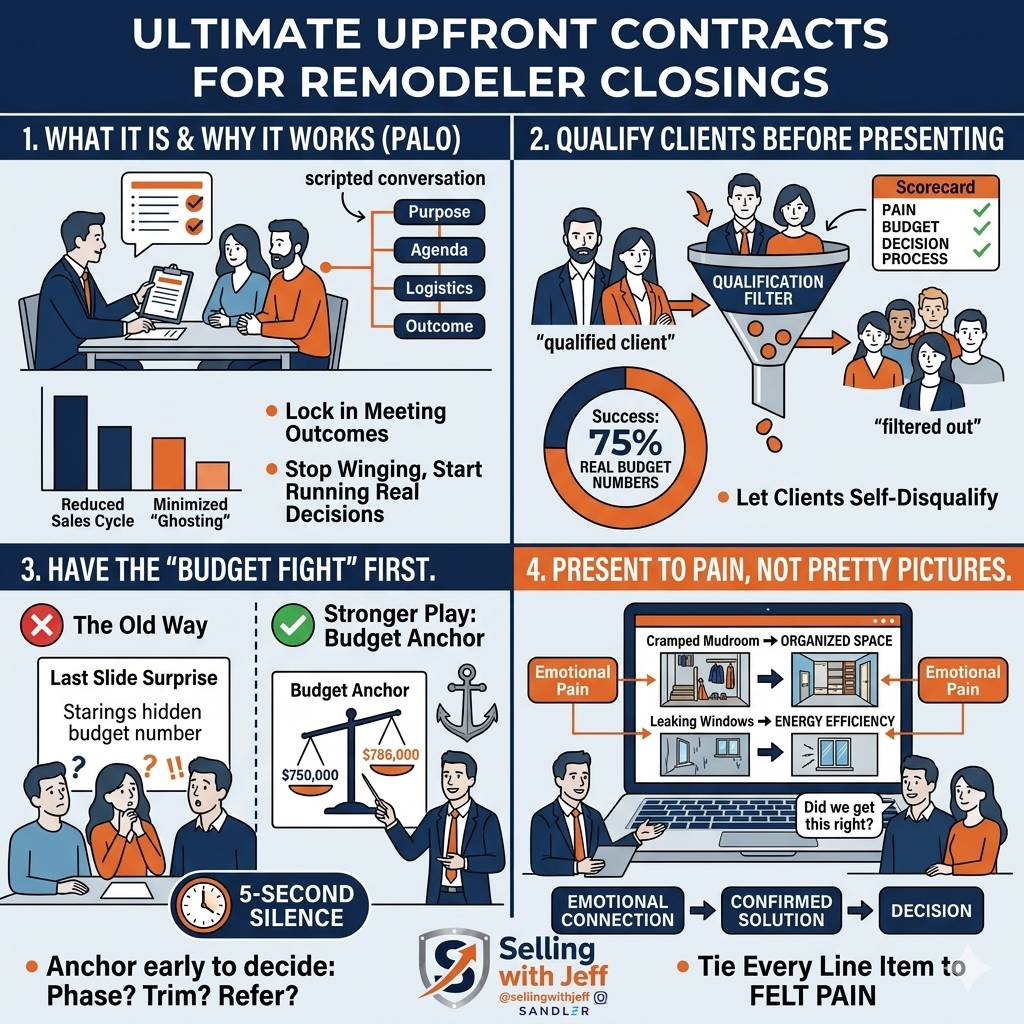
The most useful output isn’t the overall grade; it’s the breakdown. You might see that a rep scores well on bonding and upfront contracts (PALO) but underperforms on the pain funnel or money conversation. For instance, the analysis could show strong validation of the investment decision and clear future steps, but weak or rushed exploration of pain—classic premature presentation syndrome. That points directly to which role plays they should run next.
AI analytics go deeper than traditional coaching notes. They highlight weak words and filler (“um,” “like,” “you know”), show whether the rep monologued, list every question asked, and chart listening ratios. If Sandler’s benchmark is 20–30% talk time in discovery, the dashboard makes it plain when someone is consistently at 50–60%. It can also track pacing; many tools flag 170 words per minute as an ideal target, so a rep who averages 190 knows they need to slow down.
Because calls are private to each user unless explicitly shared, reps can safely upload both “train wreck” calls and wins. A closing call where the rep secured a signed contract might still reveal missed chances to deepen pain or clarify budget. Conversely, a lost deal can be dissected without blame: where did the conversation drift, which objections went unaddressed, and how could different questions have changed the outcome? Over time, this creates a library of annotated real‑world scenarios that guide individual coaching and team training topics.
Building custom AI role plays that mirror your real buyers
Custom AI role plays let sales teams rehearse conversations that look and feel like their own market—right down to homeowner personalities, past remodel history, and likely objections. Instead of generic scripts, reps practice first meetings, discovery calls, and closings with AI personas built from real clients.
The basic build flow is simple. From your AI coach home screen, choose a builder or creator option and write a short description of the scenario: “First discovery meeting with two homeowners to discuss a large addition,” for example. Use a “Create with AI” or similar feature to generate a draft, then refine it with more context. The more detail you provide, the more realistic the interaction becomes.
Context should include what the AI “knows” before the call: prior projects, budget hints, design preferences, even frustrations with past contractors. Sales leaders often paste in bullet points from lead sheets—timeline, decision makers, previous remodels, personality clues, and notes like “had terrible experience with last contractor; very cost sensitive.” You can also upload LinkedIn or social media profiles so the AI mirrors a specific person’s tone and priorities.
Personas are where the tool comes alive. For each AI character, you can set demeanor (curious, skeptical, friendly, blunt), background (first‑time homeowner vs. seasoned renovator), and behavioral traits (always challenges price; goes off on tangents; answers in short, guarded phrases). Many teams discover that the toughest “medium” or “advanced” role plays are not angry prospects at all but charming talkers who constantly drag the conversation away from the agenda.
Advanced users go a step further by feeding the AI past recordings from that same buyer type or couple. For example, you can upload a discovery call with a husband‑and‑wife team and then build a closing‑call role play that uses those recordings to simulate how they’ll likely respond when you recap budget and scope. One Sandler coach even used this approach to practice a difficult personal conversation, instructing the AI to behave like a “snarky Gen Z college student” based on real interactions—and found that the live discussion went significantly better as a result.
To ensure meaningful feedback, attach the right rubric from your own organization rather than a generic default. Use Sandler‑aligned goals such as discovery effectiveness, depth of pain, budget clarity, decision process, and objection handling. You can even pre‑load expected objections—price, timeline, living through construction—so that if the rep never surfaces them, the AI raises them later in the call. That forces reps to confront the same resistance they’ll meet in real homes.
Making AI sales practice stick: cadence, goals, and trust
Sustained results from AI coaching come from a consistent practice cadence, clear scoring goals, and a culture where reps feel safe to fail in private. Treat AI sessions like client meetings: short, scheduled, and non‑negotiable unless something is truly on fire.
A practical starting point is three 20‑minute sessions per week. Each block includes one or two role plays plus a quick review of the feedback. That’s roughly an hour a week of focused practice—enough to create improvement without burning anyone out. Trying to cram three or four back‑to‑back role plays into a single hour tends to fry people’s brains and leads to sloppy reps, just as you wouldn’t schedule three back‑to‑back in‑home appointments.
Set simple benchmarks. Many Sandler coaches treat 70 as a passing score (a “C”), 80 as a “B,” and 90+ as the real target. Ask reps to focus on one skill area at a time: for example, reach 90%+ consistently on the discovery pain funnel before layering in budget or closing scenarios. Managers can then request that reps share only their best score on a specific role play every one or two weeks. Whether it took two attempts or twelve to hit that number doesn’t matter; what matters is demonstrated proficiency.
Trust and privacy are critical. Make it explicit that admins and managers can’t see individual recordings or scores unless a rep chooses to share them. That promise often unlocks participation from skeptical veterans who don’t want their early fumbles reviewed in team meetings. Reassure them that the goal is to help them make more money, not to catch them doing something wrong.
Finally, connect practice to outcomes. Share data from your own pipeline and from external sources. For instance, Sandler partners report that teams using structured AI role play and call analysis have seen close rates improve by 30–36% compared to traditional training alone, because they rehearse tough budget and pain conversations before they’re sitting at a homeowner’s table. Internally, track metrics like talk‑to‑listen ratio, number of fully defined pains per discovery call (five pains can correlate with 90% close rates), and the frequency with which reps actually use the AI coach.
When reps see that those who “practice more than they perform” are the ones moving from the bottom of the board to the top, AI role play stops feeling like homework and starts looking like a competitive advantage.