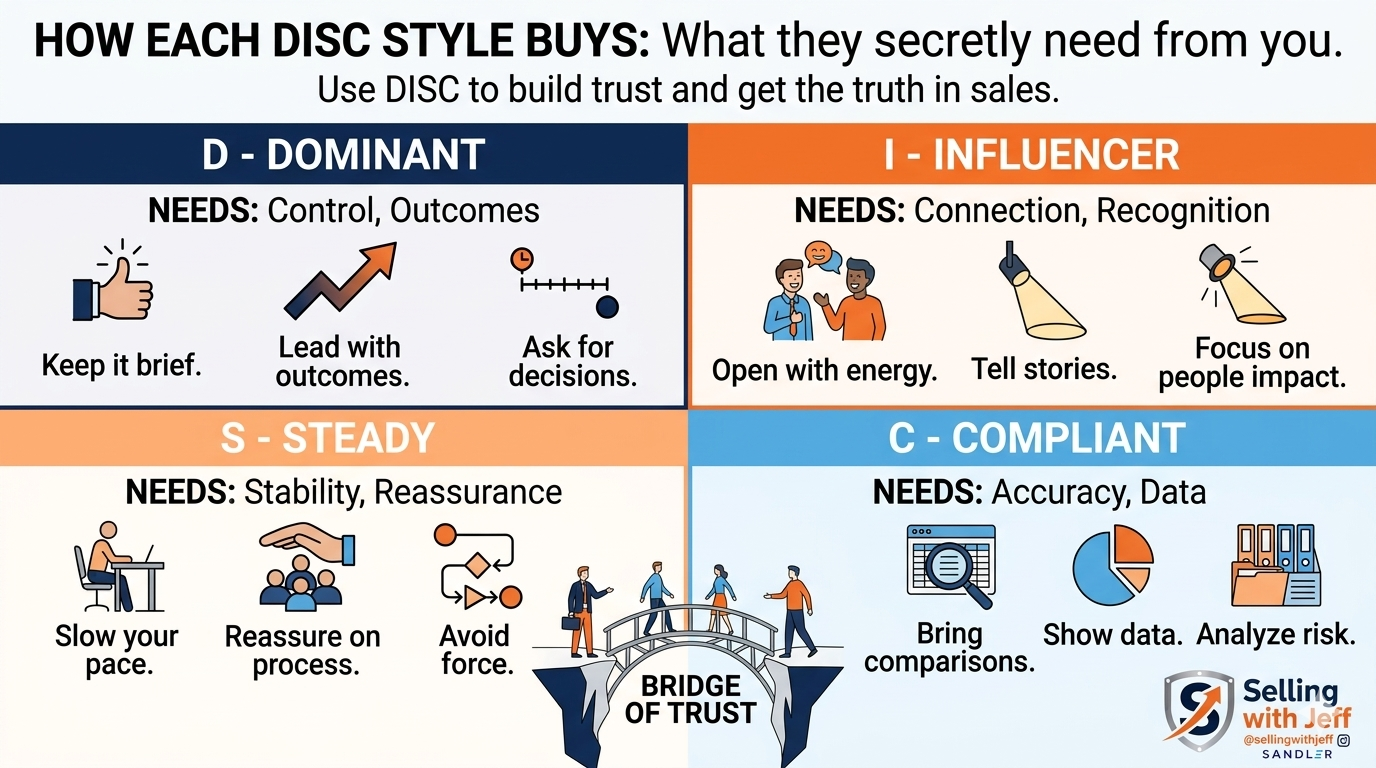
Use DISC to Build Trust Faster in Sales Calls
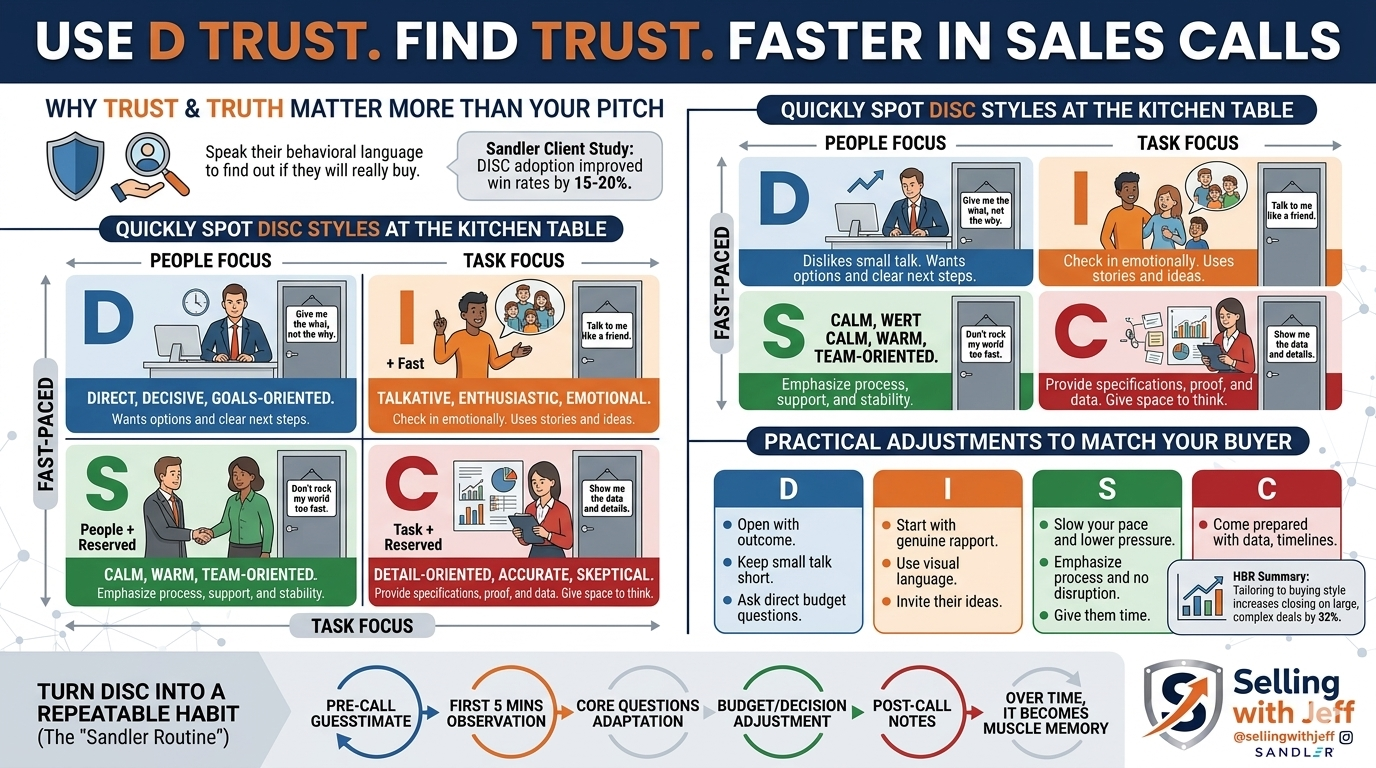
Why trust and truth matter more than your pitch
Using the DISC model in sales means flexing your communication style to match the buyer’s so you build trust quickly and get to the truth about whether they will buy. When you speak their behavioral “language,” prospects open up faster about budget, decision process, and real concerns.
In the transcript you shared, Brad says the goal of every sales call is simple: get to the truth as fast as possible. Is this prospect really going to buy from you, or are they collecting proposals to beat up their current supplier? You only find out when there is enough trust for them to say what is really going on.
That is where DISC becomes a practical sales tool instead of a personality quiz. Carl Jung’s behavioral model, later adapted into DISC (Dominant, Influencing, Steady, Compliant), gives salespeople a cheat sheet for how people prefer to communicate. Research backs up the payoff: in one Sandler client study, teams that actively adapted to DISC styles saw opportunity win rates improve by 15–20% over two quarters compared to teams that did not.
Trust is not small talk, and it is not “being nice.” It is making the other person feel safe enough to tell you the truth. DISC helps you get there faster.
A simple way to spot DISC styles at the kitchen table
You can quickly estimate a buyer’s DISC style by watching two things in the first five minutes: whether they focus on tasks or people, and whether their energy is fast‑paced or reserved. That simple two‑by‑two lens usually gives you a good first guess.
Here is a fast mental grid you can use, drawn straight from the behaviors in your source material:
- D – Dominant (Task + Fast)
Direct, decisive, wants the big picture, not the backstory. May tell you where to sit, drive the agenda, and dislike small talk. - I – Influencing (People + Fast)
Talkative, enthusiastic, stories about kids, grandkids, weekends. Gets energy from conversation and ideas. - S – Steady (People + Reserved)
Calm, warm, team‑oriented. Wants stability, time to think, and low drama. Often more comfortable once they feel you are patient and safe. - C – Compliant (Task + Reserved)
Detail‑oriented, precise, asks a lot of questions. May seem skeptical at first and wants to be sure the decision is correct.
Use what Brad did in the workshop: imagine there is a sign on the prospect’s office door. The “D sign” says, “Give me the what, not the why.” The “I sign” says, “Talk to me like a friend.” The “S sign” says, “Don’t rock my world too fast.” The “C sign” says, “Show me the data and details.”
By the end of your first five minutes in a living room or conference room, you can usually place the prospect in one quadrant well enough to adjust how you sell.
How to flex your style to match D, I, S, and C buyers
Once you spot a likely DISC style, adjust how you open, what you emphasize, and how quickly you move. Matching style is not acting fake; it is removing friction so the buyer can focus on the decision instead of your behavior.
Here are practical adjustments you can lift straight into your next call:
-
Selling to a D (control and results)
- Open with the outcome: “In 30 minutes we’ll know if it makes sense to work together.”
- Keep small talk short. Use bullet points, options, and clear next steps.
- Ask direct questions about budget and decision: “What has to be true for you to move ahead today?”
-
Selling to an I (being liked and involved)
- Start with genuine rapport: weekend, kids, a quick story.
- Use visual language and examples: “Imagine sitting in this new kitchen at Thanksgiving…”
- Check in emotionally: “How does that feel?” and invite their ideas.
-
Selling to an S (peace and stability)
- Slow your pace and lower the pressure.
- Emphasize process, support, and lack of disruption: “Here’s how we’ll keep this comfortable for you.”
- Give them time and reassurance about change.
-
Selling to a C (accuracy and correctness)
- Come prepared with specifications, timelines, and proof.
- Walk through details logically and invite questions.
- Give them space to think: “What information would help you feel completely confident?”
A study summarized by Harvard Business Review found that salespeople who tailored their approach to a buyer’s working style were 32% more likely to close large, complex deals than those who used a one‑size‑fits‑all pitch. DISC gives you a clear structure for doing that on purpose.
Turning DISC into a repeatable sales habit
To make DISC pay off, you need a simple routine you can use before, during, and after every call so adapting to styles becomes muscle memory instead of a one‑time training event.
Here is a practical rhythm that fits the professional, human sales tone from your transcript:
- Pre‑call: Based on the referral source, role, and prior emails, make a first guess at style. Jot down one adjustment you will make (pace, level of detail, amount of small talk).
- First five minutes: Confirm or revise your guess using the task/people and fast/slow lens. Notice who leads the conversation, who asks about family, and who dives straight into numbers.
- Questions phase: Use your core Sandler questions, but adjust wording. For example, with a D: “What’s the real problem you want solved?” With an S: “What would a comfortable solution look like for you?”
- Budget and decision: Keep your process consistent, but flex how you check for truth. With a C you might say, “Walk me through how you usually make decisions like this,” then pause and listen.
- Post‑call: In your notes, record the likely DISC style and what worked. Over a month you will start to see patterns in which adjustments shorten the sales cycle or protect your margin.
Over time, you stop guessing. You walk into the house, read the room, and naturally switch gears. That is what Brad modeled in the session: not a script that ignores the human, but a structure that makes it easier to be human on purpose — and to get to the truth faster, with less pressure on everyone at the table.