
What Pre-Call Planning Really Means for Remodelers
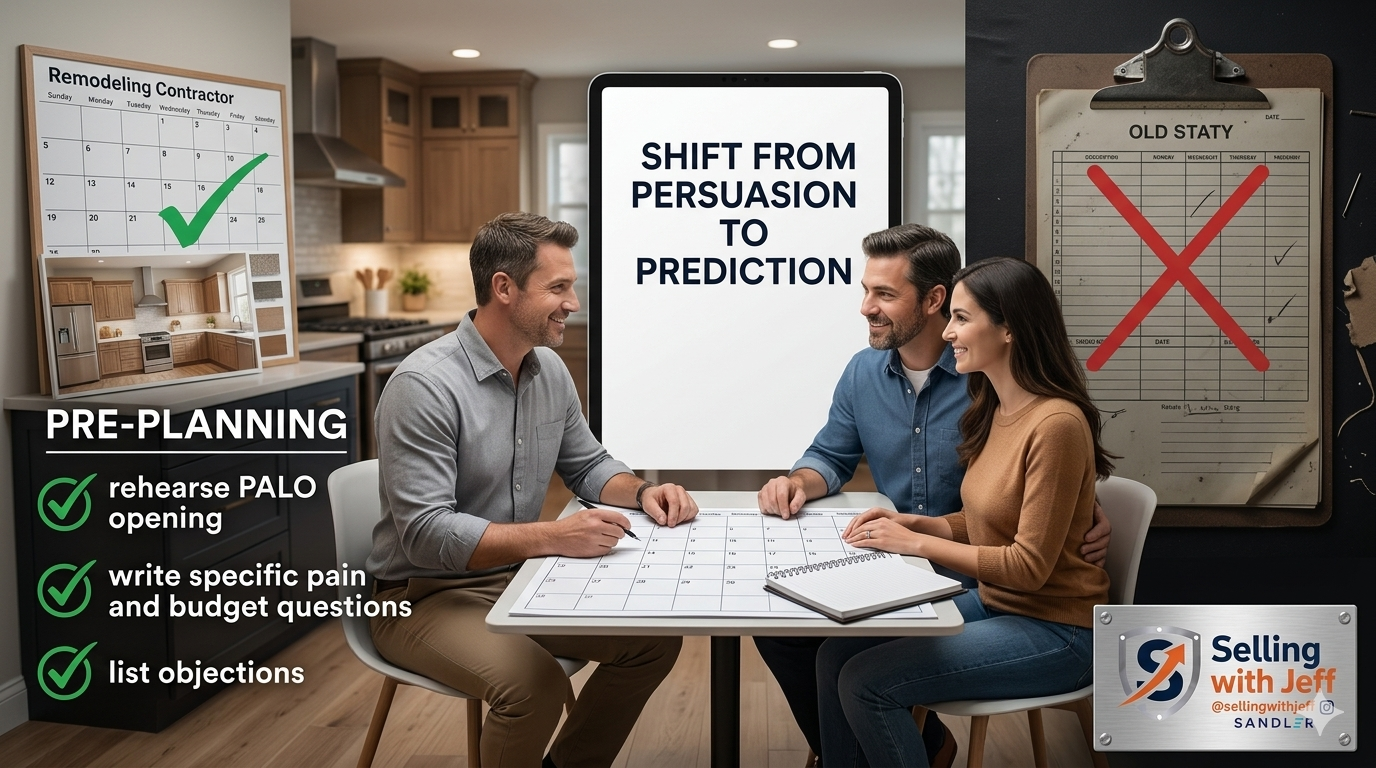
For remodelers, pre-call planning is a short, written routine you complete before every client meeting: rehearse your opening, script key questions, plan worst and best outcomes, and reset your mindset. Done in 10–15 minutes, it stops “great conversations” from ending in no decision and ghosting.
If you’re honest, you’ve had this experience: you drive an hour to a home, have a rich conversation about dreams, kids, pets, and layouts, then realize you’re out of time with no budget clarity and no next meeting on the calendar. The notes in your CRM say “great fit,” but three weeks later you’re chasing voicemail.
That’s not a talent problem. It’s a structure problem.
Data backs this up. One study found that 82% of B2B decision-makers describe sales reps as unprepared, while 76% of top performers do thorough research before calls (HubSpot). Another analysis of 25,000+ calls showed reps who keep their talk time around 40–45% close nearly 3x more deals than reps who dominate the conversation (B2B Sales Training). Prepared reps ask better questions and listen more.
Pre-call planning is simply the discipline that forces that preparation to happen on purpose instead of by luck. In the Sandler world, it’s not optional overhead; it is your insurance policy against “happy ears,” missed details, and surprises that blow up margin months later.
Use the 5 Sandler Steps to Enter Every Call Ready
In the transcript you just read, the team walked through five Sandler pre-call planning steps. On paper they’re simple. In practice they separate field-proven pros from designers who keep “winging it” and wondering why projects stall.
-
Rehearse your PALO out loud. Your PALO (Purpose, Agenda, Logistics, Outcomes) is the opening frame of the meeting. The first time you say it should not be in front of the homeowner. Take 2–3 minutes in the car or before you hit Zoom:
- Purpose: why we’re meeting.
- Agenda: what we’ll cover.
- Logistics: timing, who’s in the room, how we’ll use the time.
- Outcomes: the three acceptable outcomes—yes, no, or a mutually scheduled next step.
-
Write a list of questions, not just talking points. Most remodelers “have questions in their head” and then do the walk-of-shame email: “I forgot to ask about…” Put them in writing. Sometimes you’ll need five questions, sometimes twenty-five. It’s better to have questions you never use than to burn design hours because you missed one critical detail.
-
Be a pessimist on purpose. Spend two minutes asking, “What’s the worst thing that could realistically happen in this meeting, and how will I handle it?” Maybe the spouse can’t join, the budget is way off, or they push for free design. When you’ve pre-rehearsed those moments, you’re not flat-footed.
-
Then be an optimist—with a base hit and a home run. Define both:
- Home run: the best possible outcome (for example, a signed design agreement with both decision-makers).
- Single: the minimally viable next step that keeps the process moving (for example, a joint meeting booked with the spouse, or a trade walkthrough on the calendar).
This is where you fight self-limiting beliefs. If “home run” always feels impossible, that’s a mindset problem, not a market problem.
-
Install a supportive belief system. If you walk into the call thinking, “They probably can’t afford this,” you will unconsciously make that true. In the session, the coach reminded the team: whether you believe the process will work or won’t work, you’re usually right. This isn’t rah-rah motivation; it’s recognizing that your internal script drives which questions you’re willing to ask—especially on budget and commitment.
Teams that run a written pre-call plan like this on every late-stage call see meaningful lift. One benchmark study found reps who complete written plans close at 38% versus 22% for those who wing it—a 73% relative improvement on the same pipeline (Pulse RevOps).
Lock in Next Steps and Follow-Up Without Chasing
Pre-call planning isn’t finished when the meeting starts; it’s how you control the last 10 minutes.
A common failure pattern from the transcript: reps use every minute collecting story, scope, and wish list, then let the client bolt to their next meeting with, “Okay, let’s talk soon.” That’s how otherwise good projects end up in pipeline purgatory.
Here’s the Sandler fix:
-
Pre-commit to stopping early. Make it part of your PALO: “We’ve got an hour. Okay if we stop about 10 minutes early to recap and decide what comes next?” When they agree, you’ve set a trap for yourself to honor that pause instead of talking to the top of the hour.
-
Use SVIC to drive an adult-level decision. SVIC—Summary, Verify, Importance, Commitment—forces you to move the client from emotional “natural child” reactions to an adult decision about budget and priority.
- Summarize in their words.
- Verify: “Did I miss anything?”
- Importance: “On a 1–10, how important is solving this now?” (Yes, you have to ask. It feels clunky until it doesn’t.)
- Commitment: “What are you willing to do next if we’re a good fit?”
Without those last two steps, “budget” is just a feeling, not a real number they’re prepared to act on.
-
Send a structured recap that uses their words. The team discussed using AI meeting assistants (like Fireflies or HubSpot AI) to auto-generate call summaries. The key is not the tool; it’s the discipline:
- “Here’s what we heard you say…” followed by bullet points in the client’s own phrases.
- “Here’s what we agreed would happen next…” including the actual calendar date and time.
In one example shared, consistently sending this kind of recap email helped a design-build firm close over $5M in work in three months because it made them look dramatically more prepared than competitors.
Research on enterprise deals echoes this: analyses of hundreds of interactions show that prepared reps who enter calls with a clear next-step ask see 4–7x higher stage progression than those who improvise (AmpUp).
When you combine a written pre-call plan, a disciplined close that locks in next steps, and a follow-up recap that proves you listened, you stop confusing “busy pipeline” with “real deals.” You run calls like a pro—and you sleep better knowing ghosting is the exception, not the pattern.