Own Your Sales Role: From Tasks to Outcomes
Prepare your week with intentionality, not autopilot
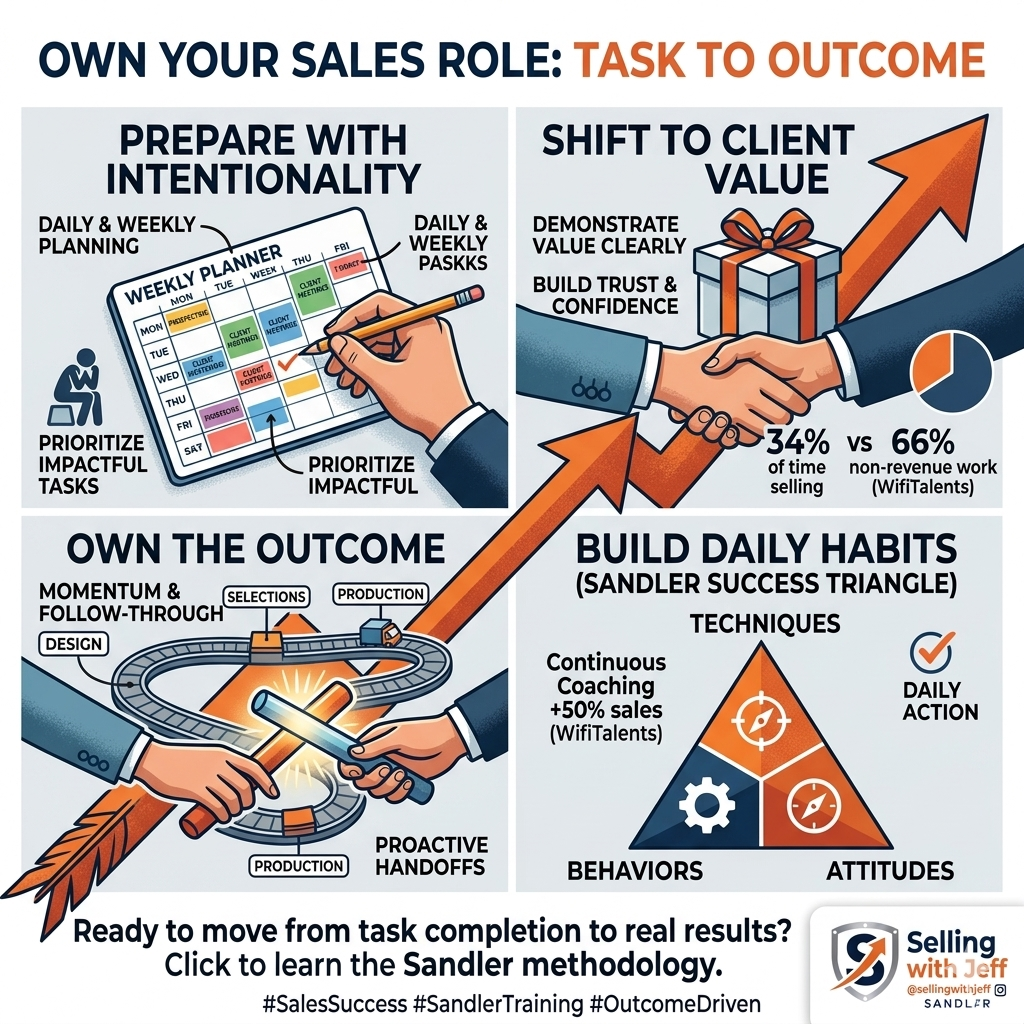
To own your role you start by deciding what a successful week looks like before it begins. Instead of letting email, Slack, and client emergencies drive your calendar, you block time for the few activities that actually move deals forward and create a better experience for clients and teammates.
Most salespeople are drowning in activity. Research shows reps spend only 34% of their time actually selling and roughly 66% on non-revenue work like admin and internal meetings (WifiTalents). Preparing with intentionality means you sit down—weekly and daily—and decide: which clients, which deals, which conversations will matter most.
Practically, that looks like using an Eisenhower-style matrix to sort your to-dos: urgent/important (do now), important/not urgent (schedule), urgent/not important (delegate or streamline), and neither (eliminate). Tools are useful, but the discipline is human: put the right blocks on the calendar, protect them, and enter meetings with a game plan instead of “winging it.”
Shift from task completion to real client value
A full checklist is comforting, but it can be deceptive. Many reps clear easy tasks first, then run out of time for the hard, high-impact work. Data shows 90% of B2B sellers lose active deals because they fail to clearly demonstrate value (WifiTalents). That’s not a task problem; it’s a value problem.
Owning your role means evaluating every task through one lens: what value does this create, and for whom—client, coworker, or company? A pricing email that anticipates common objections may be worth more than three low-stakes internal updates. A proactive call to reset expectations after a surprise soil report can save a seven‑figure project that’s about to stall.
Make this concrete. For each major opportunity this week, write one outcome statement: “By Friday, this client feels clear, confident, and committed to the next step.” Then identify 3–5 tasks that directly support that outcome and drop or delegate the rest. You’re no longer just “busy”; you’re building a result on purpose.
Own the outcome: momentum, handoffs, and follow-through
In complex projects—like design‑build or large remodels—no single person owns every task, but everyone owns the client outcome. That includes how the relationship begins, how it ends, and how smooth the handoffs feel in between. Poor ownership usually shows up as lost momentum between stages.
Time‑management research highlights that 50% of sales time is wasted on unproductive prospecting and context switching (WifiTalents). Momentum dies when a file is “thrown over the wall” to design, selections, or production with vague notes and no clear next step. Owning your role means you take responsibility for the baton pass, not just your leg of the race.
Practically, that looks like crystal‑clear internal conversations: documented expectations, timelines, and definitions of “done” before a handoff. Externally, it means proactive follow‑through—recapping decisions, confirming next milestones, and checking for hidden concerns instead of waiting for the client to chase you.
Use the success triangle to build daily sales habits
David Sandler’s success triangle—behaviors, attitudes, techniques—explains why good intentions aren’t enough. All three matter, but behavior is the entry ticket. If you don’t make the call, schedule the review, or sit down for real pre‑call planning, even a great mindset and strong skills won’t save the quarter.
Continuous coaching and training can lift net sales per rep by as much as 50% (WifiTalents), but only when people translate ideas into consistent behaviors. A practical approach is to pick one target outcome for the week (for example, “Move three stuck design agreements to contract”) and then link:
- One behavior: daily 30‑minute block to call and email each stalled client
- One attitude: calm, confident, genuinely curious—not desperate
- One technique: a specific questioning framework to uncover what’s really blocking the decision
Repeat that pattern weekly. Over time, you stop measuring yourself by how many boxes you tick and start measuring by the outcomes you own—for your clients, your team, and your pipeline.