
One-Legged Remodeling Calls: Get Both Decision-Makers
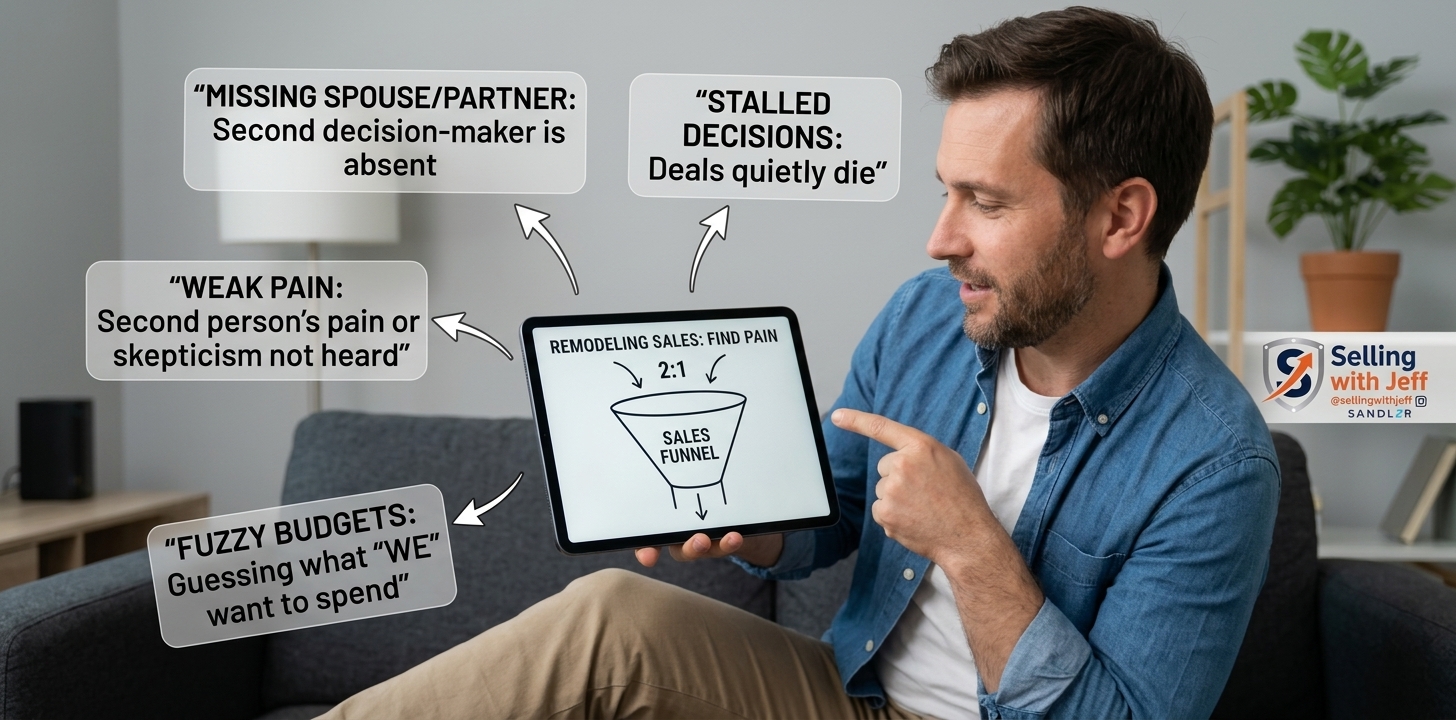
Why one-legged remodeling calls kill your close rate
One-legged sales calls happen when you meet just one decision-maker, so the absent spouse or partner still has to be sold later. For remodelers, that means weak pain, fuzzy budgets, and stalled decisions. Treat them as disqualifiers or reschedule so both decision-makers are involved early.
In remodeling, you’re almost never selling to a single person. You’re selling to a household. When only one homeowner shows up, you end up doing a free strategy session for the person who is “collecting information,” while the real decision still happens later at the kitchen table without you. That turns your carefully run sales call into secondhand gossip.
That’s exactly what your coaching conversation surfaced. When you go back and look at four to six months of leads, one-legged calls almost never become signed construction agreements. Owners who do this analysis usually find the same thing Jeff pointed out in the training: the vast majority of those “I’ll talk to my spouse” deals just quietly die.
There are three structural reasons. First, you can’t really do Sandler-level discovery on pain if only one person is in the room. You’re uncovering one version of the problem, not the shared reality. If one partner is leading the charge but the other controls the finances, you’ll never hear the second person’s pain—or their skepticism—directly.
Second, budget discussions are weaker. You may get what sounds like a solid number, but it’s usually one person’s guess about what “we” are willing to spend. In the transcript, Jeff reframed pain as anything people are willing and able to spend money, time, and inconvenience on. With a one-legged call, you don’t actually know if the household is willing and able—you only know one person’s story.
Third, decisions drag out. Time kills deals. The longer someone sits in design, or the longer they “think about it” without a clear next step, the less likely they are to move ahead. When the second decision-maker wasn’t even in the conversation, your next step depends on your contact successfully re-selling your process, your scope, and your price. That’s a big ask for a homeowner who just went through a 60–90 minute meeting.
Sandler’s own guidance on the submarine for remodelers notes that when reps follow a clear call structure and let homeowners talk 60–70% of the time, win rates climb compared with loosely run calls where the seller talks about half the time or more. One-legged calls practically guarantee a loose structure: you’re improvising around missing people instead of running the play.
The fix isn’t “sell harder” in one-legged situations. The fix is to redesign your process so one-legged calls are the exception, not the norm—and to know exactly how you’ll respond when they still happen.
Use PALO to set expectations before you ever drive out
Sandler’s upfront contract—often taught as PALO (Purpose, Agenda, Logistics, Outcome)—is where you prevent one-legged calls, long before you’re standing in a foyer with your tape measure. Most remodelers use PALO loosely (“We’ll talk about your project and next steps”), but the Logistics and Outcome pieces are where you get serious about decision-makers.
Purpose is why you’re meeting. With a remodeling prospect, that might sound like, “The purpose of this visit is to understand what’s going on with your kitchen, see the space, and decide together whether it makes sense to move into design.” Simple, plain language—no pressure.
Agenda is what you’ll each cover. Instead of talking about “a quote,” ask what they want to make sure you discuss: problems with the space, timeline, budget, fears about living through construction. You add your items: how your process works, a realistic investment range, and what the next steps might look like.
Logistics is where you quietly control the entire meeting. This is where one-legged calls are either created or eliminated. Logistics includes where you’ll meet, how long you’ll need, and who needs to be present. In the coaching session, the team landed on a powerful but polite standard: both legal homeowners (or all decision-makers) should be part of the first in-home meeting.
A simple way to say it on an intake call is:
“Before we put you on the calendar, we have a quick policy question. For in-home appointments, we ask that all legal homeowners who’ll be involved in the decision be part of the first meeting—in person or by Zoom. That way we hear everyone’s priorities directly and you don’t have to re-explain everything later. Will that work for you?”
If they push back—“My spouse wants nothing to do with it; I’m just gathering info”—you don’t argue. You lean on policy and leadership, just like Jeff suggested:
“I get that. Honestly, a lot of couples divide and conquer. My challenge is that my bosses only allow us to schedule in-home visits when all homeowners are part of the first conversation. I wish I could change that, but I can’t. If your partner can join for even part of the meeting by phone or Zoom, we can absolutely work with that.”
Outcome is your clear, defined future. You agree in advance on how the meeting will end: “By the end of our hour together, we’ll either agree it’s not a fit and part ways as friends, or we’ll outline a design agreement and schedule a follow-up to review it.” Every interaction ends with a next step and a calendar invite, not a vague “We’ll be in touch.”
When you run PALO this way, one-legged calls start to look less like an unavoidable annoyance and more like what they really are: a breakdown in logistics and outcome. Fix those, and you’ll drive fewer wasted miles and have more calls where you actually have the authority in the room to make a decision.
If you want more detail on how all the submarine compartments line up for remodelers, see this practical walkthrough: Sandler Submarine for Remodelers.
Polite scripts to require both decision-makers (without drama)
The hardest part isn’t believing in the policy; it’s saying it without sounding pushy, sexist, or inflexible. The transcript highlighted those concerns clearly: no one wants to be the person on the phone implying, “We can’t talk without your husband.” The answer is to make the standard about process, not about power.
Here are three script patterns your team can adapt.
1. The non-negotiable company policy
“We’ve learned the hard way that when only one homeowner is in the first meeting, projects stall or have to be re-started later. So our company policy is that all legal homeowners join the first appointment—in person, by Zoom, or by phone. Otherwise we’re not able to move forward. Would you be open to that if we find a time that works for both of you?”
This script works because it shifts the “bad guy” from the intake person to the company. As Jeff pointed out, most adults understand company policies. They may not love it, but they respect that the person on the phone doesn’t have the power to override it.
2. The collaborative, benefit-focused version
“Can I share why we ask that everyone who’ll be part of the decision join the first meeting? When we only meet one person, you get stuck trying to retell everything to your partner, and we end up designing to half the priorities. When both of you are there, we can hear what each of you wants, give a realistic investment range, and help you decide together whether it’s worth moving forward. With that in mind, what would it take to have both of you join, even if one of you has to dial in?”
Here you’re connecting the policy to a payoff: less rework, fewer mismatched expectations, and a smoother decision. You’re not just protecting your time; you’re protecting their experience.
3. The “I wish I could” boundary
Sometimes a caller will insist: “My spouse doesn’t want anything to do with this; I’m the decision-maker.” You still don’t take the bait.
“I hear you, and I appreciate you taking the lead. My constraint is that my manager only allows in-home visits when all homeowners are part of the first conversation. I wish I could make an exception, but I can’t. The best I can do is offer a short Zoom or phone-in for your partner so we can at least introduce ourselves and hear any must-haves or concerns. Would they be open to joining for the first or last 15 minutes?”
Notice the pattern Jeff modeled: “I wish I could.” It’s calm, respectful, and firm. You acknowledge their request without apologizing for your standards.
Backing these scripts is broader sales research. Guides on identifying decision-makers, like this one from HubSpot (How to Identify Gatekeepers, Decision-Makers, Influencers, & Blockers), emphasize that missing a key decision-maker slows or kills deals. Home improvement and remodeling are no different—your “buying committee” just happens to be a couple instead of a department.
Used consistently, these scripts don’t just protect your time. They also send a strong message about how you run projects: with clarity, boundaries, and respect for everyone involved.
What to do when one spouse no-shows at the appointment
Even with perfect PALO and clear scripts, life happens. Someone gets stuck at work, a kid needs to be picked up from soccer, or a partner simply decides not to sit in. The question is not whether this will ever happen; it’s how you’ll respond when it does—and that needs to be a conscious part of your sales process.
Option one is the strict reschedule. Many top remodelers choose this path:
“I really appreciate you having me out. Since we agreed that all decision-makers would be part of this first conversation and your partner isn’t able to join, the most respectful thing I can do is reschedule so we’re not asking you to re-sell all of this on your own. Let’s grab our calendars and find a time when both of you can be part of it.”
That response feels bold, but it has two big advantages. First, you immediately re-anchor to your agreed Logistics instead of rewarding a broken commitment. Second, as Jeff noted, people almost never put you in that position a second time. You’ve quietly shown them that your time and process matter.
Option two is a controlled partial meeting. If you decide to stay, shift your goal:
- Keep bonding and light discovery, but don’t run full pain–budget–decision.
- Reconfirm the importance of having both people in the deeper conversation.
- Set a new Outcome before you leave—a specific date and time for a full meeting with both homeowners.
You might say:
“Since we’re both here, let’s walk the space and get a high-level sense of your goals. I don’t want to go all the way into design and pricing without your partner, because that usually leads to mixed messages and rework. Before I leave, let’s schedule a time when the three of us can talk through the full plan together.”
Notice what you’re not doing: you’re not presenting a detailed proposal, and you’re not anchoring a firm price. You’re preserving your leverage and keeping the real qualification steps—pain, budget, decision—for when the full buying team is present.
Option three is to escalate the pattern. If a prospect repeatedly refuses to involve the other decision-maker, treat that as a red flag for design and production. As Kristen pointed out in the coaching call, how people behave at the beginning is usually how they behave all the way through the project.
The practical move is to track the numbers. Create simple fields or tags in your CRM: “Two-legged first meeting” vs. “One-legged first meeting.” After three to six months, run the report. Most design-build firms find what Jeff described: a clear, often dramatic gap in close rate between the two. Even if you don’t publish the exact percentages, those internal numbers will give your team the confidence to enforce the standard.
In the Sandler submarine, bonding and rapport plus PALO take maybe 10 minutes, pain can take 45–60, budget and decision another 20–25. That’s a lot of human energy. The work of tightening up how you handle one-legged calls is simply this: making sure you only invest that energy when the right people are actually in the room.