IR Theory and Your Sales Cookbook on Commission

If you’re a remodeler or builder moving to straight commission, you can’t afford to let your pipeline own your self‑worth.
Use IR theory to untangle self‑worth from sales results
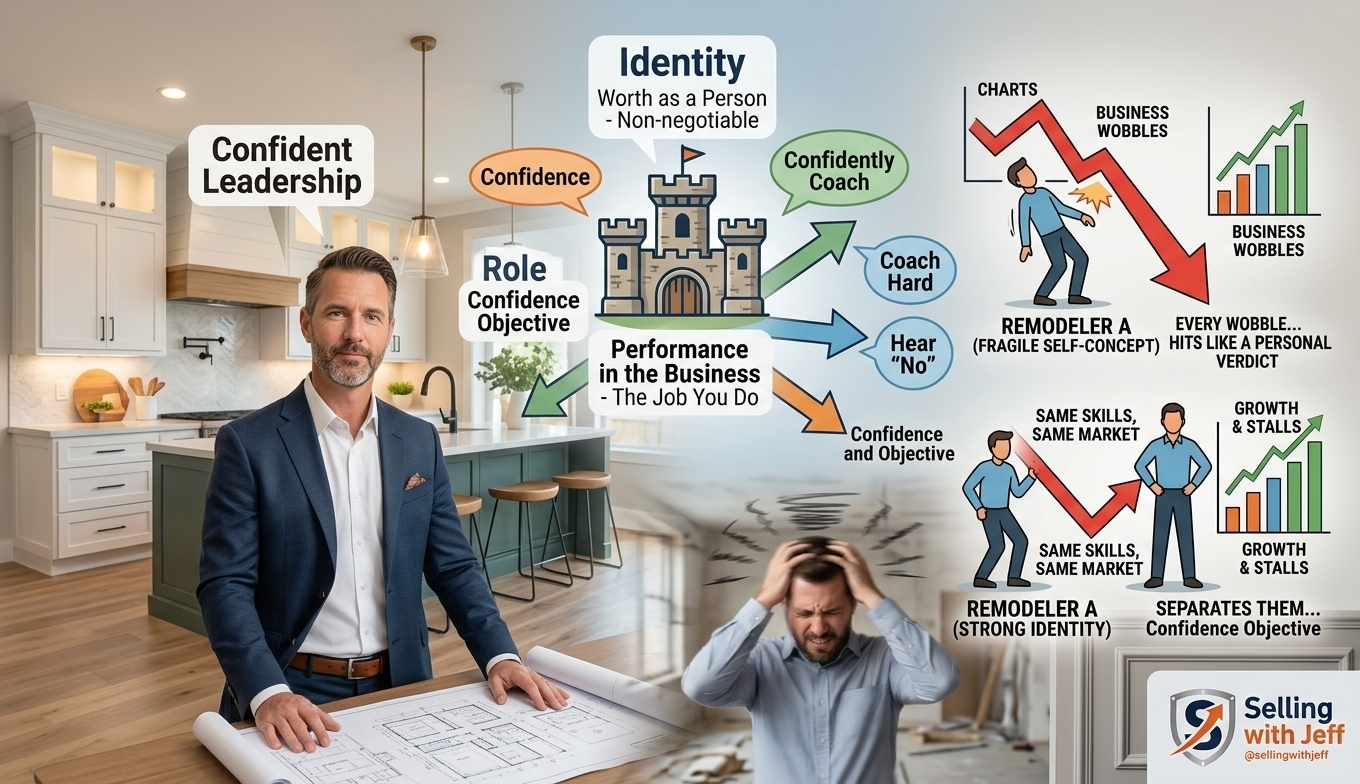
IR theory in sales says your worth as a human is separate from how you perform in the role of salesperson. When you accept that, you can go full commission, prospect aggressively, and hear “no” without spiraling—because the result hits your role, not your identity.
Most commission-based sellers blur that line. A blown sales call becomes, “I’m terrible at this.” A slow month becomes, “Maybe I’m just not cut out for sales.” Sandler’s IR framework forces a clean separation: identity is vertical (who you are), role is horizontal (the hats you wear). One Sandler series on IR highlights that when identity and role are aligned but not fused, decision-making improves and pressure drops, because you’re no longer treating every outcome as a verdict on you as a person (Sandler coaches report exactly this shift).
Your job as a professional is to protect that identity “castle” at all costs. You can perform poorly in a role on Tuesday and still wake up a good parent, partner, and leader on Wednesday. When you really believe that, you stop chasing validation in every opportunity and start running a process.
Build a prospecting cookbook you can actually control every week
Once IR is clear, you need structure: a cookbook. Your cookbook is the weekly recipe of behaviors that mathematically gets you to your income target. Instead of staring at a scary commission check, you reverse-engineer it into specific dials, meetings, and follow-ups.
In the transcript, you heard the simple version: daily dials, introductions, meetings set, and dollars closed tracked by hand. That primitive sheet worked because it respected math, not mood. Today, you might run the same logic through a task manager or AI scheduler, like the builder who loads all his sales activities into an app that auto-prioritizes his daily list.
Here’s the key: your cookbook only contains behaviors you control. “Close two deals this week” is not a cookbook item; “Run ten first visits and three budget presentations” is. When you are paid on commission, that distinction is survival. You can’t command results, but you can command behaviors, and over time the ratios stabilize into something you can bank on.
Protect your identity during tough conversations and rejection
IR theory matters most when the job hurts. Budget shocks, ghosting after design work, and flat-out hang-ups trigger every insecurity you have if you let your role bleed into your identity. One Sandler trainer described years of cold calling where dozens of people hung up daily—but he kept his sanity by reminding himself they were rejecting a salesperson at a bad moment, not a husband and father at his core (his story is a textbook IR win).
In project-based sales, the same applies when you present a $375,000 design-build number to a client who wanted to stay under $400,000 and you see the shock in their face. If your identity is tangled up in being liked, you start discounting or over-functioning. If your identity is separate, you can calmly say, “If this number doesn’t work, what would you like me to remove?” and let them own the trade-offs.
Coach your team on IR without crossing personal lines
If you lead a sales or design-build team, your people are living this identity/role collision every day. Many high performers secretly tie their value to being the hero on every job. Sandler offices that coach IR with leaders consistently see that when identity and role get tangled, feedback feels personal, decisions feel heavier, and leadership becomes exhausting (Sandler Custom Growth Solutions calls this one of the biggest shifts leaders must make).
Your job is not to play therapist; it’s to teach a framework. Name the difference between identity and role. Normalize failure in the role without letting people label themselves as failures. Then tie IR directly to process: “Because you’re okay as a person, you can afford to qualify hard, walk away from bad-fit projects, and stick to your cookbook instead of chasing every maybe.” That’s how you build a team that can push harder on commission without burning out.