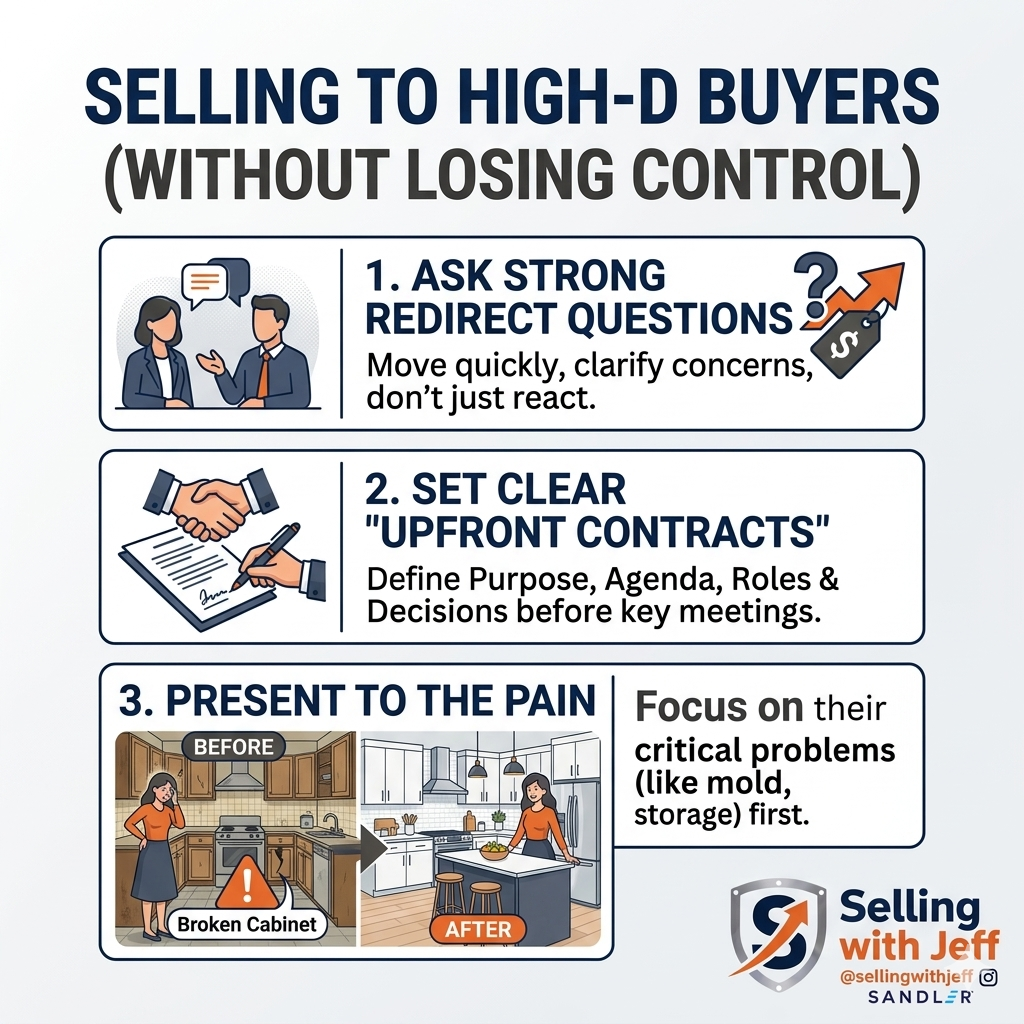
Handle Markup Questions Without Losing the Sale

Answering “What’s your markup?” with confidence and control
When a client bluntly asks, “What’s your markup?”, the best response is not a fast number—it’s a calm question. Top Sandler-trained sellers use reverses: they answer objections with questions to understand intent, protect margin, and keep control of the conversation.
Start by acknowledging the question and buying yourself a moment to think. A simple, disarming response sounds like: “That’s a question I get a lot. I’m happy to answer it, but I’m curious—how will knowing our markup affect your decision?” This does three things at once: it shows you’re not hiding, it uncovers what they really care about, and it slows down a high-pressure moment so you can respond like a pro instead of reacting defensively.
Often, you’ll find the client isn’t actually hunting for your profit—they’re trying to compare options or make sure they’re not being taken advantage of. One remodeler in the transcript above discovered that his “young lawyer” client only wanted cost-per-square-foot data to compare local flooring suppliers. By asking questions instead of blurting out a margin percentage, he was able to give her exactly what she needed (budget clarity) without exposing internal numbers or re-engineering his entire process.
You can also reframe the conversation away from raw markup toward value and industry norms. For example: “Our pricing is in line with any reputable builder in town. Labor and material costs are similar for everyone; what you’re really choosing is a partner you trust to do it right, stand behind the work, and be around in ten years if something goes wrong.” This positions you as a professional business, not a commodity seller.
With very direct, high‑D personalities, a firmer stance can work well—as long as it’s delivered with respect. One Sandler coach uses a vivid analogy: “Out of curiosity, when you buy a TV at Best Buy, do you ask what profit they’re making on it before you decide which one to take home?” Most buyers admit they don’t. That lets you follow with, “This isn’t really any different. What matters is whether the solution fits your needs, budget, and risk tolerance.” Use that kind of response selectively, with people who appreciate directness.
Whatever language you choose, avoid sliding into justification mode. Verbose explanations of overhead, payroll, and insurance rarely calm a suspicious buyer—they just invite more interrogation. Instead, ask a clarifying question, give a concise principle‑level answer, then pivot back to what they told you they care about: outcome, reliability, and total cost of ownership.
Keeping contract negotiations from spiraling out of control
When prospects start red‑lining your contract, the real risk isn’t legal—it’s control. Sandler methodology treats late‑stage contract drama as a symptom of missed upfront expectations and weak boundaries. Your job is to reset both without blowing up the deal.
The best prevention is an upfront contract about the contract itself. Earlier in the process, show a template and say something like: “Here’s the agreement we use on every project. When we’re ready to move forward, we’ll review this together. We can clarify anything you’re unsure about, but we don’t rewrite the legal boilerplate. Fair?” That one sentence would have prevented much of the endless revision loop described in the source material.
If you’re already stuck in that loop, you still have options. First, anchor responsibilities and process: “We incorporated every change we agreed on in our last meeting. This version reflects that. If we sign this, we stay on track. If we reopen legal language, two things happen: our lawyer has to review it, and your start date will move. Is that the trade‑off you want to make?” You’re not saying “no”; you’re calmly laying out consequences and forcing an adult decision.
Second, use time and risk as reality checks instead of emotional weapons. Trade quotes often expire in 30 days; tariffs and supply shocks can raise prices suddenly. It’s perfectly fair to say: “Our trade pricing is only guaranteed for another two weeks. If we go back for new quotes, you’ll be exposed to any increases. I want to avoid that for you. How important is it to change this paragraph versus locking in your current numbers?” This frames your firmness as protection, not stubbornness.
Third, recognize emotional manipulation and refuse to play. In the transcript, the client alternates between tears and bulldozing, repeatedly denying prior agreements (“If I’d only known that earlier”) even when she has signed documentation and recordings. Sandler would call this a “head trash” and control problem on the seller’s side, not just a “difficult client.” When you feel pulled into defending yourself, that’s your cue to reverse: “I’m confused. Last time we both agreed this version worked and you signed off on it. Has something changed?” Then stop talking.
Finally, don’t be afraid to ask the ultimate question: “Is this still a good mutual fit?” Walking away from a high‑revenue but toxic project can be the most profitable decision you make all year. Sandler’s rule is clear: if you can’t establish equal business stature, you’ll be treated as a vendor to be squeezed, not a partner to be trusted.
Using 30-second commercials and the three-foot rule to win more ideal clients
A powerful way to reduce future markup fights and contract battles is to attract better‑fit clients in the first place. That’s where 30-second commercials and the Sandler three-foot rule come in: every time you’re within three feet of someone, you have a scripted, natural way to start a conversation that filters for your ideal prospects.
A strong 30-second commercial has four parts, as Sandler outlines in their own guidance: a brief intro, a simple positioning line, three pain‑based bullet points, and a hook question. Instead of saying, “We’re a remodeling company,” you say something like: “I’m with a design‑build firm that helps homeowners who are frustrated with cramped layouts, embarrassed to have guests over because their homes feel dated, or worried their parents can’t safely age in place. Any of that sound familiar?”
Notice what that does. You’re not pitching; you’re describing emotional realities. If the person leans in—“Actually, my mom is struggling with stairs right now”—you’re in a real conversation. If they shrug, you’ve lost nothing and can move on. In the transcript, both Chris and Spencer use versions of this: they talk about kids needing their own space, expensive assisted living (one client was paying $18,000 a month), and homeowners feeling isolated from family gatherings because of bad layouts. These are vivid, concrete pains, not generic “we do quality work” promises.
Once you’ve identified a pain that resonates, keep the tone consultative: “Would it help if we walked your house and sketched some options? If it doesn’t make financial sense, I’ll tell you.” That language is confident but low‑pressure, which is exactly what skeptical, detail‑oriented buyers need to feel safe.
To make your own 30-second commercial, write three specific pains your best clients mention, each with an emotional word up front (frustrated, worried, embarrassed, exhausted). Then practice it out loud until it feels conversational, not memorized. Sandler emphasizes that professionals practice more than they perform; winging it is for amateurs.
When your networking and casual conversations consistently attract people who already resonate with your view of value, profit, and partnership, you’ll spend far less time defending markup or surviving contract rewrites—and much more time closing clean, profitable business.