Upfront Contracts: The Simple Habit That Shortens Sales Cycles
What an upfront contract is and why it changes every sales call
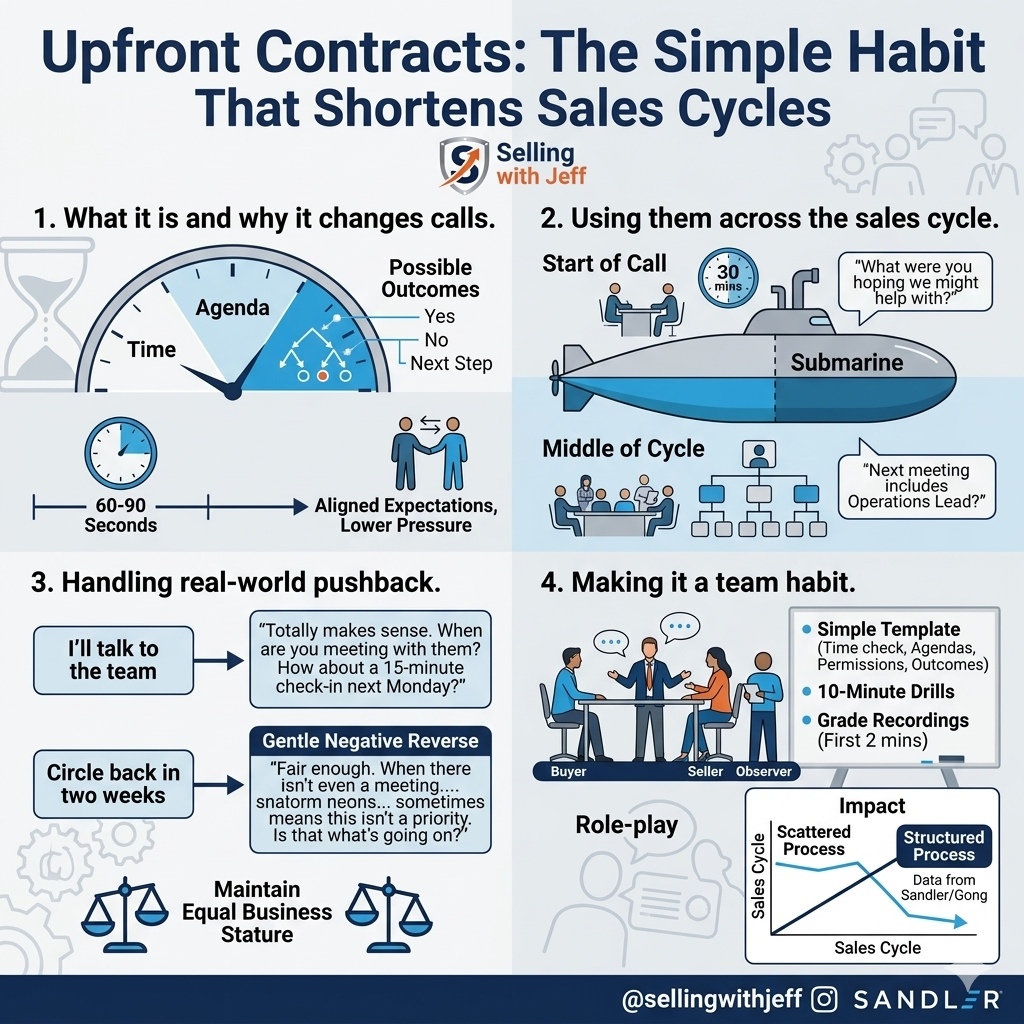
An upfront contract is a short agreement at the start of a conversation about time, agenda, and possible outcomes (including no). In 60–90 seconds, you align expectations, lower pressure, and agree what a successful meeting looks like—for both you and the prospect.
In practical terms, a strong upfront contract covers: how long you have, what they want to cover, what you need to cover, and what “yes,” “no,” or “next step” would look like. Sandler popularized this structure to stop meandering, "show up and throw up" demos and to replace them with focused, adult-to-adult business conversations.
Gong has reported that deals where reps set clear next steps are significantly more likely to close than deals without them, based on analysis of hundreds of thousands of calls (Gong). Upfront contracts are how you earn the right to those next steps without sounding pushy.
Using upfront contracts at the start, middle, and end of deals
Most reps only use a version of the upfront contract on first meetings, if at all. High-performing Sandler-style sellers use them everywhere: at the beginning of every call, at key points in the “submarine,” and especially when setting clear future commitments at the end.
At the start of a first call, you might say: “We booked 30 minutes—does that still work? Before I share anything, what were you hoping we might help with?” That pain-seeking question usually gets you real issues instead of "show me a demo". If it doesn’t, you still have permission to run a targeted 30‑second commercial.
In the middle of a cycle (meeting two or three), you tighten the “yes.” For example: “If this review hits the mark, can we agree the next meeting includes you and your operations lead?” A study summarized by Sandler shows that defining the right attendees early reduces decision cycles and no‑decisions.
Handling real-world pushback without getting salesy or desperate
Real buyers don’t always play along. They say, “Circle back in two weeks,” or “I need to run this by my team.” Without a structure, most reps either chase endlessly or fold. Upfront contracts give you language to stay calm and keep equal business stature.
When you hear “I’ll talk to the team,” respond with: “Totally makes sense. When are you meeting with them?” If they say “Thursday,” you follow with: “Great. How about a 15‑minute check‑in next Monday so you can tell me ‘yes,’ ‘no,’ or ‘we have questions’?” You’re not arguing—you’re clarifying.
If they say “I don’t know when,” you can use a gentle negative reverse: “Fair enough. When there isn’t even a meeting on the calendar, it sometimes means this isn’t a priority. Is that what’s going on here?” Often, this flushes out the real issue—budget, timing, or a hidden decision‑maker—without you turning into a high‑pressure closer.
Turning upfront contracts into a repeatable team habit
Knowing the theory is useless if your team doesn’t execute it on real calls. The most successful managers turn upfront contracts into a practiced habit through short, focused role plays instead of one‑time training events.
Start by giving reps a simple template: thank you and time check; their agenda; your agenda; permission to ask questions; clear outcomes (no, no, yes). Then, run 10‑minute drills: one rep plays the buyer, one the seller, and one observes. Rotate, and add real curveballs—"We only have 10 minutes," "Just show me pricing," or "We’re happy with our current vendor."
Teams that review recordings and grade just the first 2 minutes of calls—time check, agenda, and outcome—improve fastest. Internal data from training organizations like Sandler and external platforms like Gong show that small improvements in call openings compound into higher win rates and shorter cycles when reinforced over weeks, not days.