Turn Happy Remodeling Clients Into a Referral Engine
Why referrals beat paid leads in remodeling and design
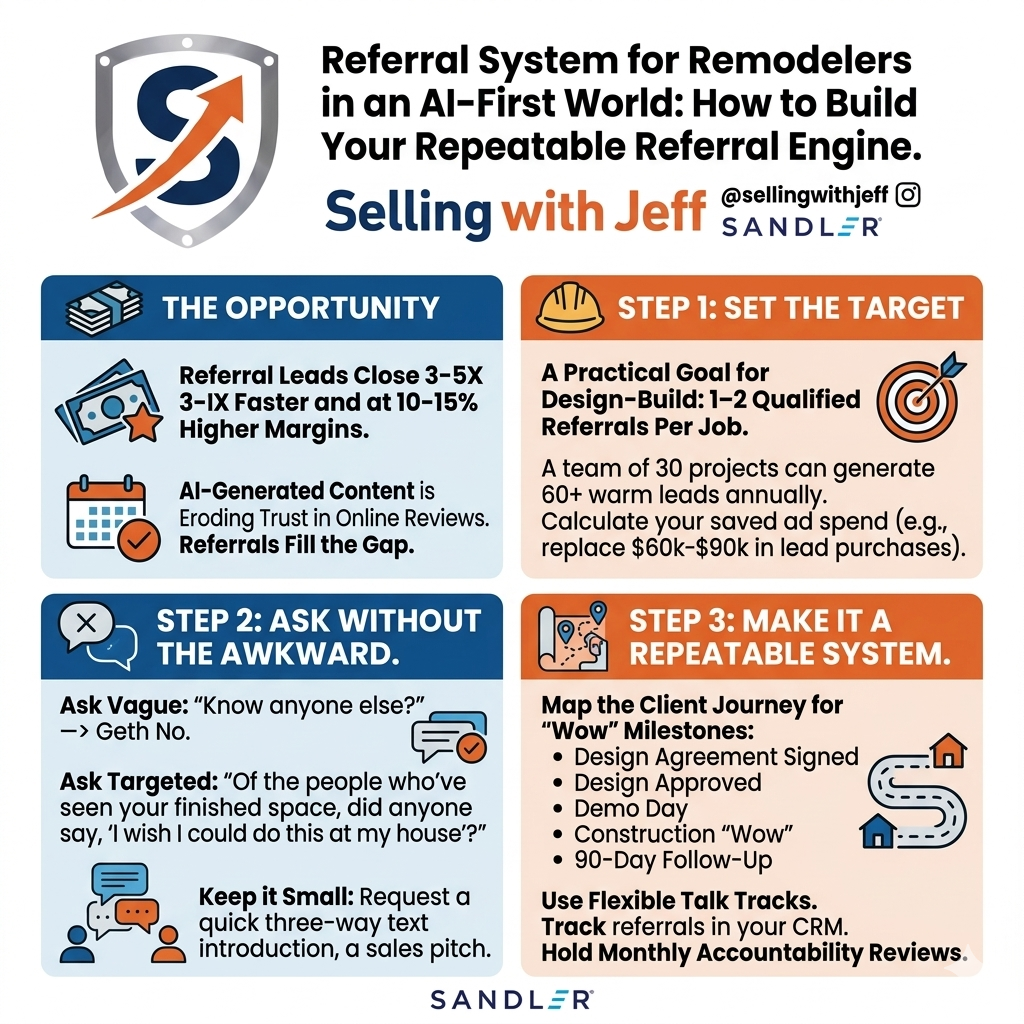
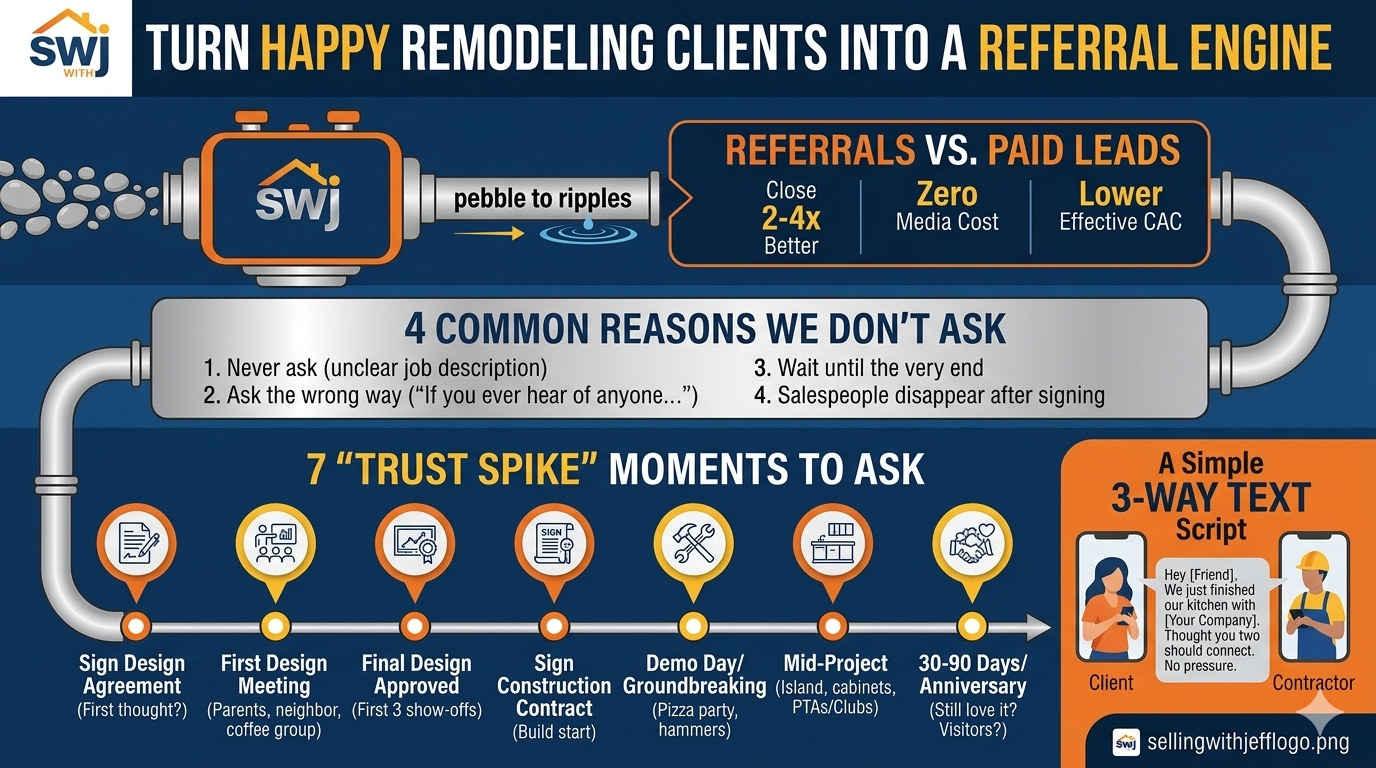
A simple remodeling referrals system will reliably beat paid marketing because it rides on trust, not ad spend. Industry data shows referred leads close 2–4x better and cost a fraction of paid channels, especially in home services and construction, where buyers feel high risk and lean heavily on people they trust.
In the training conversation, the team estimated it costs about $2,500 to win a new custom home or major remodel client once you factor in marketing, sales time, and estimating. That’s consistent with broader home‑services benchmarks where paid channels often land between $150–$350 CAC, and effective CAC can double once you include missed calls and no‑shows. By contrast, referral and introduction leads often have effectively zero media cost.
Trust is the real driver. One remodeling trainer cited research that 92% of homeowners trust referrals from people they know over any form of advertising, closely aligned with studies showing 84%+ of consumers put the most weight on recommendations from friends and family. Conversion follows that trust: referral marketing studies show referred leads can convert 30% better and carry 16% higher lifetime value than non‑referred customers, while contractor benchmarks report referral close rates around 30–50%, versus 8–15% from paid channels.
For a design‑build or high‑end remodeling firm, that difference compounds fast. Every referred deal you close is essentially pure margin on the marketing line. The problem isn’t that referrals don’t work; it’s that most teams rely on random word‑of‑mouth instead of a simple, repeatable introductions playbook.
Fix the four reasons your team rarely asks for introductions
Most remodelers don’t have a referrals problem; they have a behavior problem. In the workshop, the sales and design team named four reasons they almost never ask for introductions, even from raving‑fan clients who just signed for a seven‑figure project or finished a dream kitchen.
First, they simply don’t ask. No one ever made introductions part of the job description, and no one taught them how. Designers and project consultants are focused on selections, drawings, budgets, and schedules—not on turning happy clients into a personal sales force.
Second, when they do ask, they ask the wrong way: “If you ever hear of anyone who needs a remodel, send them my way.” It’s vague and polite. Vague questions get polite nods—and zero introductions. The forgetting curve makes it worse: three to five years after a project, many homeowners can’t even recall the builder’s name without digging through email or paperwork.
Third, they wait for the worst possible moment: the end of the punch list, when clients are exhausted, chasing credits, and mostly want everyone off their property. That’s when many teams finally ask, then conclude, “Referrals don’t work.”
Fourth, salespeople disappear after the contract is signed. They hand clients off to production and stop showing up on site. That kills the relationship—and the trust spikes—where introductions would have been natural.
A professional system tackles these four issues head‑on: redefine the ask, script it, move it earlier, and keep sales visible through the build.
Use seven “trust spike” moments to ask for warm introductions
Instead of begging for referrals once at the end, build your introductions system around seven trust spike moments—points in the client journey when excitement and confidence are naturally high. At each point, you ask a very specific question that uncovers real people, not hypothetical “anyones.”
-
When they sign the design or pre‑construction agreement. They just gave you money and a signature—a major trust spike. Ask: “Who’s the first person you’re going to tell about this, besides your spouse? What’s the first name that pops into your head?” That reveals their closest sphere of influence.
-
At the first design meeting. Designers can ask, “After you signed, who did you tell first?” Now you know exactly who they lean on for advice—parents, a neighbor, or a ‘wise women council’ coffee group. You can plan for that influence instead of being blindsided by it.
-
When final design is approved. Clients finally see “their” home or remodel on paper. Ask, “Now that the design is locked in, who are the first three people you’ll show this to?” Moving from one name to three deliberately widens the ripple.
-
When they sign the construction contract. This is a second big commitment and another chance to ask who they’ll tell about “moving ahead with the build.”
-
Demo day or groundbreaking. For remodels, nothing beats demo day; for custom homes, a golden‑shovel groundbreaking is the moment. One builder hosts a pizza party the night before demo, invites kids and parents, brings markers so kids can draw on the walls, and hands out custom hammers engraved with the client name and company logo. That one ritual has produced multiple same‑street projects.
-
Mid‑project trust spikes. When the island goes in, cabinets are set, or furniture is delivered and the client says, “It looks even better than I imagined,” that’s your cue. Ask if they’ve been talking about the project at the PTA, Harley club, or country club, and whether anyone has said, “I wish we could do something like this at our house.”
-
30–90 days after completion and every project anniversary. Call on a scheduled date: “Do you still love it? Any warranty issues?” Then, “Since it was finished, have you had people over? What did they say?” That gives clients a chance to brag and often surfaces clear buying signals from their friends.
Each of these seven moments is a small pebble; the ripples are the hundreds of people in your clients’ combined spheres of influence.
Make three‑way texts and follow‑ups your referral superpower
The fastest, least‑awkward way to turn those names into real opportunities is the three‑way text. Instead of asking a client to “give out your card,” you ask for a tiny, specific favor that helps their friend and keeps them in control of the relationship.
Here’s how it sounds on a furniture install or mid‑project call:
- You confirm they love the result.
- You ask who commented—“Who’s said, ‘Wow, I wish we could do something like this’?”
- When they name someone, you ask, “Would you be willing to do a quick three‑way text to introduce us? You can just say, ‘We just finished our kitchen with [Your Company]. Thought you two should connect. No pressure.’ I won’t reach out unless they respond.”
Contractors who use this approach regularly report that 9 out of 10 clients will pull out their phone and send the text on the spot once you phrase it this way. A short text is easier than an email introduction, and you immediately gain a direct, permission‑based channel to the new prospect.
From there, you move the conversation off the group thread and onto a one‑to‑one text, honoring their pace. Whether they move forward now or later, you’ve turned “somebody my client knows” into a real contact in your CRM.
Finally, systematize this with two simple habits:
- Calendar follow‑ups. At final walkthrough, schedule a 30–90‑day check‑in before you leave. Do the same 12 months out so you can send a handwritten anniversary note and a quick call: “Can you believe it’s been a year? Still loving it?”
- Measure introductions, not just leads. Track how many introductions each designer, salesperson, and project manager generates, and how those deals close. Studies like those summarized by Invesp show referred customers stay longer and spend more; your own numbers will quickly confirm that introductions are your highest‑ROI pipeline.
When you switch from hoping for referrals to leading clients through these moments and three‑way texts, you stop leaving money on the kitchen counter—and start growing on purpose.