
Stop Construction Slippage with Outcome Accountability
Why construction slippage happens even on ‘good’ jobs
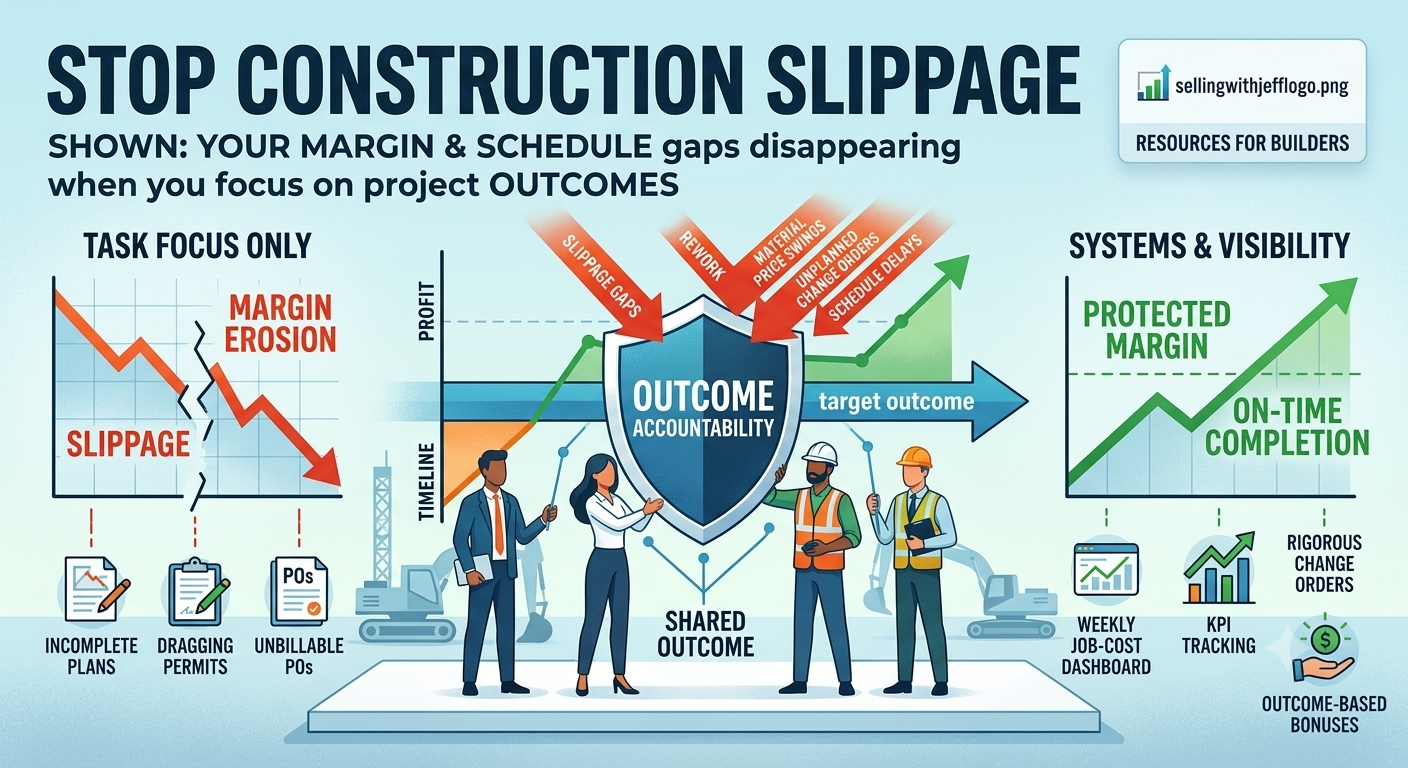
Construction gross margin slippage is the gap between the profit you bid and the profit you actually keep. It shows up when permits drag, plans are incomplete, change orders ripple through the schedule, and you end up “holding the bag” for work nobody clearly owned or priced.
Owners in these conversations were targeting 20–30% gross profit and landing closer to 19%, sometimes losing $20,000+ in unbillable POs in a single month. That lines up with what finance specialists describe as margin erosion: the slow, silent loss that appears late in the job instead of early where you can still fix it. A construction finance guide notes that slippage usually comes from labor overruns, loose change-order practices, material price swings, and weak job cost visibility, not from one big mistake alone (Builders Tax Group).
In the remodeler roundtable, root causes came up fast: inadequate plans that leave gaps between trades, schedule slippage driven by client changes, high general conditions that are never fully covered in change orders, and unpredictable permit timelines that force contractors to “oversell” just to have enough work in backlog. One GC described charging $1,500 to move a Murphy bed, only to damage a $9,000 unit and eat the replacement cost. Another saw a job that was 40% higher than a six‑month‑old preliminary budget because subcontractor pricing and material costs had jumped.
Industry benchmarks show how common this is. A project might look fine at 50–70% completion, then the margin falls apart in the last 10% as late change orders, rework and open‑ended RFIs hit the cost code reports (Siteline). By the time the WIP report reveals the damage, it’s too late to recover on that job. The real question becomes: who on the team saw the slippage early, and who owned the gap between “what should happen” and “what actually did?”
Turn accountability from tasks to shared project outcomes
In the session, the facilitator contrasted Bill Belichick’s mantra “Do your job” with Seth Godin’s warning that our job is not just to do our job. That tension is exactly where construction teams tend to lose money: everyone protects their own task definition, while the gross profit and schedule slip through the cracks between roles.
On complex residential builds and high‑end remodels, no single person “causes” slippage. Architects under‑estimate costs in early client conversations. Estimators assume clean drawings and stable pricing. Project managers chase permits and inspections. Superintendents juggle trades, while owners try to keep high‑net‑worth clients happy when they make late design changes. If each person defines accountability as “I did what was in my box,” the seams between vendors, trades and consultants become unfunded scope and unpaid time.
The group’s language around “owning the gap” is a better standard. Ultimate accountability is to the outcome: hit the gross profit target, protect general conditions, and finish on schedule within an agreed tolerance. That may mean a project manager pushes back on an architect’s informal budget range, or insists that every change order explicitly carries both cost and added days. It may mean hiring a project manager whose bonus is tied directly to on‑time completion rather than just number of jobs.
Teams that operate this way talk openly about the real economic drivers: $15–20k per month in general conditions, 3–4% historical slippage that needs to be priced back into bids, or the reality that a one‑month delay on a $10M home can wipe out the entire projected margin. Accountability then shifts from “Who made the mistake?” to “Who is responsible for keeping the outcome whole, even when something unexpected happens?”
Practical systems to keep schedule and margin on track
Turning this philosophy into daily behavior requires structure. First, define the non‑negotiables: values (safety, integrity in change orders, honest schedules), a clear vision (profitable high‑end residential work, not under‑priced developer jobs), and a mission (protecting both client experience and company GP). Then embed those into how you sell, price, and run work.
On the front end, several owners in the conversation tackled slippage by systematically padding high‑risk cost codes. One added 5% to every line item once they saw a recurring 3–4% loss trend. Another standardized a rule: any change order with even one hour of labor adds at least one day to the schedule and corresponding general conditions. Instead of absorbing “small” client requests, they now write change orders that include both direct cost and added time.
Operationally, you can back this up with a simple job‑cost dashboard reviewed weekly rather than waiting for month‑end WIP. Industry advisors recommend tracking a small set of KPIs—labor hours versus budget, committed cost versus original estimate, pending change orders, and projected final margin—so project managers see slippage as soon as it starts. AI‑driven analytics can now flag patterns such as trades that routinely delay schedules or change‑order types that usually go unpaid (Elite AI Advantage).
Finally, hiring and incentives have to line up with outcome‑based accountability. One owner tied a new PM’s bonus directly to delivering jobs on schedule, knowing that each extra month of general conditions erodes GP by $15–20k. Others invested in better estimators so production leaders are not split between running jobs and building bids. Even cultural changes—requiring professional dress on high‑end sites, or zero‑tolerance policies for safety risks like drinking on the job—support the larger message: this is a professional operation, and everyone here is accountable for the result, not just their task list.
Train your team to close the gaps before profit disappears
The residential contractors in this conversation weren’t struggling for leads; they were struggling to convert record design and pre‑construction work into predictable, profitable production. Their real constraint was capacity and discipline: enough of the right people, operating inside a shared system that closes gaps before they become slippage.
For owners, that means getting comfortable “overbooking” thoughtfully while also putting stronger teeth into pre‑construction agreements—monthly retainers, clearly defined scopes, and early value‑engineering reviews where builders influence design, not just price it. For project teams, it means embracing the idea that when a client changes a countertop or tile, the job doesn’t just cost more; it lives longer, and someone must own that extra month of overhead.
The combination of simple weekly job‑cost visibility, firm rules around schedule impact in every change order, and outcome‑linked bonuses for key roles can make a 1–2 point difference in gross margin across a portfolio. On a $10M remodeling business, that’s $100–$200k per year—enough to fund better recruiting, training, and design collaboration. In a market where leads are strong but costs and client expectations keep rising, the companies that will win are the ones who treat accountability as a team sport and slippage as a solvable, measurable problem—not an unavoidable cost of doing business.