
Sales time management: The 4 Cs and your prospecting cookbook
Your calendar is packed, yet you’re still worried about next quarter’s pipeline. You’re jumping between jobsite issues, designs, follow‑ups, and “just checking in” calls—with very little of it turning into clean yes/no decisions. That’s the core pain: busy days, thin pipeline.
What effective sales time management really means
Effective sales time management means structuring your week so the majority of your energy goes to high‑probability selling conversations, not admin or indecisive prospects. You cut low‑value work, delegate appropriately, time‑block key activities, and run a repeatable prospecting cookbook you can track and improve.
In the field, I see the same pattern over and over. Remodelers tell me they’re slammed, but when we audit the calendar, only a small slice of time is spent in real qualification and decision conversations. The rest is “pre‑sales consulting,” chasing slow movers, and fixing internal problems someone else should own.
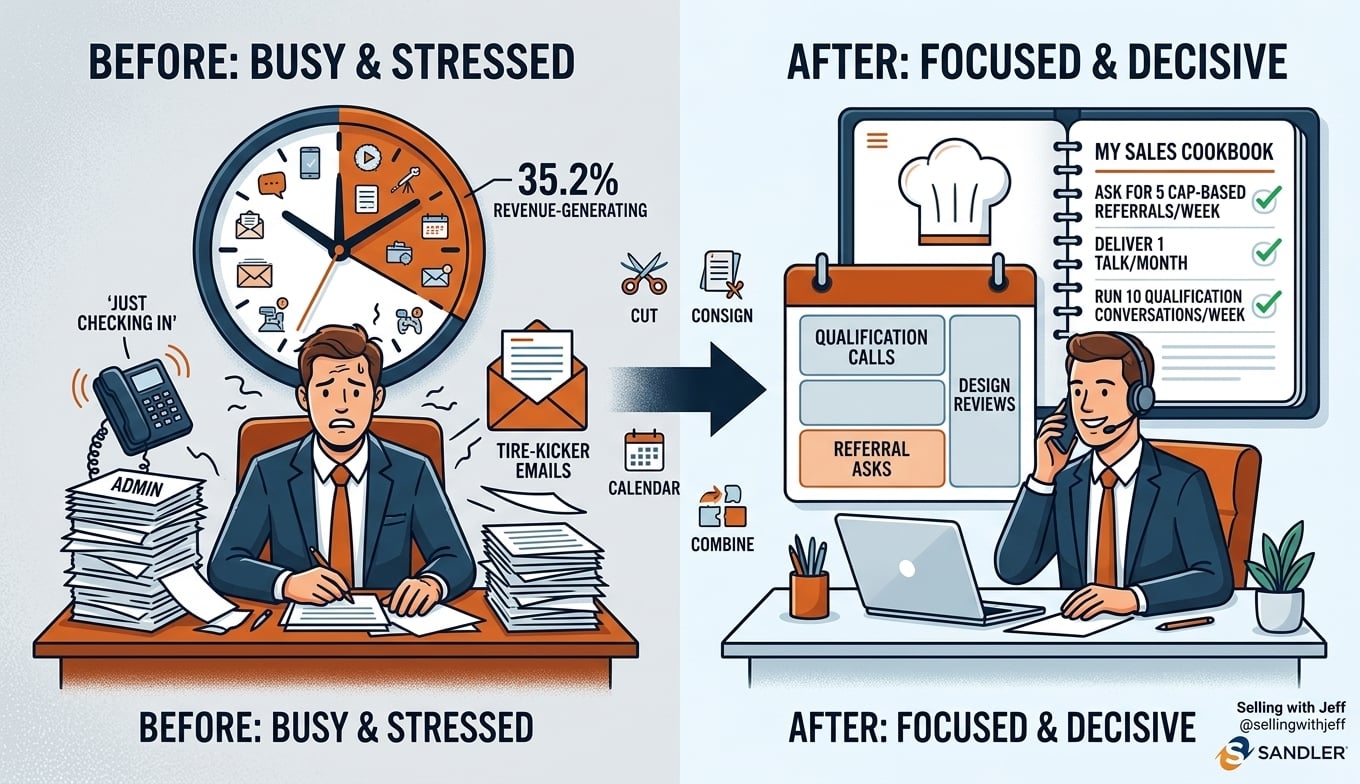
The data backs this up. One study of 721 salespeople found reps spend only 35.2% of their time on revenue‑generating activities, and 64.8% on non‑selling work like internal admin and policies. Reps who followed a clear time‑management philosophy spent 19% more time selling than those who didn’t (XANT/InsideSales research).
Salesforce’s State of Sales report tells the same story: many reps now spend less than 30% of their time actually selling (Salesforce State of Sales). If you feel “always on” but still behind quota, you’re not uniquely broken—you’re running the same broken pattern as the rest of the industry.
Here’s the punchline: this is not a motivation problem. It’s a structure problem. Once you install a simple framework—the 4 Cs plus a Sandler sales cookbook—you stop measuring success by how exhausted you are and start measuring it by how many high‑quality selling behaviors you executed.
Use the 4 Cs to take back control of your week
The 4 Cs—Cut, Consign, Calendar, Combine—are a field‑tested way to clean up your week. Simple names, brutal discipline.
1. Cut: ruthlessly delete fake productivity.
Keep a running list for one week of everything you touch: revisions, “quick” quotes, tire‑kicker emails, contractor drama. Then ask a harsh question of each item: If I never did this again, would revenue or margin suffer? If the honest answer is no, you cut it.
Chasing crappy prospects who “need another month to think” but won’t talk budget? Cut. Re‑drawing designs three times before you’re paid for design? Cut. Long, polite follow‑up voicemails to people who never agreed to a firm next step? Cut. One remodeling salesperson I coached freed up five hours a week just by eliminating those “just checking in” calls.
2. Consign: get it off your plate.
Consign is a fancy way of saying delegate. Ask: Who else should be doing this? Sometimes the answer is a teammate; often, it’s the client. When you give prospects homework—photos, inspiration links, a ballpark range they’re willing to invest—you’re testing how serious they are. Actions beat nice words every time.
A designer can own certain spec‑level questions. Ops can own scheduling subs. A coordinator can chase missing paperwork. Your job is to protect your selling time, not to be the catch‑all for everything the company forgot.
3. Calendar: stop running your to‑do list out of your head.
If it matters, it lives on your calendar. Period. One manager I worked with had 70 “urgent” tasks on a running list. When she time‑blocked all of them, she could finally show her boss there were literally not enough hours in the week. That conversation got her workload—and role—fixed.
Block drive time, prep, debrief, and five‑minute breathing breaks between meetings. More importantly, block your prospecting cookbook activities (we’ll build those in the next section). If they’re not in the calendar, they’re optional. Optional prospecting is how pipelines die.
4. Combine: batch synergistic work, never multitask.
Multitasking kills your focus, but batching similar work multiplies your output. Instead of writing one proposal here and another there, block a 90‑minute “proposal sprint” and do three. Instead of asking for referrals “when it feels right,” make it a non‑negotiable part of every design review conversation.
For example, invoicing is painful to start. Opening three systems, checking dates, cross‑referencing attendance—it’s a heavy lift. So do five invoices at once. Likewise, if you’re already visiting a jobsite, add 20 minutes to walk the street, introduce yourself to two neighbors, and invite them to your next remodeling seminar. Same drive, more pipeline.
Design a sales cookbook that matches your income goal
Once you’ve cleaned up your time with the 4 Cs, you need a repeatable recipe—a sales cookbook. In Sandler language, a cookbook is a tested list of weekly activities and quantities that, if you execute them consistently, reliably produce your income goal.
This isn’t a wish list like “be more persuasive” or “follow up faster.” It’s concrete behaviors you can count. Sandler trainers have been teaching the cookbook concept for decades as the backbone of consistent prospecting (Sandler cookbook overview).
For a remodeling salesperson, a starter cookbook might look like:
- Ask for 5 CAPS‑based referrals per week. Every time you meet a great client, ask who they know who fits your CAPS profile—same neighborhood, similar income, same problems with their home.
- Deliver 1 talk per month to a high‑end realtor office, design association, or professional group about green building, code changes, or major project pitfalls.
- Attend 2 targeted networking events per month where your ideal clients or referral partners gather, not just random business card swaps.
- Knock on 5 doors around every active jobsite with a “pardon our dust” intro and an invite to your next seminar.
- Run 10 real qualification conversations per week using a strong Upfront Contract (PALO) and a real budget/pain step.
Notice how each line has an activity and a number. Over a few months, you watch what those numbers turn into: how many introductions, design agreements, and build contracts. You’ll quickly learn that, for example, one 20‑minute talk to the right realtor office reliably creates four serious follow‑up conversations, while a generic home show booth creates a lot of brochure‑takers and very few buyers.
As Sandler says, winners have alternatives. When you track activities in your cookbook and their outcomes, you earn the right to cut low‑yield tactics and double‑down on the ones that actually produce margin.
Protect prospecting time so your pipeline never runs dry
The last step is the one most salespeople skip: making your cookbook non‑negotiable, even when you’re buried in active projects.
Here’s the uncomfortable truth. When your pipeline is thin, you get desperate. You discount, you over‑design for free, you tolerate vague “maybe later” answers because you need something—anything—to close. That’s when you make margin‑killing decisions that you’d never make if your calendar was full of good prospects.
Sandler has a rule: sell like you’re financially independent and don’t need the business. You can only do that if future you has deals coming. That’s what the cookbook protects.
Structurally, that looks like:
- Time‑blocking your cookbook first, then fitting client meetings and internal tasks around it. Prospecting blocks are appointments with your future income; you keep them the way you’d keep a meeting with your best client.
- Using Upfront Contracts on yourself. “Every week, I will complete: 5 referral asks, 10 qualification calls, 1 networking event or talk.” Write it down. Review it Friday afternoon. Did you hit the gates or not?
- Reporting cookbook activity, not just revenue. One remodeling team I coached submitted a simple weekly scorecard: referrals asked, new introductions, real qualification calls, designs sold. Within a quarter, they could see exactly which reps were building a future pipeline vs. just babysitting existing jobs.
When you manage your week this way, a few things happen fast. First, you stop feeling guilty for cutting dead‑end activity, because you can see the higher‑value actions you’re replacing it with. Second, your calendar fills with serious prospects who have pain, budget, and a clear process—because that’s who your cookbook is designed to surface.
Most importantly, you reclaim your evenings and weekends. You’re no longer trying to “out‑hustle” a broken process. You’re running a simple, disciplined system: 4 Cs to protect your time, a cookbook to direct your effort, and Sandler conversations that get you to yes or no faster. That’s how working less can finally lead to better results.