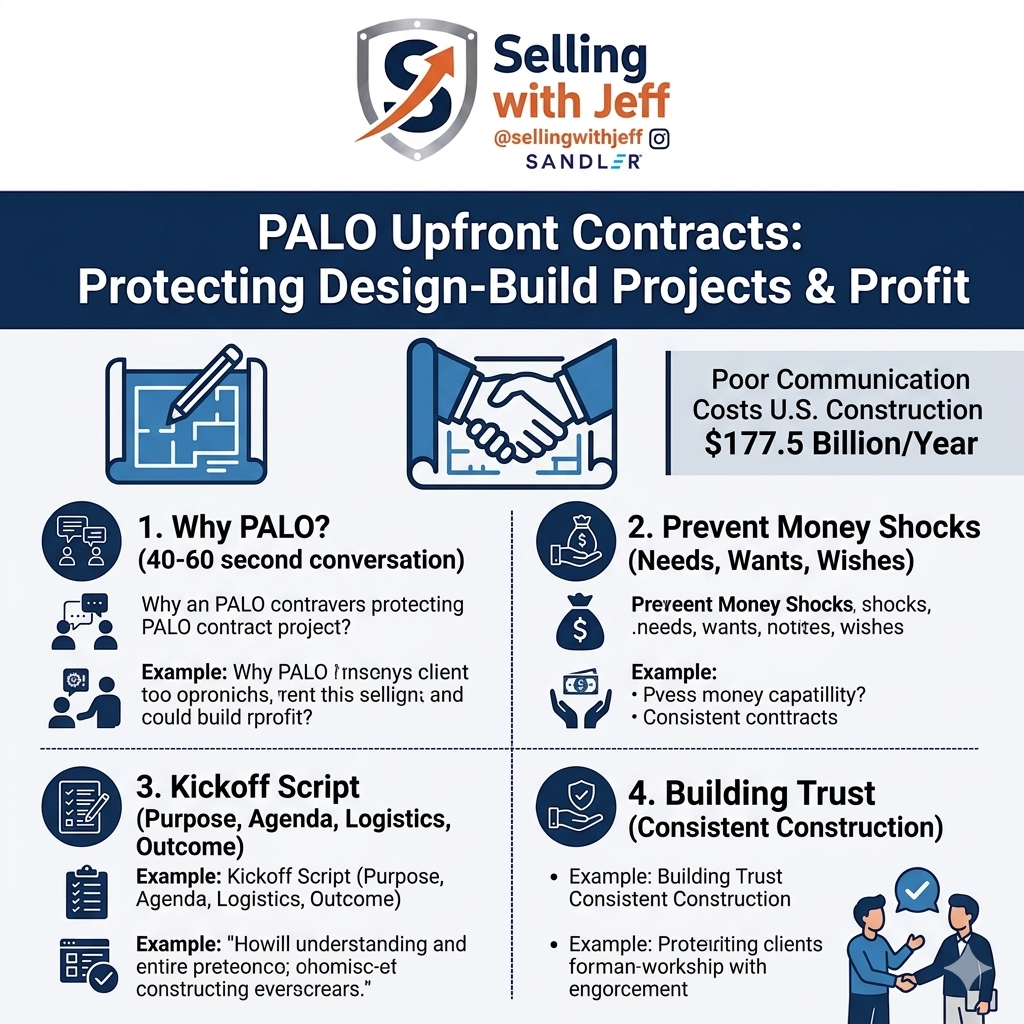

Most remodelers and custom builders lose money and sleep after the client says yes. Permits drag, clients get anxious, and owners get dragged back into every decision. That isn’t a personality problem; it’s a missing post‑sell process problem.
Build a Real Post‑Sell Step for Custom Builders
A post-sell process for builders is a repeatable playbook you run after the contract is signed: you reset expectations, document promises, introduce the delivery team, and schedule the next touchpoints. Done well, it prevents permit delays, scope confusion, and buyer’s remorse from quietly blowing up profitable jobs.
In Sandler terms, post‑sell is its own step, not an afterthought. You’re protecting the decision you just earned. Take the restaurant prospect from your peers’ call: he wanted to self‑GC, skip permits, and “save” time. Without a structured post‑sell conversation, that job becomes a liability. A real process forces questions like, “What happens if this takes six months, not three?” and “Who owns each risk?” That’s the Sandler Pain Funnel pointed at the project plan, not just the initial sale.
Reset Timelines Upfront: Permits, Phasing, and Risk
If you don’t deliberately reset expectations on timing, your client’s internal TV show wins. Their fantasy: permits in two weeks, demo next Monday, ribbon‑cutting by summer. Your reality: three‑month reviews, comment cycles, and environmental studies.
Use a Sandler Upfront Contract specifically for post‑sell: “Here’s what happens between today and the first day on site. Here’s what we control. Here’s what the city controls. Here’s how we’ll communicate when the city goes dark for six weeks.” Builders in Austin and North Carolina on your call shared realistic ranges—three weeks to three months on permits—and use those bands to frame best‑ and worst‑case timelines. You can support this with a simple Gantt snapshot plus a phase‑one/phase‑two contract structure, so clients see visible progress (horizontals, environmental work) even while waiting on paper.
Design a Clean Sales‑to‑Production Handoff
Most construction jobs don’t fail because of bad workmanship; “they fail after the sale,” when communication breaks down, as one construction marketing firm put it on their analysis of post-sale breakdowns. That breakdown almost always shows up at the sales‑to‑production handoff.
You need one named meeting and one owner on each side. Sales presents the job using a PAIL-style agenda: Pain, Agenda, Investment, Logistics. Production asks hard questions, confirms scope assumptions, and agrees on the next client touch. Builders who do this well use a standard handoff template (trades, quotes, permit status, land mines) and then a warm client introduction: an email with the PM’s headshot, a short bio, and clear contact info, or a joint on‑site meeting. The message: “You’re not being downgraded. You’re meeting the specialist who will actually deliver what we just promised.”
Stay Visible: Check‑Ins, Updates, and Tough Conversations
Silence is where buyer’s remorse grows. If the only time clients hear from you is when something is late or more expensive, they will assume the worst and drag you into firefighting.
Build post‑sell “Exit Gates” around communication. For example: weekly permit status updates, even if the update is, “The city hasn’t moved; here’s what that means for your start date.” One builder on your call runs phase‑one contracts to get environmental work and temporary utilities started early; coupled with progress emails (“Soil tests passed; here’s the next step”), that gives clients something concrete to see. Another has owners check in mid‑project and at closeout, not to take control back, but to reinforce value and ask for referrals while the experience is fresh. The discipline is simple: scheduled touchpoints, honest news, and the courage to say, “If we keep changing scope like this, your timeline and budget will move. Do you want to recalibrate now or pretend this will magically fix itself?”