
PALO Upfront Contracts for Remodelers
Why remodeler sales calls fail without upfront contracts
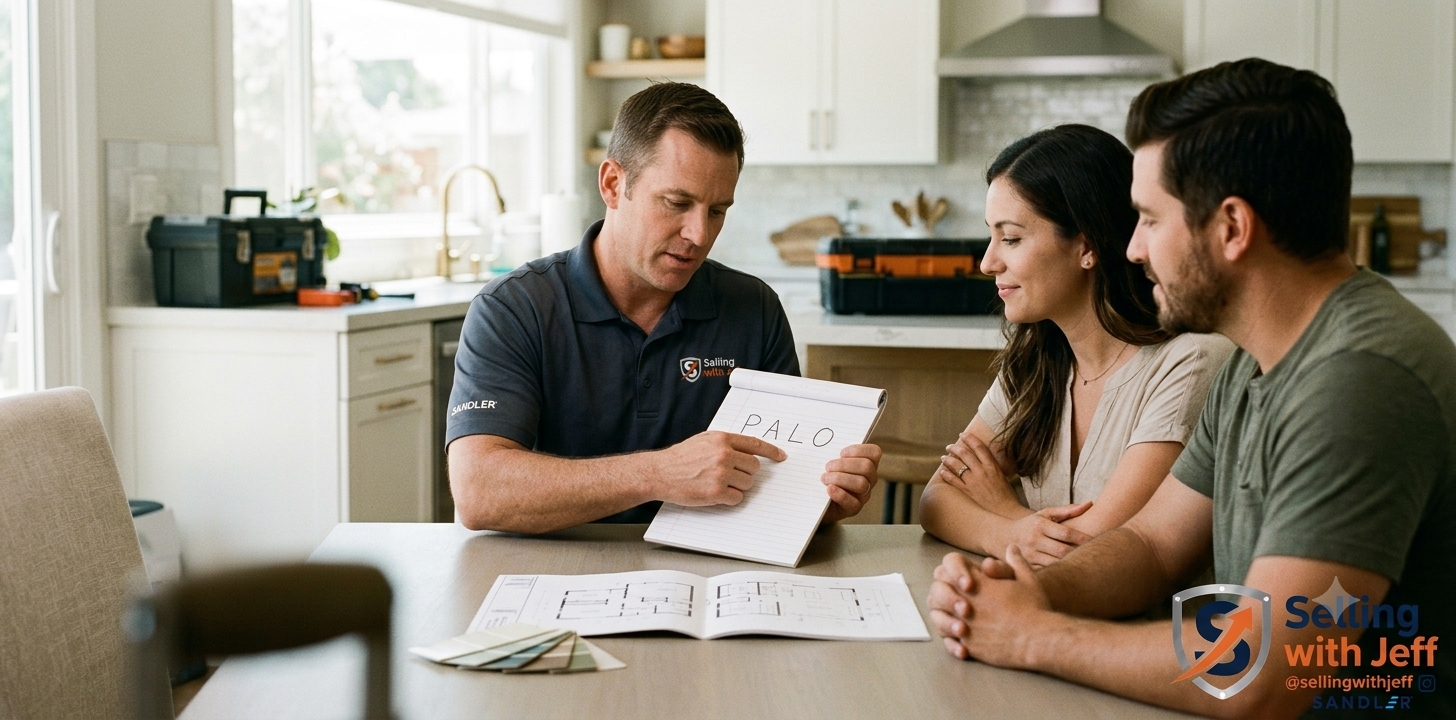
A PALO upfront contract is a short, mutual agreement at the start of a meeting that defines why you’re there, what you will cover, how long you have, who should be involved, and what decisions are on the table. In 40–60 words, it turns vague conversations into focused, adult‑to‑adult sales meetings.
Think about the worst remodeling sales calls you’ve had. You walk into a home expecting a qualified design meeting. Instead, it becomes a free design consultation, a house tour, and ends with, “We’ll talk about it and get back to you.” Or you finish a detailed design review, only to hear, “Send us the numbers and we’ll let you know after we get a few more quotes.”
The core problem isn’t your design talent or pricing. It’s the lack of a clear upfront agreement. When you skip that step, the homeowner decides what the meeting is about—usually ideas and price—while you need to qualify fit, budget, and decision process. That gap creates “wishy‑washy futures” where nothing is clearly decided.
Sandler’s concept of the upfront contract was built to fix exactly this. It’s not a legal document. It’s a conversational contract you set in the first few minutes of the meeting. Sandler trainers often teach the PALO structure—Purpose, Agenda, Logistics, Outcome—as a practical way for remodelers to keep calls on track. According to Sandler data shared in internal field studies, teams that adopt upfront contracts consistently see more decisions, fewer “think‑it‑overs,” and shorter sales cycles.
For remodelers, that matters because the stakes are high. A kitchen or primary bath project can represent six figures of revenue and months of production. If the first meeting lacks clarity, you see trouble later: scope creep, budget shocks, extra design rounds, and angry “we didn’t know it would cost this much” reactions. Homeowner guides consistently warn that a messy first consultation is a leading cause of delayed or cancelled projects.
A disciplined upfront contract changes that dynamic. You reduce anxiety by agreeing up front what will happen, including the option of “no.” You gain control without being pushy, because you are asking questions, not delivering a speech. And, as many Sandler‑trained remodelers report, you stop leaving high‑value calls with nothing more than a hope and a follow‑up task in your CRM.
The rest of this article breaks down PALO step by step and shows you how to use it in real remodeling meetings, from the first in‑home visit to design reviews.
Breaking down PALO: purpose, agenda, logistics, outcome
A PALO sales framework breaks the upfront contract into four simple pieces: Purpose, Agenda, Logistics, and Outcome. In under a minute, you confirm why you’re meeting, what you’ll cover, how much time you have, who should be there, and how the meeting will end so there are no surprises and no “we’ll see what happens.”
P – Purpose: why are we here?
Every strong meeting starts with a shared purpose. Not your internal goal (“qualify budget”), but the reason the homeowner believes you’re there. In the transcript above, the trainer starts by confirming: “We’re here to talk about your kitchen, is that right?” That simple question prevents you from launching into the wrong conversation.
Practical example:
“Thanks for having me out. Just so we’re on the same page, my understanding is we’re here to talk about updating your 1990s kitchen. Is that right, or is there anything else going on in the house we should be aware of?”
This takes ten seconds and immediately surfaces scope surprises: “Actually, we’re thinking about the mudroom and powder room too.” That changes design, budget, and timeline.
A – Agenda: their agenda first, then yours
Most reps think “agenda” means, “Here’s what I’m going to present.” In PALO, you reverse it: the client’s agenda comes first, yours second. You want to know what they hope to get out of the meeting, but you also want to avoid “losing conversations” too early—like deep price haggling before you understand the space.
Instead of asking, “What do you want to talk about today?” the trainer in your source material does something smarter:
- Asks what’s going on with the space: small kitchen, bad pantry, ugly tops, hated gas range, poor flow.
- Asks, “Anything else going on with the space?” until they’re done.
- Asks them to prioritize what’s most and least important.
That gives you a list of problems you can solve, in the order they care about, without inviting early price and timeline debates. If they do raise investment or schedule, you don’t avoid it forever—you “parking‑lot” it: acknowledge it’s important, then agree to handle it later in the process, after you understand the project.
Then you add your agenda. You explain that to help them properly, you’ll need to ask a lot of questions, some of them personal about how they use the space. This “micro‑permission” makes it much easier to ask about daily routines, frustrations, and even their investment range later without feeling intrusive.
A field‑tested script:
“You’ve given me a great list: size, storage, countertops, and flow. We’ll tackle those in that order. For me to actually help, I’ll need to ask you quite a few questions—some a little personal about how you cook, entertain, and use the kitchen. Is it okay if I ask you a bunch of questions so we can figure out what’s really going to work for you?”
Homeowners almost always say yes. They want to talk about themselves and feel heard.
L – Logistics: time, people, and constraints
Logistics sounds basic, but skipping it kills deals. If you think you have an hour and they only have 30 minutes before soccer pickup, your beautifully planned discovery gets cut short. You also need to know who is actually making the decision.
Key logistics questions include:
- “We’ve blocked an hour; do you still have the full hour today?”
- “Will both of you be involved in deciding about this project?”
- “If we’re in a really good conversation and run a bit long, do you have a few extra minutes, or is this a hard stop?”
In your transcript, the trainer even recommends rescheduling rather than running a “one‑legger” when a partner is missing. That move feels bold, but it sends a clear signal: you’re not desperate, and you won’t rely on an untrained spouse to sell your project for you. Over time, this trains your market that “both decision‑makers attend meetings” with your firm.
O – Outcome: no surprise endings
The Outcome is where most remodelers lose control. They treat the end of the meeting as open‑ended: “So, what would you like to do next?” The homeowner, caught off guard, defaults to the safest answer: “We’ll think about it.”
In PALO, you decide the possible outcomes before the meeting starts and get agreement on them. The Sandler version is “no, no, yes”:
- It’s okay for the homeowner to say no.
- It’s okay for you to say no if you’re not a fit.
- If both sides want to move forward, you’ll either sign a design agreement or at least schedule the next concrete step.
Sample script for a first in‑home visit:
“These meetings usually end one of three ways. One, you might decide we’re not the right fit—that’s completely okay; would you be comfortable just telling me ‘no’ if that’s where you land? Two, I might feel we’re not the best fit and, if so, I’ll be honest and point you to someone better. Three, if we both feel good, the next step would be a design agreement with a small fee. If that happens, is there anything that would stop us from taking that step today?”
Research shared in Sandler trainings shows that giving people permission to say no actually makes them far more likely to say yes. You remove pressure and surprise. You also avoid sending proposals into the void. Instead, you agree up front: if it makes sense to prepare a proposal, you’ll book a specific time to review it together before you leave the house.
Applying PALO in real remodeling meetings (with scripts)
A PALO framework for remodelers is most powerful when it’s used in real conversations—not as a stiff speech, but as a short series of questions at the start of every meeting. With consistent practice, it turns chaotic, wishy‑washy sales calls into predictable steps from first visit through design and contract.
Example 1: first in‑home kitchen consultation
Here’s how a full PALO might sound in the field. Assume you’ve already done basic phone qualification.
Purpose
“Thanks again for having me over. Just to confirm, we’re here to talk about updating this kitchen—maybe addressing the small size, storage, and that gas range you mentioned. Is that still the main focus, or is anything else going on in the space?”
Agenda (client first)
“Tell me a bit more about what’s going on with the kitchen that made you reach out. What’s bugging you the most day to day?”
You listen, capture their list, then ask:
“That’s helpful. So I’m hearing size, storage, counters, and overall flow. If we ran out of time today and had to leave one of these for next time, which would be least important? And which should we tackle first?”
Now add your agenda and micro‑permissions:
“To do this right, I’ll need to ask you a bunch of questions—some a little personal about how you cook, entertain, and use the space. Is it okay if I ask you those kinds of questions? And at some point, we should talk about investment, at least in ranges. Is it okay if we touch on that later too?”
Logistics
“We blocked an hour for today. Do you still have the full hour, or is there a hard stop?”
“Also, will both of you be involved in deciding whether to move forward on this project? Are we all here today?”
If not, you decide whether to reschedule or run a limited discovery session.
Outcome
“So that we’re not guessing at the end, these meetings usually end one of three ways. One, you might decide we’re not the right fit—that’s totally okay, would you be comfortable just telling me no if that’s where you land? Two, I might feel our process isn’t the best fit and, if so, I’ll be honest and point you to someone better. Three, if we both feel good, the normal next step is a design agreement with a design fee of $X. If we get there, is there anything that would keep us from making that decision today?”
You’ve now set expectations, earned permission to ask hard questions, and pre‑aligned on the possible next steps.
Example 2: design presentation and proposal review
PALO isn’t just for first visits. Use a shorter version at every milestone—especially when presenting designs and pricing.
Purpose
“Today’s meeting is to walk through your revised kitchen design and investment range, and see if it’s a fit. Anything else you want to make sure we cover before we start?”
Agenda
“Here’s what I thought: first, we review the layout; second, finishes and allowances; third, the investment and timeline. What would you like to add or change about that order?”
Logistics
“We’ve got 45 minutes together—does that still work? And are all the decision‑makers here for this step?”
Outcome
“By the end of this meeting, there are really two good outcomes. One, you decide this isn’t the right plan or timing, and you tell me ‘no’—that’s perfectly fine. Two, you feel it’s a fit and we pick a start window and sign the construction agreement. If it does feel right, is there anything that would stop us from moving forward today?”
By using PALO at every stage, you avoid vague endings like “We’ll be in touch,” reduce unpaid redesign loops, and keep your pipeline honest.
When remodelers implement this consistently, they report concrete wins: fewer ghosted proposals, higher close rates on design agreements, and salespeople who spend more time with serious buyers and less time chasing “maybes.”
The concept isn’t magic. It’s just disciplined communication. But in a remodeling world full of emotional decisions, big budgets, and complex projects, that discipline is exactly what keeps your sales process out of the wishy‑washy zone.